U.S. Senate Drafts Landmark Crypto Oversight Bill to Clarify CFTC and SEC Roles
The U.S. Senate Agriculture Committee has released a long-awaited draft of its cryptocurrency market structure legislation, marking a pivotal step toward defining how the Commodity Futures Trading Commission (CFTC) will oversee spot crypto trading.
The draft, published Monday, represents the Senate’s answer to the House’s Clarity Act and seeks to establish a clearer division of authority between the CFTC and the Securities and Exchange Commission (SEC) — an issue that has long plagued U.S. crypto regulation.
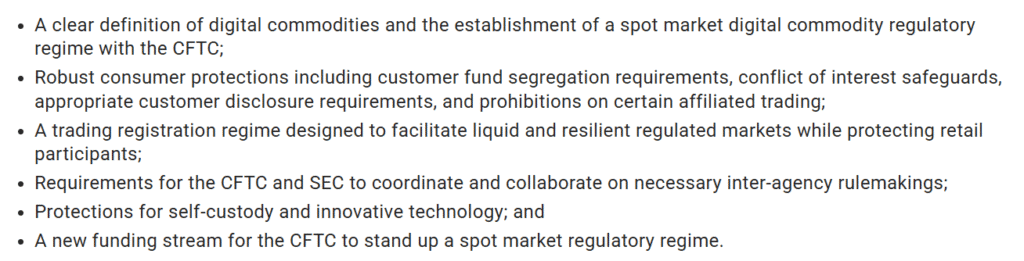
Overview of what the draft bill discusses (Source: Senate Agriculture Committee)
The move comes amid a backdrop of political gridlock, with the federal government still shuttered due to a budget dispute. Even so, Senate staffers continued to work through the weekend to finalize the bill’s preliminary text, according to individuals familiar with the discussions.
Draft Bill Lays Foundation for Crypto Oversight
The bill, led by Committee Chairman John Boozman and senior Democrat Cory Booker, defines fundamental terms such as “blockchain†and outlines how these concepts will apply under the Commodity Exchange Act. It directs the CFTC and SEC to engage in joint rulemaking on key regulatory matters, including portfolio margining and oversight of intermediaries.
Crucially, the draft still contains bracketed sections, signaling ongoing internal negotiations. These placeholders reflect areas of disagreement, particularly regarding the interplay between this legislation and other federal laws.
One section noted that Democratic members believe parts of the bill fall outside the Agriculture Committee’s jurisdiction and should involve the Senate Banking Committee, which oversees the SEC.
Another unresolved section involves the composition of the CFTC’s leadership. The current language proposes that at least two commissioners from the minority party be involved in consultation, a measure aimed at ensuring bipartisan representation. The CFTC is presently led by Acting Chair Caroline Pham, while President Donald Trump has nominated Mike Selig, a current SEC crypto task force counsel, to serve as chair. No additional commissioners have been nominated.
Industry Voices Call for DeFi Clarity
As lawmakers deliberate, industry stakeholders are watching closely, especially those in the decentralized finance (DeFi) sector. Amanda Tuminelli, executive director of the DeFi Education Fund, urged lawmakers to ensure that the final version of the bill distinguishes between centralized intermediaries and independent software developers.
“We are hoping that the section left open for DeFi will be filled in with robust developer protections that clearly distinguish centralized intermediaries from software developers without custody and control of other people’s money,†Tuminelli said in a statement.
The inclusion of DeFi-specific provisions remains a contentious issue. Earlier versions of the legislative framework were reportedly derailed after draft proposals sparked concerns that the rules would stifle innovation and impose burdensome requirements on decentralized platforms.
Senate Divisions and Legislative Uncertainty
The Agriculture Committee’s progress marks a notable advancement, but it is only one half of a broader effort. The Senate Banking Committee must still finalize its own version of the crypto oversight bill, and both panels will eventually need to reconcile their approaches before a unified proposal can be brought to a floor vote.
However, divisions within both parties — and even within individual committees — threaten to slow progress. While many Democrats are eager to find bipartisan agreement, prominent voices such as Senator Elizabeth Warren have continued to raise concerns about the risks associated with the crypto industry and the ethical implications of President Trump’s personal financial interests in digital assets.
Meanwhile, Senate Republicans remain divided over the bill’s readiness for formal consideration. Senator John Kennedy has reportedly been among the most vocal skeptics, questioning whether the current draft is sufficiently developed for a markup — the stage where proposed legislation is opened for amendments before committee votes.
Legislative Timelines Remain Fluid
Despite the bill’s publication, the timeline for passage remains uncertain. The legislative process could stretch well into next year as lawmakers balance competing priorities, including the urgent need to reopen the government.
Crypto policy experts are cautiously optimistic that the Senate could make tangible progress before year-end. Ron Hammond, head of policy and advocacy at trading firm Wintermute, said that it is “very possible that one or both committees vote their respective version of the bill by year’s end.†However, he noted that merging the Agriculture and Banking Committee versions will be a complex task involving significant political negotiation.
“The next step will be combining the bills and navigating the politics and various stakeholders,†Hammond said, adding that a Senate floor vote may not occur until the first quarter of 2026. “A lot has to happen prior.â€
Momentum Building Despite Political Hurdles
The draft’s release follows months of shifting expectations among lawmakers and industry lobbyists. Initial hopes of an August deadline were dashed, and successive targets in September and November have also slipped.
Nonetheless, the fact that Senate staffers continued to refine the draft even as the government remained shut down suggests a growing recognition of the need for regulatory clarity in the crypto sector.
The publication of this draft bill could help frame the upcoming debates around market structure and jurisdiction — long-standing questions that have created confusion for U.S. crypto firms seeking to operate within the law.
The CFTC and SEC have each pushed their own interpretations of existing statutes, leading to overlapping enforcement actions and uncertainty about which agency should govern specific types of digital assets.
By proposing a structured division of authority and a coordinated rulemaking process, the Agriculture Committee’s draft lays the groundwork for what could become the most comprehensive federal crypto framework to date.
Still, the path ahead is far from certain. As lawmakers juggle fiscal negotiations, partisan tensions, and competing legislative priorities, the crypto market structure bill may struggle to gain floor time in the near term. Even so, its publication signals a significant shift in Congress’s engagement with the industry — one that could eventually define how digital assets are regulated in the world’s largest economy.


