What Are Prediction Markets and How Do They Work? An In-Depth Explainer
Prediction markets might sound complex, but at their core, they are like stock markets for predictions about future events.
Instead of buying shares in a company, you buy and sell shares in the outcome of an event – whether it will happen or not. These markets harness the “wisdom of crowds” by letting people trade on what they think will happen in the future.
In this guide, we will answer the question “what are prediction markets?” To do this, we will look at how they work, their history, common uses, legal considerations, and where you can try them out (focusing on popular platforms like Kalshi and Polymarket because they are currently the biggest platforms in the market).
By the end, you’ll understand how prediction markets work and why they’re gaining attention. l
Understanding Prediction Markets (Definition & Basics)
Prediction markets (also known as information markets, idea futures, or event markets) are exchanges where people bet on the outcomes of future events.
Essentially, participants trade contracts (or “shares”) that pay out based on a specific event outcome. The price of these contracts fluctuates according to supply and demand – and importantly, this price reflects the crowd’s collective belief about the probability of the event.
For example, imagine a prediction market on the question: “Will it rain in Texas tomorrow?” There would typically be two outcomes (a Yes share and a No share). If a Yes share is trading at $0.20 (20 cents), that implies the market believes there’s about a 20% chance of rain.
If you buy a Yes share at $0.20 and it does rain (the event happens), you would get $1 in return (making $0.80 profit because you paid $0.20 and the share pays out $1). If it doesn’t rain, the Yes share would be worthless (you lose the $0.20 you paid). In this way, market prices correspond to probabilities – a core concept of prediction markets.
In simple terms: a prediction market lets people “invest” in an outcome they think will happen. If they’re right, they profit; if they’re wrong, they lose what they staked. Crucially, unlike a traditional bet against a casino or bookie, in prediction markets you are trading against other participants in an open market. The platform itself usually just matches traders and takes a small fee, not one side of the bet. This means the platform has no vested interest in the outcome – it’s more like a stock exchange facilitating trades.
Prediction markets can be binary (yes/no), but they also come in other forms:
- Multiple-choice markets: for questions with several possible outcomes (e.g. “Who will win the election – Alice, Bob, or Carol?”). You can buy shares in whichever candidate you think will win, and the total probabilities sum to 100% across all options.
- Continuous outcome markets: where the outcome is a number or value, not just yes/no. For instance, a market might predict “What will the temperature be on Jan 31?” or “How many sales will a company have this quarter?”. Traders buy shares corresponding to ranges or numeric outcomes, and prices indicate the expected value.
- Conditional markets: these are more complex, answering “If X happens, will Y happen?”. For example, “If Candidate A wins the election, will the stock market rise 5%?”. They help explore cause-and-effect by linking outcomes. Such markets are less common but illustrate the flexibility of the concept.
Underneath, a prediction market functions a lot like other financial markets:
- Traders with different opinions come together and buy or sell shares based on their expectations.
- If new information comes out (say, a weather forecast change or a candidate scandal), traders will adjust their positions – buying shares of outcomes they now think are more likely, or selling (or shorting) shares of outcomes that seem less likely. This causes prices to move up or down, just as stock prices move on news.
- Market price = crowd consensus probability: The current price of a “Yes” share (say 30 cents) can be read as the market’s collective estimate of a 30% chance for that event. If you believe the real probability is higher than 30%, you’d want to buy at that price (since it’s undervalued to you); if you think it’s lower, you might sell or avoid buying. This dynamic pushes the price toward an equilibrium that aggregates everyone’s information.
In summary, a prediction market is an information ecosystem. Each trader’s buy or sell is like a vote on what they think will happen, weighted by how strongly (and how much money) they believe in it.
The result is a live odds or probability that often incorporates information faster – and sometimes more accurately – than polls or expert opinions.
How Do Prediction Markets Work?
Many beginners ask: “Okay, but how do prediction markets work in practice?” Let’s break it down step by step in a simple example:
Imagine a market on: “Will Alice win the next election?”
The market launches with two outcomes: Yes (Alice wins) and No (Alice loses). Initially, without much info, the Yes share might start around $0.50 (implying 50% chance).
People then start trading based on their opinions. If a lot of traders believe Alice is likely to win, they start buying Yes shares. Demand for Yes drives its price up – say from $0.50 to $0.60 (60%). Consequently the No shares would drop to $0.40 (since one of the two outcomes must happen, their prices generally sum to $1 or 100%).
A Yes share at $0.60 would then suggest the market gives Alice a 60% chance. If you strongly disagree – maybe you know something others don’t about a scandal brewing for Alice – you might sell Yes shares (or buy No shares at $0.40). By selling Yes, you profit if Alice loses (because you essentially took the opposite side). If enough people share your view, the Yes price will fall back down.
The market is constantly adjusting as traders “vote” with their money on the odds.
Come election day, suppose Alice indeed wins. Every Yes share then pays out $1 (and No shares become $0). If you had bought 100 Yes shares at $0.60 each (costing $60), you’d get $100 after the win – netting a $40 profit. Conversely, if Alice loses, Yes shares pay zero – you’d lose what you spent. The traders who held No shares would profit in that case.
A key feature is that you don’t have to hold until the end. You can trade in and out anytime before the event happens. For instance, maybe you bought Yes at $0.50 and later the price goes to $0.80 (because new polls favor Alice). You could sell your shares at $0.80 to lock in profit even before the election. This flexibility means prediction markets continuously update to reflect the latest information and sentiments, much like how stock prices adjust to news in real time.
Most prediction markets use one of two trading mechanisms. Either the platform uses an order book or an automated market maker.
Order book (continuous double auction): This works like a stock exchange. Traders place buy and sell orders, and whenever prices match, a trade happens. Platforms like Kalshi operate this way, matching buyers and sellers.
There must be an opposing party for every trade (if you want to buy at 30¢, someone must be willing to sell at 30¢). The platform keeps a ledger and ensures the final holders get paid appropriately
Automated market maker (AMM): Some platforms (especially decentralized or crypto-based ones) use algorithms to provide liquidity. An AMM is like a robot that always offers a price for either side of the bet, using a formula that adjusts prices as people buy one side or the other.
That ensures you can trade anytime even if other traders aren’t immediately available, though the price may adjust (and you might pay a slight premium if one side is heavily bought). For example, Polymarket uses a variant of an AMM behind the scenes so you can usually buy or sell instantly. The concept is akin to a sportsbook’s odds adjusting after each bet, but in a transparent formula-driven way.
Regardless of mechanism, the outcome is binary for each contract: it will either pay out a fixed amount (often $1) if the event happens, or pay $0 if it doesn’t. Thus, the current price for a share is essentially the market’s best estimate of the probability.
This brilliant simplicity – turning opinions into a trading game – is how prediction markets work to aggregate knowledge. Why are they believed to work? The underlying idea is the wisdom of crowds. When you gather a diverse group of people, each with their own information and biases, and let them trade, the errors tend to cancel out and the truth tends to emerge as the consensus price.
Traders who are well-informed or make good predictions are financially rewarded, and those who are wrong lose money – over time, this incentivizes accuracy and incorporates all available information into the price.
In fact, real-world studies have shown prediction markets can outperform expert forecasts and polls. A famous example: the Iowa Electronic Markets (IEM) have been predicting U.S. presidential election outcomes with greater accuracy than traditional opinion polls for decades.
Of course, prediction markets aren’t magic – they can be wrong and are only as good as the information and rationality of participants. But in many cases, especially for well-publicized events like major elections, they’ve proven remarkably insightful.
By understanding how prediction markets work, you can appreciate why so many forecasters, economists, and enthusiasts find them valuable for reading the odds on world events.
A Brief History of Prediction Markets

Prediction markets have a surprisingly rich history, dating back long before modern online platforms. Humans have effectively been betting on future events for centuries.
Historical records show what we’d now call prediction markets as far back as 1503, when people bet on who would be the next Pope.
In the 1800s, betting on U.S. presidential elections was commonplace, often taking place on Wall Street. By some estimates, the money wagered on 19th-century elections was huge – sometimes equating to over half the campaign spending – and newspapers would report the odds like we see poll numbers today.
Those informal markets provided a read on public expectations even when scientific polling was nonexistent.
In 1907, English statistician Francis Galton famously observed that the average guess of a crowd at a county fair (estimating an ox’s weight) was remarkably accurate – sparking the concept of crowd wisdom. Later, economists like Friedrich Hayek (1945) theorized about how prices in a free market efficiently aggregate dispersed knowledge.
Those ideas laid intellectual groundwork for prediction markets: the notion that markets can collect information and make surprisingly good forecasts.
Fast forward to the late 1980s – the dawn of computer networking – and we see the first modern electronic prediction markets. The Iowa Electronic Markets (IEM) launched in 1988 as an academic experiment at University of Iowa. The IEM allowed trading real money (albeit small amounts) on political election outcomes. Its success was eye-opening: the IEM consistently predicted election results more accurately than polls, demonstrating the power of market-based forecasting. Around the same time, companies began experimenting internally; e.g., in 1990, staff at Project Xanadu (where economist Robin Hanson was involved) used an internal market to bet on things like whether a project would finish on time.
Hanson later became one of the big proponents of “idea futures” (another name for prediction markets).
In the mid-1990s and early 2000s, several real-money prediction market websites emerged. HedgeStreet (1991) was a CFTC-regulated market that allowed people to speculate on economic indicators. The Hollywood Stock Exchange (HSX) launched in 1996 (with play-money) letting users “invest” in movies and actors; it successfully predicted Oscar nominees and winners, showing the concept’s versatility.
Then came Intrade (founded 2001 in Ireland), which became the most famous prediction market of the 2000s. Intrade let people around the world bet on everything from elections to Oscar awards to weather events. It gained popularity especially for U.S. elections (people still remember it for tracking the 2012 Obama vs. Romney odds in real time), but it shut down in 2013 due to legal and financial issues.
Academic and play-money markets: Not all prediction markets used real money. Some, like PredictIt (launched 2014) operated under academic pretenses with low stakes, and several platforms like SciCast or later Metaculus and Good Judgment Open use points or play-money to crowdsource predictions without legal hurdles.
Corporations like Google, Ford, and others also ran internal prediction markets among employees to forecast project deadlines, sales, or other outcomes – usually rewarding winners with bragging rights or prizes rather than cash. These efforts showed that even without large monetary rewards, people enjoyed the game of predicting and often yielded useful forecasts for decision-makers.
A big development was the introduction of decentralized prediction markets on blockchain technology. The idea was to create platforms with no central operator, using smart contracts to handle bets, so they could be open to anyone globally. The first major one was Augur, built on Ethereum and launched in 2018. Augur allowed users to create and trade shares on any question, with no central authority controlling it.
While groundbreaking, Augur also demonstrated potential pitfalls: it garnered controversy when some users opened markets on morbid topics (famously, bets on the assassination of public figures). This highlighted ethical and legal challenges – essentially the dark side of an unregulated prediction market where anything goes.
Another decentralized platform, Gnosis, also launched around that time. However, the complexity of using crypto and a lack of liquidity meant early decentralized markets remained niche.
Since then, prediction markets have continued to evolve and enter the mainstream, especially with some regulatory breakthroughs. Polymarket launched in 2020, using cryptocurrency (USDC on the Polygon blockchain) to simplify global access to prediction markets. It attracted users with an easy interface and markets on hot topics like COVID-19 trends, crypto prices, and elections.
Meanwhile, Kalshi launched as a fully CFTC-regulated prediction exchange in the U.S. (approval in late 2020, officially opened to public in 2021). Kalshi’s regulated status meant it could legally offer trading on events under U.S. law (with oversight similar to a futures exchange) – a significant step in legitimacy.
In 2024, Kalshi achieved a milestone victory: a U.S. federal appeals court ruled that Kalshi could offer election prediction markets, overturning a regulatory ban. This essentially re-legalized election trading in the U.S. for the first time in over a century, paving the way for broader acceptance.
By 2025, prediction markets were gaining enough popularity to be featured in pop culture (Kalshi even appeared in an episode of South Park as a plot element).
Today, we have a mix of platforms – some fully regulated and legal in certain jurisdictions, some operating in a gray area via crypto, and some just for fun with play money.
The history of prediction markets shows a march from informal street betting to academic projects to online exchanges and now to blockchain-based networks. Despite ups and downs, the core idea has proven resilient: let people trade on their beliefs about the future, and you’ll often get remarkably insightful predictions.
Common Use Cases and Market Categories
What kind of things can you predict in these markets? The short answer: almost anything that yields a yes/no outcome or a quantifiable result.
Here are some of the most common categories of prediction markets and examples of each.
Politics & Elections

This is perhaps the best-known use case. Markets often form around major elections (e.g., “Who will win the next US presidential election?” or “Party X to win majority in Parliament?”). Election markets have drawn attention for their track record of accuracy.
They provide an alternative to opinion polls – one that updates in real time as news breaks. For example, during election night, prices on a candidate can swing wildly as results come in, essentially serving as live odds.
Politics markets can also cover things like “Will a certain bill pass Congress by end of year?” or “Will a leader remain in office through a given date?”. Participants ranging from casual political junkies to analysts use these markets to gauge the chances of various outcomes.
Finance & Economics

Prediction markets are increasingly used to forecast economic indicators and financial events. For instance, you might find a market on “Will the Federal Reserve raise interest rates at its next meeting?” or “What will the inflation rate be for this quarter?”.
Platforms like Kalshi have offered markets on things like inflation levels, job numbers, GDP data releases, and stock index outcomes. Traders, including finance professionals, might use these to hedge or speculate on economic events (similar to how one might use futures or options, but often more straightforward).
Corporate earnings and crypto prices also fall in this category – e.g., “Will Company X’s revenue exceed $Y?” or “Bitcoin to reach $30k by a certain date?”. These markets straddle the line between traditional finance and prediction markets.
Weather & Climate

Believe it or not, you can trade on the weather! These markets might ask “How many hurricanes will make landfall this season?”, “Will the highest temperature in London exceed 30°C in July?”, or “Total rainfall in City X this month above/below a benchmark?”.
Weather prediction markets can serve a practical purpose – for example, farmers or businesses could hedge against extreme weather by buying shares that pay out if a storm hits.
Climate-related markets (like “Will global average temperature hit a record this year?” or “Arctic sea ice extent threshold by date”) have also appeared, letting people put money on climate outcomes. Such markets leverage the crowd’s collective insight and sometimes even help research (by aggregating forecasts on climate events).
Sports

Sports betting is a huge industry on its own, but prediction markets can overlap with sports predictions too. Instead of the traditional sportsbook model (where you bet against the house), a sports prediction market would let users trade outcomes among themselves – for example, “Who will win the Super Bowl?” or “Over/under 2.5 goals in tomorrow’s soccer match?”.
In practice, dedicated sports exchanges (like Betfair) and daily fantasy sports platforms have incorporated some prediction market-like features.
Interestingly, a recent development in the U.S. has been tying sports betting with regulated prediction markets: for instance, PrizePicks (a fantasy sports app) partnered with Kalshi to offer sports outcome markets through Kalshi’s exchange, so users can trade on game winners and season totals in a legally compliant way.
While sports outcomes are typically regulated under gambling laws, this partnership shows the line blurring, with prediction markets infrastructure being used to host sports bets in some states.
Sports markets are popular because they’re familiar and fun, but keep in mind availability varies by platform and local law (Kalshi’s platform, for example, focuses more on events like politics, economics, etc., whereas sports betting is still mostly done via sportsbooks).
Entertainment & Culture

These markets tap into pop culture and news. For example: “Who will win Best Picture at the Oscars?”, “Will a certain singer win Album of the Year?”, or even quirky ones like “Will Celebrity X and Y announce a breakup this year?”.
Entertainment markets let fans trade on award show outcomes, TV show finales, or celebrity news. Platforms have also seen markets on viral internet happenings or cultural trends (e.g., “Will [a specific meme or phrase] reach #1 on Twitter trending?”).
A notable platform in this realm is the Hollywood Stock Exchange (HSX), where players use virtual currency to predict movie box office results and award winners – it has demonstrated impressive accuracy in forecasting Oscar results.
Now, with real-money markets like those on Polymarket or Kalshi (or via partnerships like the one mentioned with PrizePicks), people can financially back their predictions on entertainment events too.
Miscellaneous (Science, World Events, etc.)
Really, anything quantifiable can become a prediction market. There have been markets on scientific breakthroughs (e.g., “Will a new prime number of more than 100 million digits be discovered this year?”), technology events (“Will SpaceX successfully launch a manned mission to Mars by 2030?”), global events (“Will country X join the EU by 2025?”), and even public health outcomes (“Will the WHO declare an end to the pandemic this year?”).
During the COVID-19 pandemic, prediction markets on case numbers, vaccine approvals, and policy changes became quite popular, as people sought aggregated forecasts amidst uncertainty.
Some platforms also host combination markets (parlay-style questions linking multiple events) and conditional markets as discussed earlier, though those are more niche.
Below is a summary of major prediction market categories with examples:
| Category | Typical Examples | Notes |
| Politics & Elections | – “Who will win the Presidential election?”– “Will Congress pass Bill X this year?” | Extremely popular and often accurate. Markets act as real-time polls of public sentiment. In the US, now possible on regulated exchanges. |
| Finance & Economics | – “Will the Fed raise interest rates next meeting?”– “Tesla stock above $300 at year-end?” | Used for hedging/speculation on economic events. E.g. Kalshi offers inflation, GDP, and other economic indicator markets. Bridges prediction markets with traditional finance. |
| Weather & Climate | – “Number of named hurricanes this season?”– “Record high temperature in City Y this summer?” | Useful for forecasting and risk management (e.g. energy, agriculture). Some markets use official weather data for resolution. Often seasonal markets (hurricanes, first snow, etc.). |
| Sports | – “Who will win the World Cup?”– “Over/under 50 points in the game?” | Sports outcomes are usually gambling territory, but prediction market style (peer-to-peer) betting exists. Kalshi’s partnership allows some sports markets in a regulated format. Fans enjoy trading as odds change during a season or match. |
| Entertainment & Culture | – “Best Picture Oscar winner?”– “Will Artist X top the charts?” | Fun markets on awards, TV shows, celebrity news. They bring in a broader audience beyond finance and politics. HSX (virtual) has a strong track record in movies. Real-money platforms now host award show and pop culture markets too. |
| Science & Tech | – “First human on Mars by 2030?”– “Will a new particle be discovered this year?” | Niche but intriguing markets. Often play-money or for research. They gauge expert opinion on breakthroughs. E.g., some communities bet on AI milestones, Nobel prize winners, etc. |
Table: Common prediction market categories, example questions, and notes.
Popular Prediction Market Platforms (Kalshi, Polymarket, & More)
With the concept covered, you might be wondering: Where can I actually participate in a prediction market?
Over the years, several platforms have emerged. Each platform has its own twist – some are centralized and regulated, others are decentralized and crypto-based; some use real money, others use play money.
Here is a comparison of a few major prediction market platforms.
| Platform | Launched | Currency | Regulation | Availability | Key Features/Topics |
| Kalshi (US) | 2021 (public) | USD (fiat) | Yes – CFTC-regulated exchange | U.S. residents only | Wide range: politics, economics, climate, etc. Fully legal in the US. First to offer regulated election markets after 2024 court win. User-friendly interface with graphs, combo markets, and leaderboards. |
| Polymarket (global) | 2020 | USDC (crypto stablecoin) | Not formally regulated (operates offshore) | Accessible in ~180 countries (U.S. users geo-blocked) | Crypto-based, runs on Polygon blockchain. Topics: politics, crypto, sports, pop culture, etc. Known for fast markets on breaking news. Plans for a regulated U.S. version in future. Requires crypto wallet (but supports credit card buys of USDC). |
| PredictIt (US) | 2014 | USD | Academic exemption (No-action letter) until 2022; now seeking full CFTC compliance | U.S. (was limited as educational project) | Focus on politics/elections. Low max investment per market (historically $850, recently ~$3,500). Provides analysis tools. Not-for-profit, originally for research. Continuing after legal battles with regulators. |
| Augur (decentralized) | 2018 | ETH (crypto) | None (decentralized protocol) | Global (no central control; UI access varies) | Fully decentralized, no limits on questions – which led to controversial markets. Low usage now due to complexity and no KYC. Shows what a truly open market is (for better or worse). |
| Betfair Exchange (UK/global) | ~2000 | Various (fiat) | Yes – Gambling license (UK & other regions) | UK, parts of Europe, etc. (Not in US) | A betting exchange for sports that works like a prediction market (users bet against each other). Huge liquidity for sports; also has politics and entertainment markets for users where legal. Not called a “prediction market” per se, but functionally similar for those topics. |
| Manifold Markets (online) | 2021 | Play money (≋ or points; can buy in with $) | N/A (game platform) | Worldwide (website) | Playful prediction platform where users get free tokens and can bet on anything (user-created questions). Emphasizes community forecasting. No real-money risk (though you can tip creators). Good for practice or casual use. |
| Metaculus (online) | 2015 | No money (reputation points) | N/A | Worldwide | Not a traditional market but a forecasting community. Users make predictions and are scored by accuracy. No trading, but effectively crowd-sourced odds. Often tackles science/tech questions. |
Table: Comparison of notable prediction market platforms (features and status).
Now, let’s spotlight the two platforms mentioned earlier, Kalshi and Polymarket, as they represent two cutting-edge but very different approaches.
Kalshi (Regulated U.S. Exchange)
Kalshi is a U.S.-based prediction market platform that made headlines as the first federally regulated exchange for event contracts in the United States. Think of Kalshi as the “Wall Street” of prediction markets – it operates under the oversight of the Commodity Futures Trading Commission (CFTC), which means it has the legal blessing to let people trade on event outcomes (within approved categories) just like they would trade commodities or stocks.
Launch and Regulation
Kalshi was founded in 2018 and launched to the public around 2021 after obtaining regulatory approval. Getting CFTC approval was a big deal; prior to Kalshi, real-money prediction markets in the US were mostly limited to academic projects like IEM or PredictIt with strict limits.
Kalshi’s approval signaled a new era where everyday Americans could legally trade on events (from economic indicators to Oscars) on a regulated platform. Users must be US residents, 18+ and pass Know-Your-Customer (KYC) verification to trade.
Kalshi uses USD – users deposit dollars (via bank transfer, debit card, etc.) and trade in dollars. It’s very much like a stock trading app in feel. The interface shows markets with charts, you can see price history, place limit orders, etc. Kalshi acts purely as an exchange (taking a small fee per trade). Because it’s regulated, it provides market rules and official resolution criteria for each contract (so you know exactly what constitutes, say, a “government shutdown” or “rainfall above X” as an event).
Kalshi’s markets run as binary options (Yes/No contracts) priced from $0.01 to $0.99, paying $1 if the event happens. Some markets are phrased as a question (e.g., “Will X happen by date Y?”), others as conditions (“Value of metric Z above W?”).
Topics and Examples
Kalshi has offered a broad array of markets: politics (e.g., election outcomes, policy decisions), finance/economics (Fed interest rate moves, inflation rate milestones, stock market events), climate and weather (hurricane counts, temperature records), and even things like entertainment awards and cultural events.
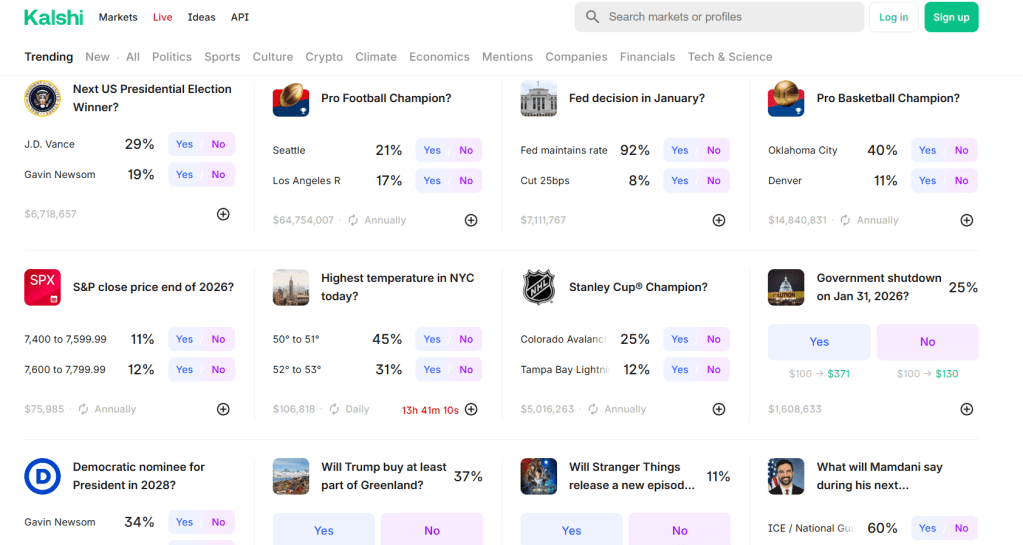
Some of the market available on Kalshi (Source: Kalshi)
One notable example: in late 2023, Kalshi attempted to list markets on U.S. Congressional control (who will control the House/Senate after the 2024 election). Initially, the CFTC disapproved those political markets, but Kalshi fought back in court and won in October 2024, meaning they could list election-related markets going forward.
So by 2025, U.S. users could legally trade on things like the presidential election outcome on Kalshi – something that had effectively been banned for decades. This court victory was hailed as a “monumental milestone” by Kalshi.
Unique Features
Because it’s regulated, Kalshi enforces some limits (to prevent any one person from risking too much or manipulating markets easily). But they also have innovative features. For example, combo markets (allowing combined positions/outcomes), a Leaderboard where users can see top traders (adding a social/competitive element), and a clean UI with data charts for each market.
They’ve also collaborated with other financial apps – notably, there were reports of Robinhood exploring integration with Kalshi to offer event contracts to its users, and as of late 2025, a partnership with a sports fantasy app (PrizePicks) uses Kalshi’s markets under the hood to offer team and culture predictions.
All of that points to prediction markets moving into the mainstream finance and entertainment space, with Kalshi as a key player.
Trust and Legality
From a beginner’s perspective, Kalshi might be a comfortable entry point because it’s legally sanctioned and has investor protections.
Funds are held securely, and outcomes are resolved based on publicly verifiable data (often government reports or trusted sources).
The CFTC oversight means no “wild west” shenanigans – Kalshi cannot list markets on certain taboo subjects (e.g., no assassination markets, obviously; and currently, no sports betting on its own due to other regulations).
They also have compliance like reporting requirements and are subject to U.S. law (for instance, insider trading rules – there’s even talk of new laws to ban government officials from using markets like Kalshi to trade on inside info). For users, this means a relatively safe and above-board experience.
In summary, Kalshi is ideal if you’re in the U.S. and want a legitimate, real-money platform to trade on world events, without dealing with cryptocurrency or legal gray areas. It’s the “regulated prediction market” taking the concept into the traditional finance arena.
Polymarket (Decentralized Crypto Market)

Polymarket offers a very different flavor of prediction market – a decentralized, cryptocurrency-powered approach. It brands itself as the world’s largest prediction market (by volume of trades globally), and it runs on the Polygon blockchain (a layer-2 network for Ethereum) using USDC stablecoin for bets.
To a user, Polymarket feels like a web app where you can browse a bunch of questions and bet on Yes or No by buying shares, similar to other markets. Under the hood, however, trades are settled on the blockchain.
Users typically need a crypto wallet (like MetaMask) and USDC (a cryptocurrency token pegged 1:1 to the US dollar) to trade. Polymarket’s contracts are essentially smart contracts that hold the pooled funds and later pay out to winners.
The use of USDC means you don’t have to worry about crypto volatility – 1 USDC is always ~$1 – it’s just the medium for trading. (Polymarket has also added features to simplify onboarding, like letting users purchase USDC with a credit card on the platform, so beginners don’t need prior crypto experience).
Topics and Culture
Polymarket became known for having markets on just about any newsy topic you can imagine: elections and politics (worldwide, not just US), crypto industry events (will Ethereum successfully do X upgrade), public policy (will lockdowns happen?), health and science (will a new COVID variant emerge?), pop culture (celebrity news, tech rumors), and more.

Some of the markets available on Polymarket (Source: Polymarket)
If it’s trending on Twitter or making headlines, chances are someone has created a market for it on Polymarket. For example, Polymarket traders have speculated on things like “Will Elon Musk step down as CEO of Twitter by date X?”, “Will a certain meme stock hit $Y price?”, or “Will we find extraterrestrial life by 2030?”.
It’s quite broad and sometimes whimsical. The platform often becomes a hub for communities to put money on their hunches – during the 2020 U.S. election, Polymarket had markets on each swing state’s outcome and even on conspiracy-theory topics (like outcomes of court challenges).
Live odds from Polymarket have been cited in the media when big events are underway, as a pulse of what the crypto-savvy crowd predicts.
User Experience
Despite the underlying complexity of blockchain, Polymarket’s interface is beginner-friendly. You don’t need to know it’s on a blockchain to use it – you just see a question, the current odds, and buttons to buy Yes or No shares.
Trades are near-instant and fees are minimal (Polygon network has very low transaction costs). One difference is Polymarket currently doesn’t let you set custom prices (no traditional order book); you buy at the going price, which is determined by their automated market maker formula.
If you want a lot of shares, the price might slip a bit as you buy more. But for most small trades, it’s seamless.
Community and Tools
Polymarket has built a community where users discuss markets and share insights. They’ve even introduced Polymarket Analytics and “Polysight” AI tools to help users analyze market trends. This includes charts of price over time and volume, and some AI-generated commentary on why a price might be moving (pulling in news or social media sentiment).
Those tools can be helpful for newcomers to understand market movements. Polymarket also has a Discord community where users propose new markets and discuss existing ones, adding a social layer to the experience.
Trust and Resolutions
One question people often have with decentralized markets is “Who decides the outcome and pays out?”
Polymarket, while blockchain-based, still has a centralized resolution process – essentially the Polymarket team (or designated referees) specify a trusted source for each market’s result in the market description (e.g., an election market will say it resolves based on official election commission results). If the outcome is disputed or unclear, there’s a process for disputes (users can challenge an outcome and an arbitration mechanism kicks in).
In practice, Polymarket has had a good track record of resolving markets fairly and quickly based on real-world outcomes, though using it does require some level of trust in the platform’s integrity.
The blockchain aspect guarantees that funds are escrowed and can only be released according to the smart contract rules, which adds security – but the outcome still needs an oracle (a bridge from the real world data to the contract). Polymarket currently acts as this oracle.
In summary, Polymarket is a go-to platform if you’re outside the U.S. (or tech-savvy in the U.S. using it read-only) and want a wide variety of markets, especially in the crypto, global politics, or pop culture arenas. It combines the cutting-edge ethos of decentralized finance with an intuitive interface.
Just remember that being crypto-based means you handle a wallet and tokens – which has its own learning curve – and that you’re participating in a space that’s not under a specific financial regulator (aside from the broad settlement they did). Polymarket’s success has shown that there’s high demand for an open prediction market accessible worldwide, and it continues to grow, with plans to formally enter the U.S. market through regulatory channels in the future.
Other Platforms and Alternatives
Beyond Kalshi and Polymarket, there are a few other noteworthy platforms.
PredictIt
As mentioned, PredictIt is a long-running market mostly for political junkies. It operated under an academic license from 2014 until recently. In 2022 the CFTC withdrew its no-action relief (citing compliance issues), which led to legal battles and uncertainty.
However, as of late 2023, a court injunction allowed PredictIt to continue operating pending resolution, and in September 2025 it apparently secured an arrangement for compliance.
PredictIt limits how much money you can invest per market (to keep it “non-speculative” – historically $850 cap, now reportedly raised to $3,500.
It’s open to U.S. users and uses real money (deposits via credit card, etc.), focusing on elections and government events. While smaller in scale compared to Kalshi, it has a dedicated user base and often interesting niche political markets. It’s also been a source of data for academic research on forecasting. Newcomers might find it simpler (straight yes/no markets, clear rules, but note the lower liquidity and limits).
Betfair and Smarkets
These are betting exchanges popular in Europe. They function like prediction markets for all intents and purposes – users bet against each other on sports and events.
Betfair Exchange, based in the UK, is the largest, with tons of liquidity on major sports and even things like UK elections, Eurovision song contest, etc.
Smarkets is a similar, newer exchange. If you’re in a region where these operate, they offer a slick way to trade event outcomes (though typically framed as betting odds instead of share prices).
The principle is the same: you can back or lay (equivalent to buy or short) an outcome, and the odds move with the money. These companies are regulated under gambling laws in their jurisdictions.
Decentralized Protocols
Aside from Polymarket, other crypto platforms include Augur (as discussed, it’s fully open but not very user-friendly) and OJX/Zeitgeist on Polkadot, Flux on Solana, among others. Many are experimental or aimed at crypto enthusiasts. They often lack the liquidity and ease-of-use that Polymarket achieved, but the space is evolving.
If you’re a DeFi (decentralized finance) enthusiast, you might explore these for the sake of curiosity.
Manifold Markets & Play-Money Sites
If you want to dip your toe without risking real money, platforms like Manifold Markets allow users to create and bet on predictions using a fake currency (Manifold’s “Ṁ” points, which you can also buy with a few real dollars if you want more, but it’s mostly play).
Manifold is very popular among the EA (effective altruism) and forecasting crowd, and they even allow creators to donate their earned points to charities.
Good Judgment Open and Metaculus are not betting markets but prediction competitions where you forecast probabilities and get scored – these can scratch the same itch for those more interested in the forecasting aspect than the gambling aspect. They also tend to have more long-term and science questions. While you can’t win money on those, you also can’t lose any, and they provide a great learning environment.
As a beginner, choose the platform that fits your comfort and locale:
- If you’re in the US and okay with providing ID verification, Kalshi is a solid, legitimate choice.
- If you’re outside the US or already into crypto, Polymarket offers breadth and excitement (just mind the need for a crypto wallet).
- If your interest is mainly political forecasting in the US, PredictIt has many niche markets and a community built around discussions of election odds.
- Or, start with Manifold/Metaculus to practice forecasting without financial risk, then graduate to real-money markets once you’re confident.
No matter the platform, remember that while the mechanics may differ slightly, the fundamental idea is the same: you’re buying and selling predictions. Now, before you jump in, it’s important to cover the legal and ethical side of things – after all, prediction markets live in a crossroads of finance, gambling, and information markets.
Legal and Regulatory Considerations
Prediction markets can be fascinating and useful, but they also raise legal and regulatory questions. Are they considered gambling? Are they financial instruments? The answer can depend on where you are and how the market is structured.
United States
In the US, the primary regulator for prediction markets (at least those involving commodities or financial-like contracts) is the Commodity Futures Trading Commission (CFTC).
The CFTC has historically treated real-money event markets as a form of binary options or futures, which means you generally need to be a registered exchange to offer them. This is why Kalshi went through a formal approval process – it is a designated contract market under CFTC oversight.
The CFTC carved out narrow exceptions for academic purposes (that’s how the IEM and PredictIt operated – with no-action relief letters), but they frowned upon unregulated platforms.
Gambling vs. Market
One reason for strict regulation is that prediction markets can look like gambling – people betting on events. In fact, election betting was outlawed in many states for a long time, and the CFTC explicitly has tried to restrict election markets, viewing them as crossing into gambling territory outside its mandate.
The debate came to a head when the CFTC in 2022 told PredictIt to shut down and initially prevented Kalshi from introducing election markets. However, the landscape changed with the October 2024 court ruling in Kalshi’s favor that we discussed.
Now, regulated election markets are moving forward, but they will be closely watched. In general, sports betting and casino-style betting are regulated by states (and not allowed on prediction exchanges like Kalshi), whereas event contracts on things like economic data fall under the CFTC.
Insider Trading & Manipulation
Because these markets involve potentially significant outcomes (e.g., a market on a company’s earnings or a government policy), there are concerns about insiders trading on non-public information.
Insider trading is illegal in stock markets, and similar rules can apply to event markets. For example, a government official with knowledge of an upcoming policy decision could, in theory, try to profit on a prediction market – something lawmakers have noticed.
A bill was even proposed to explicitly ban U.S. government employees from using prediction markets for this reason.
Market manipulation (e.g., a rich person betting heavily to sway the odds and create a false impression) is another worry. Regulators like the CFTC aim to monitor such activities on the platforms they oversee.
So far, large-scale manipulation in prediction markets is not common (it would be costly to sustain a wrong price), but the legal framework is being discussed and developed.
Taxes
In the U.S., any profits from prediction markets (like Kalshi or PredictIt) are generally subject to taxes similar to other investment or gambling income, depending on how they’re classified. If treated as investments, capital gains tax could apply; if seen as gambling winnings, other tax rules might apply. Participants should keep records of their wins/losses for tax time.
International
Other countries have a patchwork of rules.
UK & Europe
Many countries classify betting on events as a form of gambling.
The UK, for instance, has a legal betting industry, so event markets (sports, politics, etc.) can be offered by licensed operators. This is why Betfair can legally host a market on, say, the next Prime Minister – it’s covered under their gambling license.
However, offering what looks like a financial derivative to the public (like a binary option) is tightly regulated in the EU (ESMA banned binary options for retail a while back due to scam concerns).
Prediction markets occupy a gray area between those definitions, so any platform in Europe would need to carefully abide by either financial or gambling regulations.
Australia, Canada, etc.
Typically, these have strict gambling laws too. Polymarket lists Australia as restricted, likely because of gambling regulation.
Canada currently doesn’t have major prediction market platforms of its own, and U.S. ones aren’t officially operating there, but Canadians often participated in PredictIt or crypto platforms in the past (legality was murky but generally not enforced for small-scale personal use).
China and Others
Some countries ban public gambling entirely, so prediction markets would be illegal there. India also has strict anti-gambling laws which could encompass betting on events.
Decentralized Platforms and Enforcement
A tricky area is how regulators deal with decentralized, blockchain-based prediction markets.
Augur, for example, is just open-source code on Ethereum – there’s no company to fine or shut down. While Augur usage is low, it set a precedent that “if anyone can create a market on anything, how do you enforce laws against that?”. So far, regulators have focused on the more centralized parts (for instance, Polymarket the company, which could be fined – and indeed was by the CFTC).
They can also target front-end websites that facilitate access. If truly peer-to-peer prediction markets grew (with no central operator and using cryptocurrency), regulators might still find ways to limit them (e.g. outlawing their use, or going after individuals who create markets on illicit things). It’s an evolving area of law.
Ethical Considerations
Alongside legality, there are ethical questions. Some academics and policymakers worry that prediction markets on sensitive topics could have harmful effects.
A notorious example was the proposed “Policy Analysis Market” (PAM) in the early 2000s, a U.S. government-backed project that would have allowed trading on events in the Middle East (even things like the likelihood of a terrorist attack).
When news of that plan broke, it was slammed as a “terrorism betting market” and was quickly shut down due to public outcry – the idea of people potentially profiting from violence or disasters was too controversial.
Similarly, Augur’s instance of users setting up an assassination market raised alarms.
Reputable platforms now have policies to reject markets that are immoral or could incentivize wrongdoing.
For example, you won’t find a market on “X person to die by date Y” on Kalshi or Polymarket – those would be immediately removed. Some platforms even avoid markets on things like school shootings or natural disasters to avoid the appearance of insensitivity or perverse incentives.
Bottom line: If you’re using prediction markets, make sure it’s legal for you to do so. Use the platforms that operate in your jurisdiction. If you’re in the U.S., stick to regulated ones (Kalshi, or PredictIt as an academic tool). If you’re elsewhere, ensure you’re not violating local laws by participating. And be aware that this is a developing space legally – rules might change as governments catch up with the trend.
The encouraging news for fans of prediction markets is that they are gradually becoming more accepted. The CFTC’s engagement (even if sometimes adversarial) and things like Kalshi’s legal victory are paving a path to legitimacy.
Meanwhile, more conventional gambling regulators are also opening up (for instance, some U.S. states are considering allowing certain event betting under their sports betting laws). So the trajectory seems to be toward more regulated, but permissible, use of prediction markets. If legality prevents you from participating directly, you can still observe these markets.
Often the information they provide (the odds) is freely viewable online, and that alone can be valuable for insight into events. In fact, some governments and businesses that can’t legally bet themselves still watch prediction market prices as a forecasting signal.
Benefits and Challenges of Prediction Markets
Before we wrap up, it’s worth summarizing why prediction markets are useful and what challenges or criticisms they face.
Benefits
Aggregated Knowledge
Prediction markets distill information from many people. Each trader might have a piece of the puzzle – one might know about local sentiment, another about historical trends, another spots a news detail – and the market price combines all this. This often yields more accurate forecasts than individual experts or surveys. As mentioned, Iowa markets beat polls, and a crowd of traders can out-perform pundits who may be biased. James Surowiecki’s book The Wisdom of Crowds famously highlighted this strength
Incentives for Truthfulness
Unlike polls where respondents may not think hard or may even mislead, in a prediction market people have skin in the game. The motto is often “put your money where your mouth is.” This tends to enforce honesty (or at least serious consideration) – if you’re wrong, you lose money, so you’re motivated to be as right as possible.
It can cut through noise and hype; for example, if media pundits are all saying one thing but the people who are betting money think differently, the market odds might be a better reality check.
Real-Time Updating
Markets can react instantly to new information – say a candidate drops out of a race, or a surprising economic report comes out – the prices adjust within minutes (or even seconds if traders are quick). This real-time aspect means prediction markets provide a continuously updated probability, which is useful for anyone following the event (journalists, analysts, decision-makers, etc.)
Hedging and Decision-making
For some, prediction markets allow a form of hedging. For instance, a company might effectively hedge a policy risk (if a law that hurts their business might pass, they could bet “Yes it will pass” – if it does, their market losses are offset by winning the bet). Individuals might hedge personal concerns too (bet on “no rain” for your wedding day – if it rains, at least you get a payout).
While not many people use it this way yet, the potential is there to integrate with risk management. Moreover, organizations can use internal prediction markets to improve decisions (employees forecasting project completion dates have been known to predict delays more candidly than managers might admit).
Engagement and Fun
On a less technical note, prediction markets are engaging. They turn following the news or world events into a more interactive experience.
Instead of passively reading headlines, you can take a stance and potentially profit from your knowledge or hunches. This can increase interest in civic events (some argue that allowing election betting legally could boost voter engagement, for example). It’s also an educational tool – by participating, you learn to quantify uncertainty and think in probabilities.
Challenges & Criticisms
Accuracy Limits
While often good, prediction markets are not infallible. They can be only as accurate as the information traders have. If everyone is operating under the same false assumption, the market odds will reflect that until corrected.
Also, if an event is very unique with little prior data (say, a novel scientific breakthrough), traders may have no clue and the market might just hang around 50/50 randomly. In thin markets, a single trader’s opinion can sway the odds a lot, which might be misleading if that trader is wrong.
Liquidity and Participation
Markets work best with lots of active participants and liquidity (money available to back up bets).
Some prediction markets suffer from low liquidity – wide bid/ask spreads and low trading volumes – which can make the odds less reliable and the market easier to manipulate.
If only a handful of people are trading, you shouldn’t put too much stock in the price (it could jump from 20% to 80% on one trade of $50, which doesn’t mean the true probability changed that much). Greater participation leads to more stable and meaningful odds. This is why growing user bases is important for platforms.
Legal Hurdles
As we just discussed, legality is a big challenge. Being shut down or limited by regulators has killed or crippled some markets (Intrade’s closure in 2013 left a void for years; PredictIt’s uncertainty impacted its liquidity).
Until a clear framework exists in all major jurisdictions, prediction markets can’t reach their full potential. The gambling stigma also deters some people – they might find the idea distasteful or fear it encourages betting behavior.
Ethical Issues
There is the concern that certain markets could be unethical. While mainstream platforms self-regulate, the mere existence of a market might occasionally create odd incentives.
A classic hypothetical: if there was a huge bet on a certain thing happening, could someone influence the event for profit? (E.g., a market on “Will a certain CEO resign by end of year” might, in theory, encourage activist investors to push them out if the pot is large enough. This is mostly theoretical and no evidence of such schemes, but critics raise it.)
These concerns mean operators must choose questions wisely and sometimes avoid those that might be problematic.
Cognitive Biases and Herding
Traders are human and can be swayed by biases – overconfidence, fear, bandwagon effects. There have been cases where markets got things wrong possibly due to echo chambers (for instance, some people cite the 2016 U.S. election where betting odds gave Clinton a high chance but Trump won – though polls were wrong too; the market odds did move as results came in).
Additionally, if a large group wants an outcome to be true (say a fan community), they might bet more on it than is rational (injecting wishful thinking). However, because money is on the line, blatantly irrational exuberance is usually corrected by others taking the opposite side for profit.
Information Cascades
If people assume the market odds are correct, they might stop bringing new information (like “well, the market says 80%, it must know something, so I’ll also bet it’s 80%”). This can theoretically lead to self-confirming cycles. It’s a topic of research – generally markets do a decent job, but they’re not immune to collective blindness.
Despite those challenges, the overall experience from many events has been that a well-designed prediction market with enough participation can be a powerful forecasting tool.
They’re not a replacement for expert analysis or robust data models, but they complement them. For instance, some election forecasters blend prediction market data with polling data and expert opinion to get a composite forecast.
For a beginner, the main takeaways are: use prediction markets as a guide, not gospel; be aware of their limitations (especially if a market looks too quiet or one-sided, the price might be less meaningful), and participate responsibly.
Let’s emphasize that last point – responsibly – as with any real-money trading or betting, you should only risk what you can afford to lose and be mindful of the addictive nature it could have for some individuals.
The goal is to learn and maybe earn, not to gamble away savings.
With that said, prediction markets, when used wisely, open up a fascinating world where you can essentially trade on your opinions and gain insights from the collective wisdom of others.
Many newcomers find that even if they don’t make a big profit, they start thinking about probability and risk in a more nuanced way – which is a great skill in life generally. Now, let’s wrap up with a FAQ section to answer some common beginner questions you might still have:
Frequently Asked Questions
What is a prediction market in simple terms?
It’s basically a market for betting on future events. Think of it as a stock market, but instead of stocks you’re buying shares in an outcome (like “Yes, this event will happen” or “No, it won’t”). If the outcome you invested in comes true, you get paid; if not, you lose what you put in.
The price of the share reflects the probability of the event as determined by all the traders. In short, a prediction market is a platform where people trade on what they believe will happen in the future.
How do prediction markets work?
How do prediction markets work is best explained with an example: Imagine a question like “Will a certain movie win the Oscar for Best Picture?” If shares for “Yes” are trading at $0.30, that implies a 30% chance it will win.
If you buy those shares at 30¢ each and the movie indeed wins (outcome is yes), you’ll get $1 per share (making 70¢ profit per share). If it loses, your shares are worth $0 (you lose what you paid). People trade these shares with each other, so the price goes up if more people think it’s likely (buying yes), or goes down if people doubt it (selling yes or buying no). It’s an ongoing market – prices update as traders react to news and information.
You can usually enter or exit a position anytime before the event happens. In summary, they work by harnessing supply and demand of opinions – money flows towards the outcome people collectively think is more likely, and that pushes the price to represent the probability.
What does it mean if a market is at 70%?
If a prediction market says 70% (or $0.70) for an outcome, it means the market’s consensus is that there’s a 70% probability of that event happening.
In betting terms, it’s like 2.33-to-1 odds in favor. Another way to see it: if you think the true chances are higher than 70%, you might buy because you consider it undervalued. If you think the true chances are lower, you might sell or bet the opposite side.
The 70% number is not a guarantee – it’s an estimate that will move as opinions change. Also, a 70% outcome still fails 3 out of 10 times! So it’s saying “likely but not certain.”
Are prediction markets legal?
It depends on where you are and which platform. In some countries, they are legal and regulated; in others they might be considered gambling and restricted. For example, in the U.S., only CFTC-regulated exchanges (like Kalshi) or those with special permission (PredictIt for academic purposes) are legal for real-money prediction trading.
Using unregulated offshore or crypto prediction markets as a U.S. resident is generally not legal (and those platforms usually block U.S. users). In the UK and some other countries, betting on events (like politics or sports) is legal through licensed bookmakers/exchanges, so prediction markets can operate under those regulations.
Always check the platform’s terms – reputable ones will clarify who can use them. If you’re in a place where it’s not legal, you can still view the markets, but you shouldn’t trade. Play-money platforms, of course, are legal since no real money is at stake.
How are prediction markets different from gambling or betting?
The line can be blurry, but here are key differences.
Exchange vs House: In a typical sports bet or casino, you’re betting against “the house” (bookmaker or casino), which sets odds and can limit or ban winners. In a prediction market, you’re trading with other participants in an exchange style – the platform is just a middleman that takes a small fee, and it doesn’t care who wins. This means skilled traders aren’t shown the door for winning too much; a prediction market wants liquidity and volume, not to beat you.
Market-Driven Odds: Prediction market odds (prices) are determined by open market activity. In contrast, a sportsbook sets initial odds and moves them based on bets, but it’s more centralized.
Ability to Trade Out: Many prediction markets let you sell your position at any time before the event concludes. Traditional bets often lock you in until the result (though cash-out features are becoming more common now in betting apps).
Regulation and Perception: Gambling is often regulated by gaming commissions, while prediction markets (especially on financial/economic events) might be regulated by financial authorities like the CFTC, treating them more like trading. Prediction markets have an aura of forecasting tools or financial instruments, whereas gambling is seen as entertainment wagering.
That said, from a participant’s view, both involve risking money on uncertain outcomes. So, prediction markets are a form of gambling in the broad sense, but a structured and often legally distinct form. Advocates prefer to emphasize the information aggregation aspect – you’re investing in information, not just playing a game of chance.
Can I make money on prediction markets?
Yes, you can make money if you’re better at predicting than the average trader – but you can also lose money if you’re not! Just like stock trading, some people profit by being savvy and others lose by being on the wrong side of events.
There have been instances where sharp observers made good returns (for example, those who correctly foresaw a surprise election outcome could profit nicely by buying shares when the odds were against that outcome).
However, it’s not a get-rich-quick scheme. Markets are often quite accurate, so finding mispriced odds consistently is challenging. Also, the platforms take a small percentage fee on trades or winnings, which means casual, frequent trading can eat into profits. The best approach if you aim to profit is:
– Pick areas you know better than others (you might have an edge in local politics, or a sport, or a niche topic).
– Do your homework (e.g., if it’s an election market, analyze polls, demographics, etc., better than the crowd).
– Start small to learn – don’t risk a lot until you see how the prices move.
Over time, you might grow your bankroll. Some top traders treat it seriously and do make significant money (there are even leaderboards on some platforms like Kalshi showing returns). But never forget, you could also have a streak of bad luck or poor predictions and lose funds. So, only invest what you can afford to lose, and view any earnings as a reward for skill and a bit of luck.
What are some popular platforms I should consider (and what’s the difference)?
Kalshi: If you’re in the U.S., this is a regulated exchange for event trading. Uses USD, very secure and legal. Good for serious trading on politics, econ, etc.
– Polymarket: If you’re outside the U.S. (or familiar with crypto), Polymarket is a big player using cryptocurrency (USDC) on blockchain. It has lots of markets on diverse topics, easy interface, but requires a crypto wallet and isn’t legal for U.S. users at the moment.
– PredictIt: U.S.-focused, politics-centric market. Lower stakes and more of an academic vibe. Good for U.S. politics enthusiasts, though its future depends on regulatory situations.
– Betfair Exchange / Smarkets: If you’re in the UK or certain countries, these are betting exchanges where you can trade sports and some event outcomes (like political elections). They feel more like betting sites.
– Augur and other DeFi markets: These are decentralized protocols. Interesting for tech-savvy users, but less beginner-friendly and sometimes very low liquidity.
– Manifold / Metaculus / Good Judgment: These don’t use real money (or only nominal amounts). Great for practice, participating in forecasting without risk. Manifold in particular is user-friendly and fun, with play-money that can be turned into charitable donations.
Choose based on your region and comfort. For most beginners, if legal, I’d say Kalshi (for a regulated, straightforward experience) or Polymarket (for a global, crypto-powered experience) are top options, as discussed earlier in detail.
Do I need to know about cryptocurrency to use a prediction market?
Not necessarily. If you stick to platforms like Kalshi or PredictIt, you deal in regular money (fiat currency) via traditional payment methods – no crypto knowledge needed.
If you choose Polymarket or Augur or other blockchain-based markets, you will encounter crypto. Polymarket tries to simplify this by letting you buy stablecoins with a card, but you’ll still end up using a crypto wallet and tokens behind the scenes.
For Polymarket: you’d have to learn how to set up a Polygon wallet (or use their integrated wallet), convert USD to USDC, etc. It’s doable for beginners thanks to guides and a relatively user-friendly process, but it is an extra step. So, you don’t have to use crypto – it’s only required on the decentralized platforms.
If you’re new to crypto and just want to try prediction markets, starting on a non-crypto platform might be wise. You can always explore the crypto ones later if you get more comfortable.
What happens if my prediction is wrong? Can I lose more money than I bet?
If your prediction is wrong, you lose the amount you staked on that outcome, but you cannot lose more than what you put in (assuming you’re not using any leverage, which most prediction markets don’t offer to retail users).
For example, if you spend $50 buying shares on “Yes” and the outcome is “No,” you lose that $50 – it’s gone to those on the winning side. But you won’t go into negative balance or owe money beyond your initial investment. This is because each contract is a binary option with a fixed maximum payout (usually $1 per share if correct, $0 if incorrect).
There is no concept of margin calls or loans in standard prediction markets. It’s worth noting: if you sell shares (short an outcome) without owning them first, some platforms may require you to have sufficient funds as collateral (essentially the maximum you could lose on that short).
But again, that maximum is capped. In summary, you can lose money, but only what you decided to stake. It’s wise to treat it like betting – don’t stake money you can’t afford to lose because there are no sure things.
How are outcomes determined and settled? What if an outcome is ambiguous?
Every market has rules about how it will be resolved. Typically, the market description will specify an official source or criterion. For instance, a political market might say it will resolve based on the election results as reported by the Associated Press or a government election commission.
A weather market might use data from NOAA or Met Office. Platforms like Kalshi provide a summary of rules for each market as required by regulators, so you can read exactly what conditions define a Yes or No outcome.
If the event happens, all Yes shares pay out $1 (or 100%); if not, No shares pay out. If a market was on a numeric outcome (say a range), the winning range pays out. In cases of ambiguity or unforeseen circumstances, each platform has procedures.
If an event is canceled or the question becomes meaningless, usually the market is voided and everyone’s stakes are returned (or sometimes a particular rule kicks in; e.g., if a sports season is shortened, the platform might void those markets).
If the outcome is disputed (like a contested election or an unclear news report), typically the market will wait until a clear resolution emerges or a specified deadline. Some platforms allow for dispute resolution mechanisms (Polymarket has a system where users can raise disputes and ultimately an arbitrator or governance system decides).
Platforms strive to avoid ambiguity by phrasing the question clearly. E.g., instead of “Will politician X win?” it might say “Will X be declared the winner by source Y by date Z?” to remove doubt.
For the vast majority of markets, the outcome is cut-and-dry and gets resolved shortly after the event with no issue. It’s always a good idea to read the market rules before betting, so you know exactly what you’re betting on and how it will be decided. If something odd happens and you believe the market was resolved incorrectly, reputable platforms have customer support or processes to address that. But such cases are rare if the question is well-defined.
How accurate are prediction markets?
They’re pretty accurate on average, often more so than polls or individual experts for certain kinds of events. But they’re not perfect. Studies and real-world track records show that prediction markets tend to correctly estimate probabilities – meaning if something is priced at 70%, it will happen about 70% of the time in the long run, which is what you’d want for a well-calibrated forecast.
They’ve had famous successes, like predicting election outcomes, Oscar winners, even things like the spread of diseases, sometimes beating official forecasts.
However, they can also be wrong – especially in cases where information is scarce or the crowd is biased. A great example: In the 2016 Brexit referendum, betting markets had the “Remain” outcome favored (around 70% chance on betting exchanges) up until the votes started coming in, and that turned out wrong (Leave won).
The market wasn’t totally off (30% is a real possibility, not an extreme longshot), but many people felt overconfident in the wrong outcome. On the flip side, markets predicted Donald Trump’s win in 2016 only late on election night as state results came in – prior to that, they also leaned towards Clinton.
Those events showed markets are not magical clairvoyants; they’re as good as the info available and the crowd’s interpretation of it. That said, markets continuously update, so their strength is in being dynamic. If you followed the market odds through a campaign or season, you’d see them react to debates, scandals, game results, etc., giving a pretty coherent narrative of changing probabilities.
They also generally avoid overreaction – for instance, one bad poll might move a candidate’s price a bit, but not wildly, as traders balance it with other data. In summary: prediction markets are one of the best forecasting tools for a variety of events, but they’re not 100% accurate or unbiased. Treat the percentages as informed estimates. Over time, you might find them more reliable than any single pundit or poll – but always consider the context. If a market is thin or seems one-sided, its accuracy may suffer. As more people participate and more data flows in, the accuracy tends to improve.
What are the risks of using prediction markets?
The main risks include:
Financial Loss
As with any betting or trading, you can lose money. Always be prepared for that. Don’t chase losses; it’s easy to get sucked in (“I was so sure, maybe I’ll double down”) – treat it rationally.
Market Risk
Some events might resolve unexpectedly (upsets happen!). Also, occasionally a market might be suspended or voided due to external issues (like regulatory action or ambiguous outcomes).
Liquidity Risk
If you want to cash out a position, you need someone to take the other side. In a low-liquidity market, you might have to accept a worse price or be unable to exit large positions quickly.
Platform Risk
Use established platforms to minimize this. But theoretically a platform could be hacked or go bankrupt. With regulated ones like Kalshi, there are safeguards (segregated accounts, etc.). With crypto ones like Polymarket, funds are in smart contracts (which have been secure so far, but smart contracts have hack risk in general). With lesser-known sites, there’s risk of them just disappearing with funds (so stick to reputable names).
Legal Risk
If you inadvertently use a platform that’s not allowed in your region, you could face consequences, though typically enforcement is on the operators, not individual small users. Still, it’s a risk not worth taking – better to stay on the right side of the law.
Addiction Risk
Because it’s real-money and can be exciting, there’s a potential gambling addiction risk. If you find yourself compulsively betting on too many things or beyond your means, take a step back. Many platforms have self-limits or self-exclusion features (Kalshi, being regulated, likely offers ways to set limits or cooling-off periods, as do others).
Overall, if used prudently and legally, prediction markets are as safe as any other form of online trading/gambling. The key is manage your bankroll and keep a clear head. They can actually encourage good habits like thinking in probabilities and not overextending on “sure things.”


