Brazil’s Central Bank Introduces Landmark Crypto Licensing Regime
Brazil’s central bank has issued its most comprehensive set of crypto regulations to date, introducing a formal licensing regime for digital asset service providers and bringing a wide range of crypto-related activities under existing foreign exchange and capital market laws.
The new framework, which comes into effect on Feb. 2, aims to enhance transparency, strengthen financial oversight, and align the country’s fast-growing crypto sector with established financial norms.
Three-Pillar Regulatory Framework
The rules are set out in three resolutions that collectively define how crypto businesses must operate within Brazil’s financial system, stipulate minimum capital requirements, and clarify how cross-border and foreign exchange transactions involving digital assets will be treated under the law. Existing firms will have nine months from the effective date to achieve full compliance.
This regulatory regime, known officially as the framework for Sociedades Prestadoras de Serviços de Ativos Virtuais (SPSAVs)—or Virtual Asset Service Providers (VASPs)—marks a turning point in how Brazil approaches the supervision of its digital economy.
For the first time, companies offering crypto custody, exchange, and intermediation services will be required to obtain licenses from the Banco Central do Brasil (BCB) and adhere to a structured operational framework.
Under the new system, VASPs are divided into three main categories based on their service type: intermediaries, custodians, and brokerages. Each will have to meet specific operational and capital standards to ensure compliance with anti-money laundering (AML) and counter-terrorism financing (CTF) obligations.
Striking a Balance Between Innovation and Security
At a press conference announcing the rules, Gilneu Vivan, the bank’s director of regulation, highlighted the delicate balancing act that guided the regulatory design.
The challenge “was finding a way to unite innovation and security,†Vivan said, according to local outlet Portal do Bitcoin. “The crypto market depends heavily on technology and has very important obligations related to anti-money laundering. All of this requires guarantees that it will be well executed.â€
The BCB’s approach seeks to address long-standing concerns over illicit activity and market integrity without stifling technological progress. While discussions about a formal regulatory regime began as early as 2019, previous efforts stalled due to institutional disagreements and industry pushback.
Capital Requirements Spark Industry Criticism
Despite broad support for clearer oversight, the new framework has drawn criticism from parts of Brazil’s crypto industry—particularly over its capital requirements and tight compliance timeline.
According to the central bank, companies must maintain a minimum capital base of 10.8 million reais (around $2 million), with some categories required to hold as much as 37.2 million reais depending on the scope of services offered. These figures far exceed the 1–3 million reais initially proposed during the public consultation phase.
Bernardo Srur, president of the Brazilian Association of Cryptoeconomy (ABCripto), acknowledged the framework as “positive and necessary,†but warned that the high financial barrier and short compliance window could restrict market competition. Smaller startups, he argued, might struggle to meet the new thresholds in time, potentially consolidating power among larger, well-capitalized firms.
Companies that fail to comply within the nine-month grace period—covering proof of capital reserves, risk management procedures, cybersecurity protocols, and customer due diligence systems—will be prohibited from operating in the country.
Additionally, foreign firms providing crypto services to Brazilian clients must establish a local legal entity and transfer their operations under that structure, ensuring accountability under domestic jurisdiction.
New Oversight on International Crypto Transactions
One of the most consequential elements of the regulatory package involves the integration of crypto activities into Brazil’s foreign exchange (FX) and cross-border capital control frameworks. The move brings several types of crypto transactions—including those involving stablecoins and self-custody wallets—under the same oversight applied to traditional financial operations.
Under the new rules, authorized entities such as VASPs will be allowed to conduct crypto-related FX transactions, but with strict limits and reporting requirements. Each transaction will be capped at $100,000, and firms must report monthly to the central bank starting May 4. Reports must include detailed information on clients, transaction amounts (in reais), asset types, and relationships between counterparties.
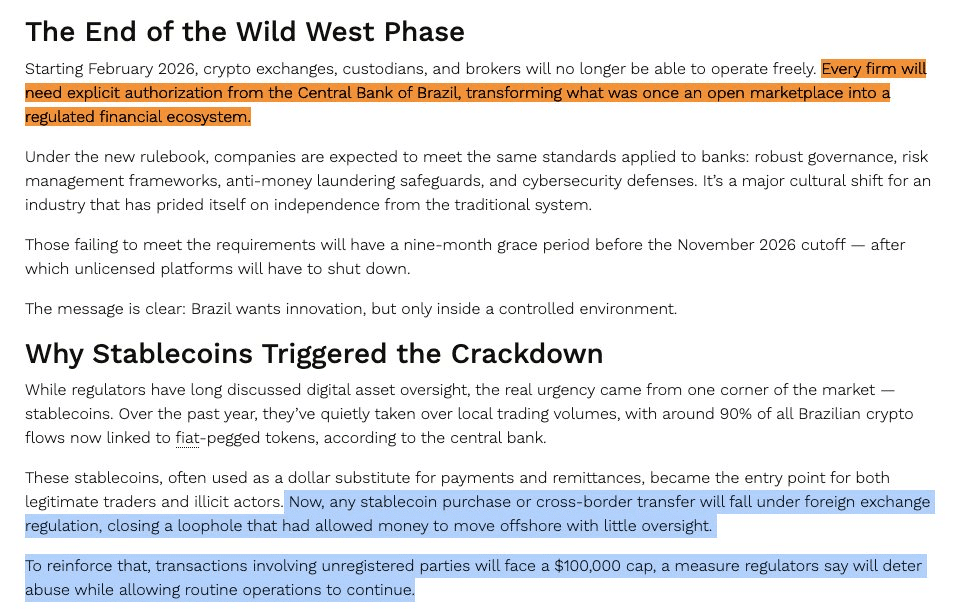
Brazil central bank’s crackdown on stablecoins (Source: X)
The central bank has also prohibited VASPs from handling physical cash—whether domestic or foreign—or using it to fund crypto purchases. This restriction is designed to reduce the risk of money laundering and limit the use of crypto as a conduit for untraceable cash movements.
Aiming for Transparency and Financial Stability
Officials at Banco Central do Brasil say the overarching goal of the framework is to improve transparency and reduce opportunities for regulatory arbitrage—where companies exploit jurisdictional gaps to avoid oversight.
By folding crypto activity into the broader FX and capital markets system, the bank aims to ensure that digital asset flows are properly captured in national economic statistics and the balance of payments.
Outlook for the Brazilian Crypto Market
Industry observers say the new framework could have mixed effects.
On one hand, stricter capital requirements and enhanced reporting standards could deter smaller, less-capitalized firms and reduce speculative activity. On the other, the clarity provided by the licensing structure may encourage institutional investment, attract international partnerships, and enhance consumer trust in the crypto ecosystem.
The next nine months will be crucial for both regulators and the private sector. Companies must adapt their internal systems to meet the new operational standards, while the central bank will need to ensure consistent enforcement and clear communication to avoid confusion across Brazil’s rapidly evolving crypto market.
As the Feb. 2 deadline approaches, all eyes will be on how effectively Brazil’s central bank can implement this ambitious regulatory overhaul—and whether it will serve as a model for other countries seeking to bridge the gap between crypto innovation and financial stability.


