
Arthur Hayes Warns AI Job Losses Could Trigger Banking Crisis and Bitcoin Boom
BitMEX co-founder Arthur Hayes says Bitcoin is flashing a “global fiat liquidity fire alarm†as it diverges from U.S. tech stocks, signaling what he believes could be a major credit destruction event driven by artificial intelligence-related job losses.
In a recent blog post, Hayes argued that Bitcoin’s price behavior often reflects shifts in global fiat liquidity faster than traditional markets. He pointed to the widening gap between Bitcoin and the Nasdaq 100 Index as a sign that credit conditions may be tightening beneath the surface, even as equities remain relatively stable.
According to Hayes, markets historically treat Bitcoin as a high-beta version of tech stocks because of their past correlation. When the two assets begin moving in opposite directions, he said, it can indicate deeper structural stresses within the financial system.
Bitcoin as a Liquidity Alarm
Hayes described Bitcoin as the most responsive freely traded asset to changes in fiat credit supply. In his view, the recent divergence between Bitcoin and the Nasdaq is an early warning sign that markets are beginning to price in a credit contraction.
The core of Hayes’ thesis centers on the potential impact of artificial intelligence on white-collar employment. He argued that rapid automation could lead to large-scale layoffs among knowledge workers, who typically carry higher levels of consumer credit and mortgage debt.
Citing U.S. labor statistics, Hayes estimated there are more than 70 million knowledge workers in the United States. He used federal credit data to model what would happen if roughly 20% of those workers lost their jobs due to AI-driven automation.
Under that scenario, Hayes projected approximately $330 billion in losses tied to consumer credit and another $227 billion linked to mortgage debt. After accounting for existing loan-loss reserves, he estimated that U.S. commercial banks could face an effective 13% write-down of industry-wide equity.
While he said the largest “too-big-to-fail†institutions would likely remain solvent, Hayes predicted smaller and more leveraged regional banks could face severe stress.
He compared the potential outcome to the regional banking crisis of early 2023, but suggested it could be more severe because it would be tied to a structural shift in employment rather than a liquidity mismatch.
Deflation First, Money Printing Later
Hayes described the potential crisis as a classic deflation-then-inflation cycle. In his view, markets would initially price in loan defaults and financial-sector losses, pushing down risk assets. Eventually, central banks would intervene with aggressive liquidity measures to stabilize the system.
He drew parallels to the 2008 global financial crisis, when widespread mortgage defaults forced the Federal Reserve to launch years of quantitative easing. Hayes expects a similar policy response if AI-driven job losses begin to impair consumer credit on a large scale.
In that scenario, he believes Bitcoin would ultimately benefit. The cryptocurrency has historically surged after periods of monetary expansion, as increased fiat liquidity tends to flow into scarce digital assets.
Hayes argued that the deeper the initial downturn, the more forceful the eventual monetary response is likely to be, which could set the stage for Bitcoin to reach new highs.
Early Warning Signs Across Markets
Hayes also pointed to several market signals that he believes support his thesis. Among them are weakness in software-as-a-service stocks, rising consumer credit delinquencies, and shifting performance between consumer discretionary and staple sectors.
He said those trends could reflect declining confidence in sectors tied to knowledge-worker spending, as investors begin to price in the long-term impact of AI automation.
Most notably, Hayes highlighted Bitcoin’s decline from its October 2025 peak while the Nasdaq remained relatively flat. He interpreted the divergence as a sign that liquidity conditions may be deteriorating even before equity markets fully react.
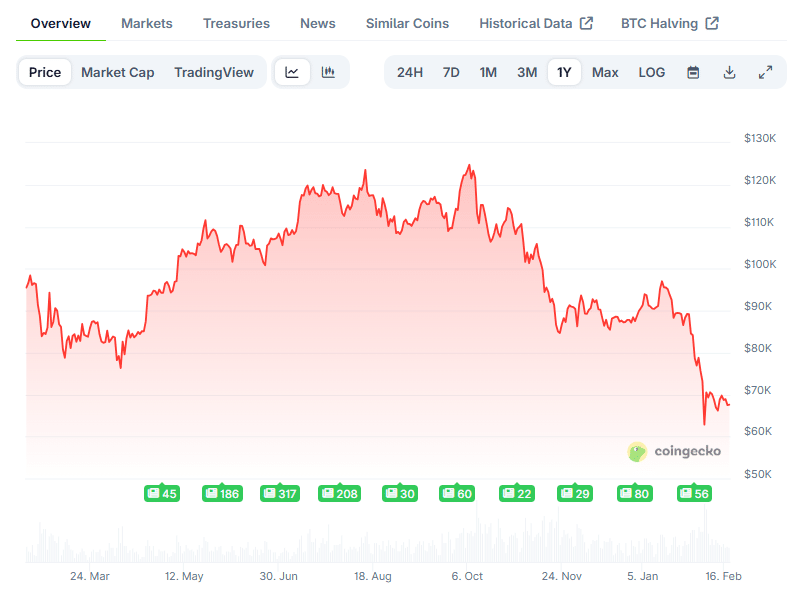
BTC price movement over the past year (Source: CoinGecko)
Fed Response May Come Too Late
Despite the warning signs, Hayes argued that the Federal Reserve is unlikely to act preemptively. He said central banks historically wait for a full-blown crisis before launching large-scale interventions, and political tensions surrounding monetary policy could further delay action.
As a result, he expects markets to experience a sharper downturn before policymakers step in with liquidity programs or emergency measures.
Hayes outlined two potential scenarios for Bitcoin: either the cryptocurrency has already completed its downturn and equities will soon follow, or Bitcoin could fall further as stock markets catch up to tightening credit conditions. In either case, he advised traders to limit leverage and remain liquid until central banks signal a shift back toward monetary easing.
Once that pivot arrives, however, Hayes expects a rapid rebound in risk assets, with Bitcoin and other cryptocurrencies benefiting from renewed fiat liquidity.
His conclusion: the coming AI-driven credit cycle could first trigger a deflationary shock, but ultimately lead to another wave of money printing that propels digital assets to new highs.


