
SEC Chair Declares “Crypto’s Time Has Come” as U.S. Markets Enter New Era
The U.S. Securities and Exchange Commission (SEC) is charting a new course for digital assets, with Chair Paul Atkins declaring that “crypto’s time has come.â€
Speaking at the OECD’s first Roundtable on Global Financial Markets, Atkins pledged to modernize the securities rulebook and expand the agency’s “Project Crypto†initiative, signaling a decisive break from the SEC’s enforcement-heavy past.
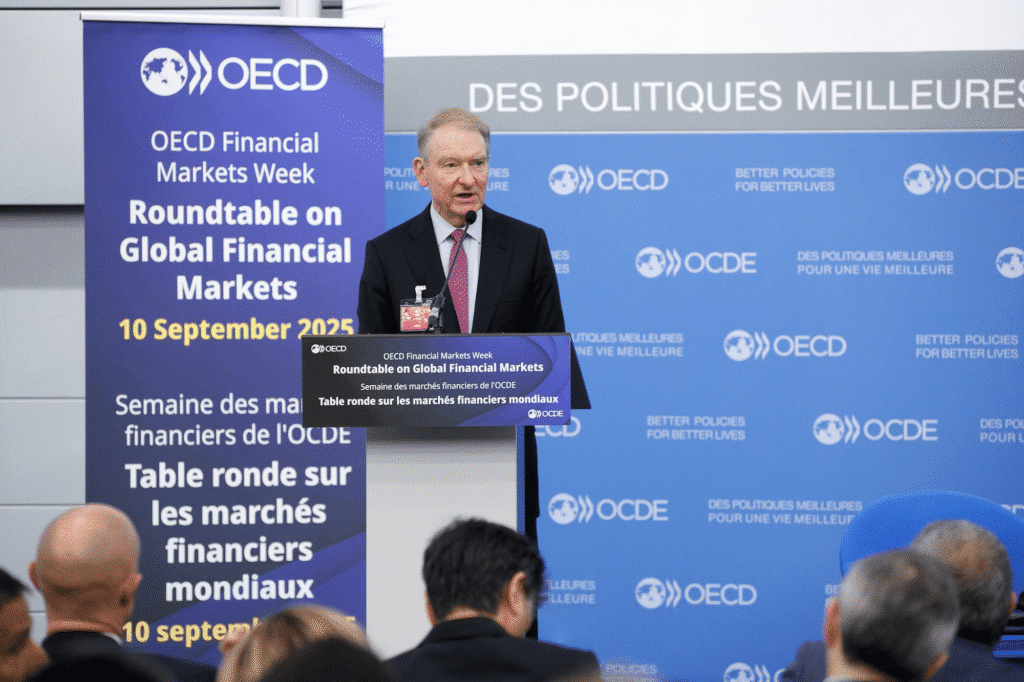
Paul Atkins speaking at OECD roundtable (Source: X)
A Shift in Regulatory Philosophy
Atkins announced that the agency will no longer rely on ad hoc enforcement to dictate policy, instead providing bright-line rules for tokens, custody, and integrated platforms.Â
“Policy will no longer be set by ad hoc enforcement actions,†Atkins said, framing the agency’s pivot as “a golden age of financial innovation on U.S. soil.â€
Most tokens, he argued, should not be considered securities. To that end, the agency will roll out a framework for entrepreneurs to raise capital on-chain without the “endless legal uncertainty†that has plagued the industry for years.Â
Updated custody rules will offer investors multiple safeguarding options, while new licensing models will allow platforms to combine trading, lending, and staking under one regulatory umbrella.
SEC Expanding Project Crypto
First unveiled in Washington on July 31, 2025, Project Crypto is now being positioned as the SEC’s north star for blockchain regulation.
Atkins said the program will clear the way for tokenized securities, new on-chain asset classes, and decentralized finance tools, while keeping investor protections intact. He also floated the idea of “super-app†platforms — one-stop shops for trading, lending, and custody — that could cement U.S. leadership in crypto innovation.
The SEC chair emphasized that the U.S. must move quickly to ensure the next wave of financial innovation develops domestically rather than overseas. “Crypto’s time has come,†Atkins concluded, “and it is America’s responsibility to lead.â€
Market Context and Institutional Momentum
Atkins’ remarks came just two days after Nasdaq President Tal Cohen announced on LinkedIn that tokenization represents an “extraordinary opportunity†for markets, noting that Nasdaq has already filed with the agency to trade tokenized securities.Â
Atkins also addressed broader financial themes, warning that the European Union’s “double materiality†reporting rules could distort global standards. He urged stable funding for the International Accounting Standards Board (IASB) and hinted that the SEC may revisit its allowance of IFRS without reconciliation to U.S. GAAP if concerns persist.
Turning to technology, Atkins highlighted artificial intelligence as a force set to reshape finance through what he called “agentic finance.†In this model, autonomous AI systems would execute trades, manage risk, and allocate capital with compliance built directly into code. When coupled with blockchain, these systems could democratize access to advanced strategies and lower costs for everyday investors.
The Road Ahead
Atkins acknowledged that guardrails will be needed to ensure investor protection, but he urged regulators not to overreact. Instead, he described the coming years as a chance for the U.S. to establish itself as the global leader in both blockchain and AI-driven finance.
By pledging to modernize securities laws and expand Project Crypto, the regulator is opening the door to a new era where capital markets operate directly on-chain, entrepreneurs raise funds with clarity, and investors gain access to innovative digital assets under clear, commonsense rules.


