
Crypto Treasury Companies: A New Wave of Compounding Crypto Investments?
What Are Crypto Treasury Companies? Crypto treasury companies are businesses that hold significant cryptocurrency assets on their balance sheets, often as an alternative to cash or traditional investments.
In recent years, more firms worldwide have followed the lead of Strategy (formerly MicroStrategy) by adding Bitcoin and other digital assets to their corporate treasuries. This trend, known as digital asset treasuries (DATs), sees companies buying and holding cryptocurrencies like Bitcoin and Ether (Ethereum’s native token) as long-term reserves. These firms are effectively turning part of their corporate treasury into crypto holdings, sometimes so extensively that they become proxies for those cryptocurrencies.
In fact, some public companies now own such large piles of Bitcoin or Ether that investors treat their stock as a way to gain crypto exposure, often caring less about the company’s original business model.
For example, Strategy (NASDAQ: MSTR) — which rebranded from MicroStrategy in 2025 — amassed over 600,000 BTC and became a de facto Bitcoin investment vehicle, while BitMine Immersion (BMNR) has emerged as the single largest Ethereum-holding entity in the world.
The Evolution of Treasury Management
The trend of crypto treasury companies began with Bitcoin around 2020, when companies like MicroStrategy, Tesla, and Square (now Block) started buying Bitcoin as an inflation hedge and reserve asset.Â
Bitcoin’s appeal was its fixed supply and store-of-value narrative, but it generates no yield. By contrast, the movement has now expanded to Ethereum and other proof-of-stake cryptocurrencies, which offer not just price appreciation but also staking rewards.
Ether hit a sweet spot for some firms – it’s considered both “institutional-grade†and still early in adoption, with the bonus that it can earn interest through staking.
Staking involves locking up tokens to help secure the network in exchange for rewards, and it can offer yields around 3–4% annually. This key difference means holding Ether can produce ongoing income, unlike Bitcoin which relies solely on price gains.
Staking is often confused with mining, but there are some key differences. To explore how the two methods of generating a crypto passive income differ from each other, read our guide: Staking vs Mining: Which is Better?
Back to staking. As one crypto CEO explained, “Holding ether is more like owning oil, whereas bitcoin is more one-dimensional, like goldâ€, highlighting Ethereum’s utility in powering decentralized finance in addition to being a store of value.
In the last year, a wave of small-cap companies began accumulating Ether for these yields, pushing total corporate ETH holdings to roughly 4.36 million ETH (about $20.1 billion) by August 2025.
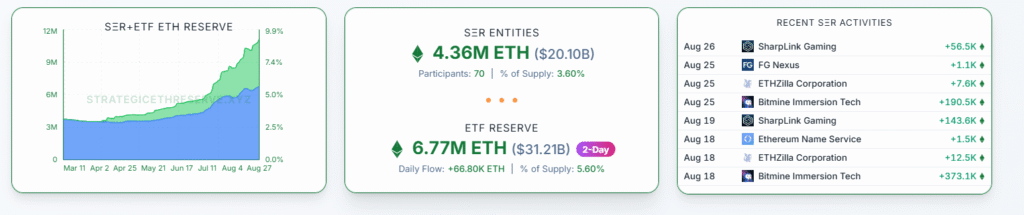
Corporate ETH holdings (Source: StrategicETHReserve)
This marks a new phase where treasury management evolves from passive holding to active yield generation, blending traditional corporate finance with crypto’s growth potential.
Why Companies Are Building Crypto Treasuries
Seeking Yield and Compounded Growth
A major driver of this crypto treasury trend is the opportunity for compounding returns. Crypto treasury companies aim to grow their net asset value (NAV) per share over time by accumulating more crypto tokens – effectively increasing the amount of crypto backing each share.Â
Venture firm Pantera Capital, which has invested heavily in these companies, explains the appeal plainly: “DATs can generate yield to grow net asset value per share, resulting in more underlying token ownership over time than just holding spot.â€
In other words, a Digital Asset Treasury (DAT) company doesn’t merely sit on its crypto; it actively earns yield (via staking, lending, or DeFi strategies) and raises capital to buy even more crypto, so that each share of the company gradually represents a larger pile of coins.
This is analogous to how a dividend-paying stock or a reinvestment fund compounds value – profits (or yields) are reinvested to increase future earnings. The outcome is that owning a stake in a well-run crypto treasury firm could offer higher return potential than holding the tokens directly or via a static ETF.
In fact, investing in an aggressive Ether-focused treasury company has been likened to “hiring a DeFi portfolio manager to grow your holdingsâ€, whereas an ETF simply holds the asset without expansion.
Also read: Altcoins with High Staking Rewards: Earn Passive Income in Crypto
Diversification and Hedge Motivation
Some companies also view crypto treasuries as a diversification tool or hedge against inflation and currency risk.
Bitcoin, for instance, has been treated as “digital gold†– a hedge against fiat currency debasement. Ethereum offers exposure to the growing decentralized finance and blockchain economy, which some executives find attractive as a strategic bet on the future of finance.
It’s considered large and credible enough for institutional portfolios while still offering upside from broader adoption. In a low-yield environment for traditional treasuries, holding crypto (especially yield-bearing crypto) can potentially boost a company’s returns on reserves. This active treasury strategy is seen as “tech-forwardâ€, with firms believing that participating in blockchain networks (like Ethereum’s staking) not only earns yield but also strategically positions them in the emerging on-chain financial system.
Also read: Is Ethereum the Next Amazon?
Of course, this approach is not without volatility – crypto prices can swing widely – but proponents argue that over a long horizon, the compounded token growth plus any price appreciation could significantly enhance treasury value.
Staking, DeFi, and Earning Interest
Unlike traditional corporate cash holdings (which might earn minimal interest in a bank), crypto treasury companies can be actively put to work.Â
Staking Ethereum or Solana yields a baseline return (often around 4–5% for ETH and potentially more for SOL). Several crypto treasury companies are going a step further, deploying assets in DeFi (decentralized finance) protocols to chase higher yields.
Also read: How to Stake ETH: A Step-by-Step Guide for Beginners
For example, GameSquare Holdings – a digital media company turned ETH accumulator – considers the ~3% from simple ETH staking as the “risk-free rate,†and aims for 8–14% annual yield by providing liquidity, investing in Web3 ventures, and using advanced strategies.
Similarly, BTCS Inc., one of the earliest public blockchain companies, now runs its own Ethereum validator nodes and even uses a leveraged “flywheel†strategy (depositing ETH to borrow stablecoins and buy more ETH to stake) to amplify returns.
Those methods resemble hedge-fund-like tactics within a corporate structure. The overarching goal is clear: grow the crypto holdings over time. As one executive put it, “If we have 10 Ether, I hope we can have 11 Ether next yearâ€, reflecting the pursuit of steadily increasing the crypto stack per share.
This ability to generate ongoing income from crypto assets makes treasury companies unique, and arguably one of the rare ways for equity investors to tap into compounding crypto gains over time, rather than just one-off price speculation.
Crypto Treasuries vs. Dividend Stocks: A Comparison
At first glance, a crypto treasury company might seem very different from a traditional dividend-paying stock. But there are some interesting parallels in how both can deliver compounding value to investors:
- Reinvested Earnings vs. Reinvested Yield: Dividend stocks reward shareholders with regular cash payouts (which investors can reinvest in more shares). Crypto treasury firms typically don’t pay out their yield as dividends; instead, they reinvest the “earnings†(staking rewards, etc.) back into acquiring more crypto. This mirrors a company reinvesting profits to fuel growth. Over time, the reinvestment can compound. For instance, a crypto firm staking a large Ether trove will steadily increase its ETH holdings, much like a company that reinvests earnings grows its equity or a fund that reinvests dividends accumulates more assets.
- NAV per Share Growth: In the stock world, a company that retains and reinvests profits should see its book value and earnings per share grow, eventually boosting its stock price. In the crypto treasury world, the equivalent metric is tokens per share – how much crypto each share of the company represents. Management of these firms use various levers to grow tokens-per-share (TPS): issuing new shares at a premium to bring in cash for more tokens, using debt financing to buy tokens, and of course earning staking yield and DeFi income to accumulate additional coins. BitMine Immersion (BMNR) provides a striking example: within one month of launching its Ethereum treasury strategy, BitMine increased its ETH-per-share by 330%, which in turn propelled its stock price up during that period. The vast majority of BitMine’s stock surge was attributed not to just Ether’s price rise, but to growing the underlying ETH pile per share, a dynamic unique to the treasury model. This is akin to a company whose dividend reinvestments significantly increase its book value – investors reward it with a higher share price.
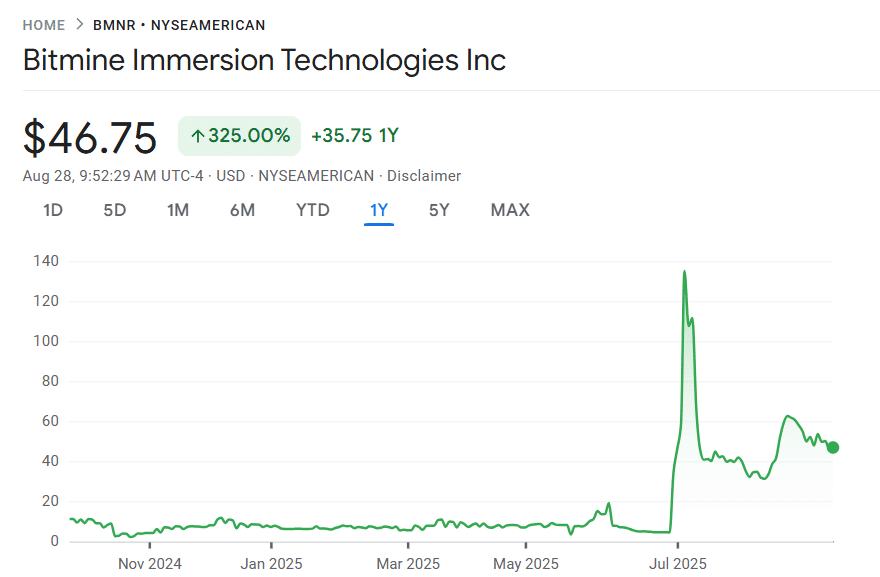
BitMine share chart (Source: Google Finance)
- Valuation Premiums for Yield Generation: High-quality dividend stocks (or banks, which generate interest yield on assets) often trade at a premium to their book value because investors expect them to keep producing and growing returns. Similarly, crypto treasury companies that can sustainably grow their NAV per share may command a premium valuation above the market value of their underlying crypto. Pantera Capital draws an analogy: just as top banks trade above book value by earning superior yields on their assets, a well-run DAT can trade above its net crypto asset value if it consistently grows its crypto per share. In practice, some crypto holding firms do trade at premiums (investors pay more than the current spot value of the crypto on the balance sheet), essentially betting on management’s ability to compound those holdings further. This dynamic is rare in the crypto sector and harks back to how reliable dividend growers or reinvestment-driven companies trade on expectations of future compounding.
In summary, crypto treasury companies introduce a total return approach to crypto investing: part comes from the underlying coin’s price movements (like a stock’s capital gains) and part comes from yield that is re-invested (analogous to reinvested dividends).
For investors seeking long-term crypto exposure, this model offers a tantalizing prospect of compound growth. It’s worth noting, however, that unlike traditional dividends, the “yield†in crypto treasuries isn’t usually paid out in cash to shareholders – it’s reflected in the company’s growing asset base and potentially in its stock price appreciation.
Case Studies: Notable Crypto Treasury Players
Bitcoin-Focused Treasuries: The original wave of crypto treasury companies was all about Bitcoin. MicroStrategy – now simply called Strategy – famously kicked off the trend in 2020 by converting large portions of its cash into Bitcoin.Â
As of 2025, Strategy (MSTR) has accumulated well over 600,000 BTC on its balance sheet, making it the largest corporate holder of Bitcoin in the world.
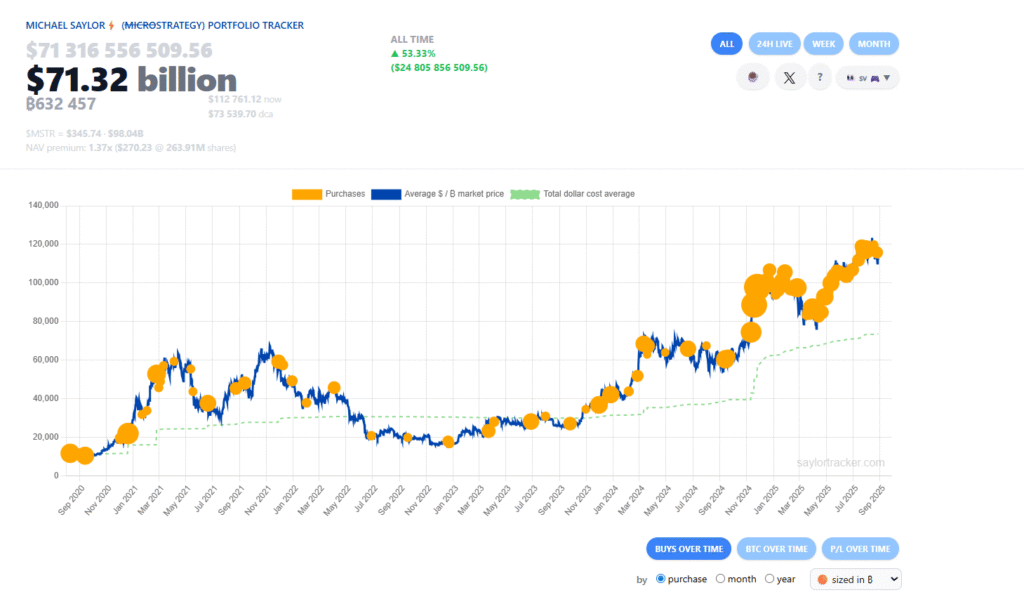
Strategy Bitcoin holdings (Source: SaylorTracker)
This bold strategy transformed the company’s stock performance (often moving in tandem with BTC prices) and inspired others to follow.
Tesla holds about 11,509 BTC, and fintech firm Block (SQ) also allocated treasury funds to Bitcoin, signaling an acceptance of crypto as a reserve asset. Several Bitcoin mining companies like Marathon Digital (MARA) and Riot Platforms (RIOT) effectively serve as Bitcoin treasury stocks as well – they hold a portion of mined BTC on their books, leveraging their operations to accumulate the asset.
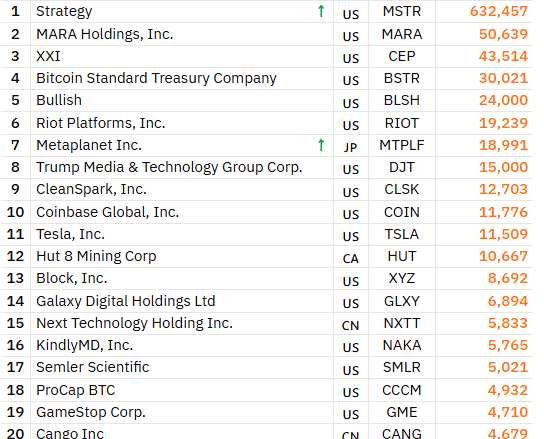
Top 20 Bitcoin treasury companies (Source: Bitcoin Treasuries)
For instance, Marathon holds over 50,000 BTC by mid-2025. A notable newcomer is Twenty One Capital (NASDAQ: XXI), which by 2025 holds 43,514 BTC (worth over $4 billion) as a pure Bitcoin treasury play.
These Bitcoin-focused companies do not benefit from staking yields (since BTC is not stake-able), but they often use strategies like issuing equity or debt to buy more Bitcoin. Their value proposition to investors is straightforward: high-conviction, long-term Bitcoin ownership through a stock.
However, they also highlight the volatility of this approach – for example, Strategy’s stock price has seen both huge rallies and steep drawdowns following Bitcoin’s swings.
Ethereum and Staking-Oriented Treasuries: The rise of Ethereum treasury companies is a more recent phenomenon, exploding in 2025.
BitMine Immersion (BMNR) is the headline example. Led by Tom Lee of Fundstrat, BitMine pivoted to an Ethereum-focused treasury strategy with an ambitious goal dubbed “The Alchemy of 5%†– to acquire 5% of all ETH in circulation.
In just a few months, BitMine has already become the largest Ethereum treasury in the world, holding about 1.7 million ETH (≈$7.99 billion as of Aug 2025), which is even more than the Ethereum Foundation’s own holdings. This makes BitMine the third-largest crypto treasury company globally (trailing only Strategy and Twenty One Capital in total crypto holdings).
BitMine aggressively grew its stash by issuing stock (it even expanded an equity program to $24.5 billion to fund more ETH purchases) and by staking its ETH to earn additional yield.
The market rewarded this rapid accumulation – BitMine’s stock price rocketed, at one point jumping from about $34 in late June to over $160 by early August. While it has been volatile, BitMine showcased the market’s appetite for an Ethereum proxy that also grows its Ethereum holdings.
Beyond BitMine, a cohort of other Ether-heavy firms has emerged: SharpLink Gaming (SBET), affiliated with Ethereum co-founder Joseph Lubin, now holds nearly 800,000 ETH. Bit Digital (BTBT), originally a Bitcoin miner, shifted focus to Ethereum and amassed over 120,000 ETH while running staking validators and even DeFi lending strategies.
GameSquare Holdings (GAME), a digital media firm, acquired about 15,000 ETH and actively works to boost yield through partnerships with crypto funds. There’s also ETHZilla (ETHZ), which raised $425 million to buy around 102,000 ETH and implement an on-chain yield program targeting up to 10% returns.
Many of those companies are small- or mid-cap firms that reinvented themselves around an Ether treasury strategy, illustrating how the corporate landscape is adapting to crypto opportunities.
It’s telling that public companies and even governments now hold over 3 million ETH combined (roughly 2.5% of Ether’s supply) in their treasuries – a figure that has been climbing rapidly.
Solana and Other Crypto Treasuries: The concept isn’t limited to Bitcoin and Ethereum. Other tokens, especially those with staking or yield features, are also being scooped up by treasury-focused entities.
Solana (SOL) is one such example. By mid-2025, public Solana treasuries held about $695 million in SOL (roughly 0.7% of SOL’s supply), and this is expected to grow. Pantera Capital, seeing the potential, announced plans to raise a massive $1.25 billion to convert a Nasdaq-listed company into “Solana Co.,†a dedicated Solana treasury vehicle.
The idea is to create the world’s largest SOL-holding company, mirroring the Ether strategies but for Solana’s ecosystem. Already, smaller firms have pivoted to SOL: DeFi Development Corp (formerly Janover) accumulated over 160,000 SOL (>$20 million) and shifted from real estate into crypto treasury operations. An education company, Classover, bought 6,500 SOL and set up a $500 million convertible note to fund more SOL acquisitions and staking.
Even traditional crypto VCs like Galaxy Digital and Multicoin are raising funds to back Solana treasury initiatives. Besides Solana, other tokens in Pantera’s DAT portfolio include the likes of BNB, Sui, TON, and even newer crypto projects – indicating a broadening landscape.
The global nature of this trend is notable: Pantera’s investments span the US, UK, and Israel, and we’ve seen crypto treasury plays from Canadian firms (e.g., SOL Investments in Canada) to European publicly traded companies (the UK’s Smarter Web Company has a Bitcoin treasury strategy).
In short, what started as a niche experiment is becoming an international phenomenon, with companies around the world building crypto war chests and even competing to accumulate significant portions of crypto networks.
Risks and Regulatory Considerations
While crypto treasury companies offer exciting upside, they also come with non-trivial risks and challenges that both companies and investors must weigh:
- Volatility and Valuation Swings: Cryptocurrencies are notoriously volatile, and so are the stocks of companies that hold them. We’ve seen examples like BitMine’s stock whipsawing from $34 to $161 and back to $61 within weeks. Such extreme moves often resemble the boom-bust patterns of “meme stocks,†driven by speculation as much as fundamentals. Analysts caution that some rallies in these stocks have “hallmarks of the meme crazeâ€, meaning prices can overshoot and then crash. For investors, this volatility means while the upside is high, the ride can be gut-wrenching. Moreover, if a company’s crypto holdings drop in value (e.g., a bear market in Ether or Bitcoin), the firm’s balance sheet and stock can deteriorate rapidly. Many DATs are small to mid-cap firms, which can exacerbate volatility due to lower trading liquidity. The market can also at times value these companies at a discount to their NAV (if sentiment is poor) or an inflated premium (if optimism is running hot), so investors might not always get a pure play on underlying asset value.
- Regulatory and Accounting Hurdles: The intersection of corporate treasuries and crypto lies in a regulatory gray area. Globally, accounting standards for digital assets are still evolving – for instance, under U.S. GAAP, crypto is often treated as an intangible asset, which can complicate balance sheet reporting. There are open questions about how to account for staking rewards (are they income? how to value locked staked tokens?) and whether providing staking or DeFi services could trigger the need for financial licenses. The U.S. SEC has begun to offer guidance (recently indicating some easing of stance on certain staking activities), but “every staking reward could be landing in a compliance gray zoneâ€, one investment advisor warns. Taxation is another issue: if staking rewards are considered income, companies face complex tax reporting and liabilities even if those rewards are in token form. Additionally, corporate officers (CFOs and treasurers) tend to be conservative – “Most CFOs would not swap liquid cash for ether,†one treasury consultant notes, underscoring that for many boards, crypto still feels too experimental and volatile for mainstream adoption. In some jurisdictions, there are also limits or disclosures required for holding crypto, and companies must ensure robust custody solutions to safeguard these assets (losing private keys or being hacked would be a disaster). Overall, the regulatory environment is gradually improving but remains uncertain, which can deter risk-averse firms and investors.
- Leverage and Operational Risk: A number of crypto treasury firms employ financial engineering to boost their crypto holdings – such as issuing new equity, taking on debt, or using leveraged DeFi strategies (like the Aave borrowing by BTCS). These tactics can amplify returns but also amplify risk. Debt-funded crypto purchases make a company’s health dependent on both crypto market prices and credit markets. If crypto prices tumble, a highly leveraged DAT might face solvency issues or margin calls (this concern is reminiscent of banks leveraging too far). A recent critique pointed out that some digital asset treasury firms keep buying tokens with borrowed cash and even look to use those tokens as collateral for more loans – a risky loop if the market turns south. There’s also operational risk: running staking infrastructure, participating in DeFi protocols, and safeguarding private keys all require expertise. Missteps (like slashing penalties on staked ETH or smart contract bugs in DeFi) could lead to losses beyond simple market price risk. The technical complexity means these companies must invest in crypto-native expertise and security. Investors should be aware that they are effectively entrusting management not only with capital allocation but also with navigating cutting-edge crypto operations.
In essence, crypto treasury companies occupy a high-risk, high-reward corner of the market. They blend elements of corporate finance, investment fund strategies, and crypto-tech operations, which is a lot to get right. Proper regulatory compliance and risk management will be critical for this sector to gain broader acceptance.
Future Outlook: The Trend and What’s Next
The emergence of crypto treasury companies represents a significant shift in how traditional markets can intersect with the crypto economy. Going forward, several trends are likely:
Institutional Acceptance and Growth
There are signs that larger investors and institutions are warming up to the idea of DATs. Pantera Capital’s $300 million bet on these companies across the U.S., U.K., and Israel is one example.
The firm expects that “the growth story of the highest quality DATs will come to be appreciated by more institutional investors, just like what happened with Strategy (MicroStrategy).†If a few of these crypto treasury firms can demonstrate sustained NAV-per-share growth and risk management, we may see more pension funds, asset managers, or even sovereign wealth funds taking small positions in them as a way to gain crypto exposure with an active management twist.
Moreover, if cryptocurrencies like Bitcoin and Ether continue their long-term appreciation, holding them in corporate treasuries could become as commonplace as holding foreign currencies or gold for diversification.
Competitive Arms Race in Yield Strategies
As more companies adopt this model, there’s likely to be healthy competition – even an “arms race†– in extracting the best yields from crypto. We’re already witnessing what one commentator called a push towards an institutional “DeFi Summer 2.0,†where Ethereum treasury companies compete to deploy capital into the most rewarding DeFi protocols.
Firms like GameSquare, BitMine, SharpLink, and others will continually look for innovative ways to earn above-average returns on their assets, whether through new staking services, liquidity provision, or integrating AI-driven trading algorithms.
(In fact, some are partnering with quant funds and deploying algorithmic strategies to maximize yield across dozens of protocols.) This competition could benefit the broader crypto ecosystem by increasing liquidity in DeFi and setting higher standards for risk-adjusted returns.
However, it could also lead companies to take on excess risk in pursuit of yield, so investors will need to monitor each firm’s strategy closely. Over time, we may see specialization: some treasury companies might stick to low-risk staking only (positioning themselves as quasi-“crypto bondsâ€), while others aggressively venture into complex DeFi (acting more like crypto hedge funds under a corporate wrapper).
Selective Survival and Maturity
It’s unlikely that every upstart crypto treasury company today will survive and thrive. Industry experts suspect that only a handful of top players will dominate in the long run, based on their ability to acquire assets and manage them wisely. We could see consolidation in the space – for instance, a larger DAT might acquire a smaller one (Pantera’s strategy even mentions potentially acquiring other DATs trading below NAV as a growth lever).
The ones that do succeed could become very influential, essentially functioning like hybrid crypto holding companies or crypto ETFs with active strategies. If their valuations grow, they might also start to resemble financial institutions in their own right. It’s telling that some traditional finance veterans (such as Stanley Druckenmiller and Bill Miller) have backed these ventures, hinting at the belief that a new class of crypto-powered financial firms is in the making.
Broader Adoption vs. Caution
On the corporate side, will we see mainstream companies (Fortune 500 types) adopt crypto treasuries widely? For now, that remains limited. Many large-company CFOs are still hesitant to expose their balance sheet to crypto volatility.
However, if regulatory clarity improves and if one or two crypto treasury firms demonstrate stellar long-term performance, it could shift perceptions. In a world of increasing on-chain finance (e.g., more real-world assets being tokenized and moved to blockchains), companies might eventually feel it’s normal to hold some crypto much like they hold other financial instruments. There’s also a possibility of new financial products emerging – for example, indexes or ETFs of crypto treasury companies, allowing investors to bet on the sector as a whole.
Global Perspective
This trend is global and likely to spread further. We’ve seen initiatives in North America, Europe, and Asia-Pacific. Countries with progressive crypto regulations might become hotbeds for these treasury companies. It’s conceivable that government or sovereign wealth funds could even set up crypto treasury entities to manage national crypto reserves, akin to how some hold gold or equities (though that may be years away). On the other hand, less crypto-friendly jurisdictions may impose restrictions that limit companies from doing this. The balance of regulation internationally will influence where crypto treasury firms choose to base themselves.
In conclusion, crypto treasury companies represent an innovative fusion of corporate finance and crypto investment.
They offer a potentially powerful mechanism for compounding crypto wealth through a public stock format, giving investors a novel avenue to participate in the crypto economy’s growth. The concept is still in its early days – experimental and volatile – but the momentum in 2025 suggests it could be a lasting part of the financial landscape. Just as dividend stocks and reinvestment plans have helped traditional investors build wealth over decades, crypto treasuries might become a parallel for the crypto-savvy investor: a way to gain managed, compounding exposure to digital assets. Whether they will fulfill that promise reliably is a story still being written, with plenty of chapters to come.
Disclaimer: The information presented in this article is for informational and educational purposes only and should not be considered financial advice. Cryptocurrency markets are highly volatile and speculative in nature. Readers should conduct their own research or consult a qualified financial advisor before making investment decisions. Ecoinimist is not responsible for any financial losses incurred based on the information provided.
Frequently Asked Questions
What is a crypto treasury company?
How are crypto treasury companies different from ETFs?
Why would a company hold crypto in its treasury?
How do crypto treasury companies make money?
– Yield generation – through staking, lending, or DeFi protocols, which provide ongoing token rewards.
Many treasury firms reinvest these earnings into more crypto, creating compounding growth.
What are the risks of investing in these companies?
Which companies are leading in this space?
– BitMine Immersion (BMNR): The largest Ethereum treasury company, with over 1.7 million ETH.
– SharpLink Gaming (SBET), Bit Digital (BTBT), and GameSquare (GAME): Smaller but notable Ethereum-focused treasuries.
– Tesla (TSLA), Block (SQ), and Marathon Digital (MARA): Other public firms with significant Bitcoin reserves.


