
Why Big Tech is Buying Bitcoin Miners to Avoid a 2028 Grid Lockout
Bitcoin mining companies may be holding one of the most undervalued assets in the digital asset sector: large-scale power infrastructure already connected to the grid.
As competition intensifies between Bitcoin network expansion and artificial intelligence data center development, publicly listed miners are increasingly being viewed not just as crypto infrastructure companies, but as potential energy and computing platforms positioned for two major capital cycles at once.
That shift in market attention comes as analysts, including VanEck’s Matthew Sigel, argue that miners with existing megawatt capacity have already secured an advantage that many AI-focused operators are still years away from obtaining.
New hyperscale data center projects often face lengthy grid interconnection delays, with some regions reporting queue times extending beyond 2028. Bitcoin miners, by contrast, already control sites with power agreements, transmission access, cooling systems, and operational relationships with grid providers.
Existing Power Capacity Creates A Strategic Lead
The argument gaining traction among market participants is that miners bypassed one of the most difficult parts of modern infrastructure development long before AI demand accelerated.
Mining facilities were originally built to maximize access to low-cost electricity for hash generation, but those same characteristics now align closely with what AI computing operators require for high-density data processing.
That overlap has created a valuation debate. Several analysts have pointed out that listed Bitcoin miners continue to trade well below traditional data center peers when measured by market capitalization relative to installed megawatt capacity.
In practical terms, that means markets may still be valuing miners primarily on Bitcoin production, while assigning limited value to the underlying energy footprint they control.
Industry forecasts suggest that public mining firms are planning to expand from roughly 7 gigawatts of power today to about 20 gigawatts by 2027, a scale that increasingly overlaps with infrastructure sought by hyperscale computing companies.
Another factor strengthening the investment case is grid flexibility. Unlike conventional industrial power users, miners can rapidly curtail electricity usage when demand spikes elsewhere on the grid. That allows utilities to call on mining operators during peak demand periods, turning temporary shutdowns into a revenue-generating service.
As electricity demand rises from AI clusters, domestic manufacturing, and broader grid pressure, that flexibility is becoming commercially valuable beyond Bitcoin itself.
AI Growth Adds Pressure To Mining Valuations
Artificial intelligence data center demand is projected to grow at an annual pace of roughly 24% through 2030, creating significant pressure on power markets and available infrastructure.
For Bitcoin miners already operating at industrial scale, that trend is increasingly being viewed as a catalyst for repricing rather than a secondary business opportunity.
The shift is already visible in corporate strategy.
MARA Holdings has begun converting portions of its mining footprint into large-scale data center campuses designed to serve high-performance computing demand.
Core Scientific recently secured financing of up to $1 billion from Morgan Stanley to support infrastructure tied to its AI-focused expansion plans.
Meanwhile, CleanSpark also indicated during its first-quarter 2026 commentary that returns from new Bitcoin mining deployment currently lag opportunities available through AI-related infrastructure.
That strategic shift is beginning to influence network metrics.
According to network tracking data, Bitcoin’s global hash rate has fallen about 6% from its November 2025 peak, suggesting some capacity may already be moving away from pure mining economics toward higher-margin compute alternatives.
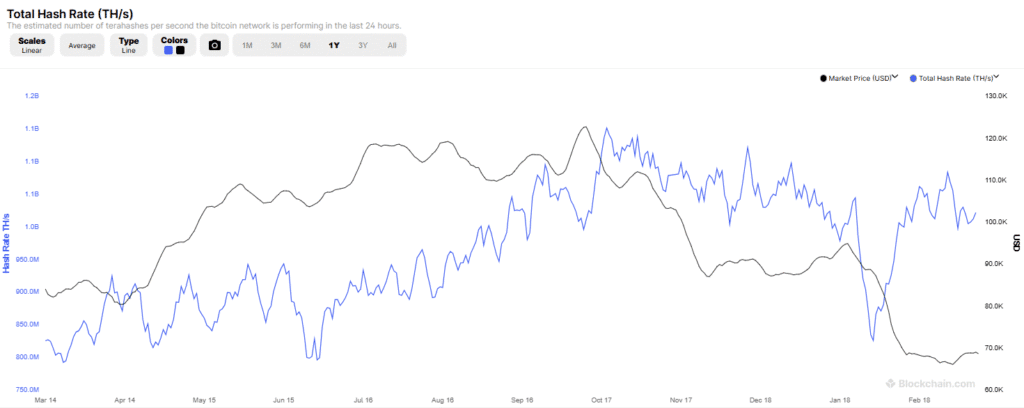
Bitcoin hashrate (Source: Blockchain.com)
While the reduction remains too small to materially affect network security, it has introduced new questions about how miners balance hash generation against non-Bitcoin revenue opportunities.
Mining Expansion Continues Despite Diversification
Not all miners are reducing Bitcoin exposure.
Bitdeer Technologies Group is deploying 50,000 proprietary ASIC machines across 413 megawatts of infrastructure, a buildout that could add roughly 33 exahashes per second to the Bitcoin network.
At current market conditions, that level of deployment could generate hundreds of millions of dollars in additional annual Bitcoin revenue if operating efficiency targets are met.
The next major test for investors will likely come during first-quarter 2026 earnings reports, where markets are expected to focus less on mined Bitcoin totals and more on power capacity disclosures, AI contract wins, and revenue tied to grid curtailment programs.
If miners continue proving they can monetize both hash rate and compute demand, the valuation gap between crypto mining firms and traditional infrastructure operators may become increasingly difficult for markets to ignore.


