
Quantum Fears Over Bitcoin Are Overblown, Says CoinShares
While the rise of quantum computing has long been framed as a looming “doomsday” scenario for cryptocurrency, a new analysis from CoinShares suggests the threat may be significantly overstated.
Christopher Bendiksen, Bitcoin research lead at CoinShares, argues that the vast majority of the Bitcoin network remains insulated from quantum attacks, with only a tiny fraction of existing supply residing in vulnerable addresses.
In a recent post, CoinShares Bitcoin research lead Christopher Bendiksen downplayed concerns that quantum computers could soon compromise the integrity of the Bitcoin market.
According to Bendiksen’s analysis, only a small fraction of Bitcoin is held in wallets vulnerable to quantum computing attacks.
Quantum Vulnerabilities in Bitcoin Wallets
Bendiksen estimates that 10,230 out of 1.63 million BTC are stored in wallet addresses with publicly visible cryptographic keys that are susceptible to quantum computing attacks.
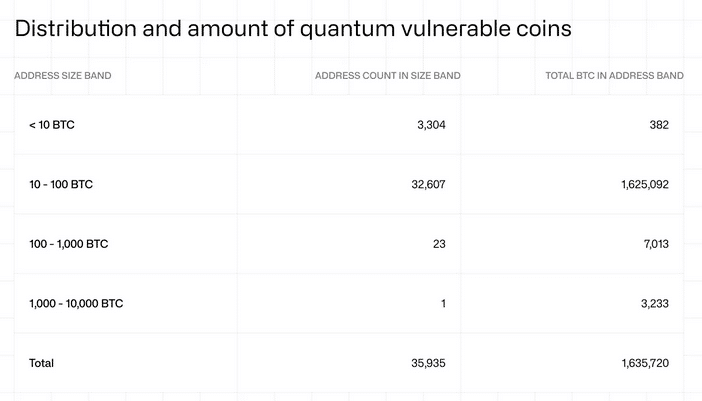
Distribution of coins that are vulnerable to quantum computing (Source: CoinShares)
The majority of the BTC (1.62 million) is held in wallets with holdings under 100 BTC, which Bendiksen claims would each take over a millennium to unlock, even in the most optimistic scenario.
Quantum Algorithms: A Theoretical Risk
Bendiksen emphasizes that the theoretical risks stem from quantum algorithms such as Shor’s and Grover’s, which could potentially break Bitcoin’s elliptic-curve signatures and weaken SHA-256.
However, he argues that neither algorithm can alter the network’s 21 million supply cap or bypass proof-of-work, two fundamental features of the Bitcoin network.
Quantum Fears Divide the Bitcoin Community
The issue has sparked debate among Bitcoin enthusiasts, with some, like Strategy executive chairman Michael Saylor and Blockstream CEO Adam Back, believing that quantum threats are overstated and will not disrupt the network for decades.
Bendiksen shares those views, stating that cracking Bitcoin’s cryptography would require millions of fault-tolerant qubits – far beyond current technological capabilities.
On the other hand, some experts, such as Capriole Investments founder Charles Edwards, view quantum computing as a potential “existential threat” to Bitcoin.
Edwards suggests that an upgrade is needed now to strengthen network security, which could involve the adoption of post-quantum signatures.


