CME’s Bitcoin Futures Dominance Slips as Binance Pulls Ahead
Binance has overtaken the Chicago Mercantile Exchange as the largest venue for Bitcoin futures open interest, signaling a shift in derivatives market dynamics as institutional arbitrage activity fades and retail-driven trading remains firm.
According to data from CoinGlass, Binance now holds roughly 124,620 BTC in open interest, representing about $10.98 billion in notional value. This edges out the CME Group, which currently stands at approximately 123,040 BTC, or close to $10.83 billion.
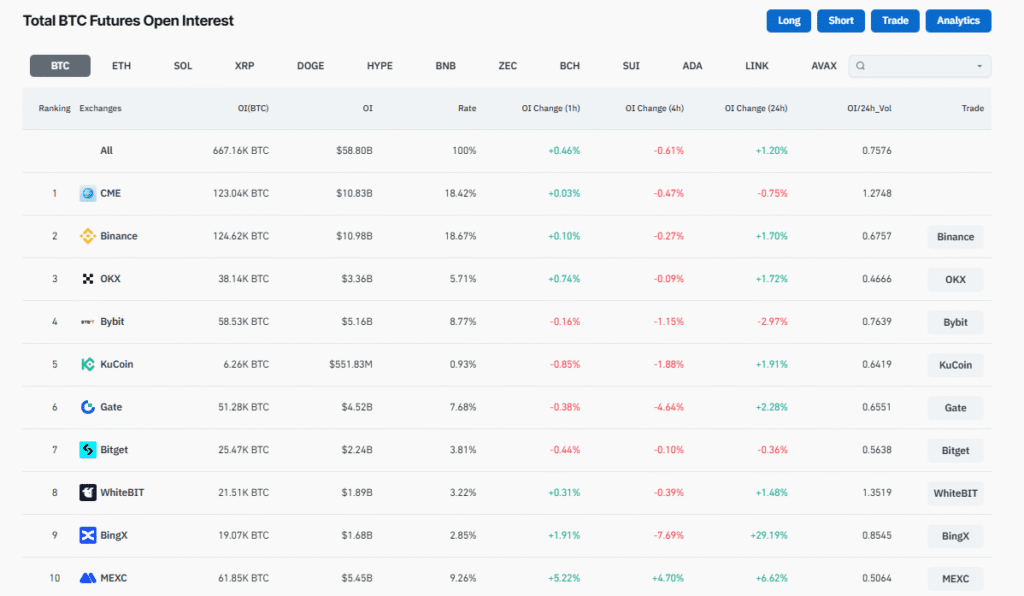
Total BTC Futures Open Interest (Source: CoinGlass)
The change marks the end of a period in which CME dominated BTC futures positioning, largely on the back of institutional demand tied to arbitrage strategies and spot ETF-related flows.
CME Open Interest Slips as Basis Trade Returns Compress
CME’s decline has been gradual but persistent. The exchange began the year with around 175,000 BTC in open interest, a level that has steadily eroded as the profitability of the basis trade weakened.
The basis trade involves purchasing spot Bitcoin while simultaneously selling futures contracts to capture the price premium between the two markets. When futures trade at a meaningful premium, the strategy can generate relatively stable, yield-like returns for hedge funds and proprietary trading firms.
That premium has narrowed considerably. Data from Velo shows that the annualized basis rate on CME bitcoin futures has compressed to roughly 5%. This is a sharp decline from just over a year ago, when the basis surged to around 15% as BTC prices rallied toward $100,000 following President Donald Trump’s election victory.
At its peak, CME open interest reached a record 200,000 BTC, reflecting heavy institutional positioning to capitalize on those elevated spreads.
Market Efficiency Shrinks Arbitrage Opportunities
The compression of the basis sheds light on the growing efficiency of Bitcoin’s derivatives markets. As more capital crowded into the same arbitrage trades, excess returns were competed away, reducing the incentive for institutions to maintain large futures positions on CME.
With spot and futures prices now closely aligned, many basis traders have scaled back exposure or shifted capital to other strategies offering better risk-adjusted returns. The result has been a steady drawdown in CME open interest throughout the year.
CME had held the top position in global BTC futures open interest since November 2023, supported by institutional positioning ahead of the launch of U.S. spot Bitcoin ETFs in January 2024. This structural advantage, at least for now, has faded.
Binance Open Interest Holds Steady on Retail Demand
While CME activity has cooled, Binance’s open interest has remained relatively stable. Analysts attribute that resilience to the exchange’s strong appeal among retail traders and short-term speculators, who are more likely to take directional bets on BTC’s price rather than engage in yield-driven arbitrage.
Binance offers a wide range of perpetual and futures products with higher leverage and deep liquidity, making it a preferred venue for traders positioning for near-term price moves. Even as volatility has declined from last year’s highs, retail participation has continued to support open interest on the platform.
The contrast suggests a growing split within the Bitcoin derivatives market: regulated venues like CME catering primarily to institutional strategies tied to efficiency and yield, and offshore exchanges like Binance capturing speculative and momentum-driven flows.
What the Shift Signals for Bitcoin Derivatives
The loss of CME’s top ranking does not necessarily signal a broader institutional retreat from Bitcoin futures. Instead, market participants see it as a recalibration following an unusually profitable phase for basis trading.
Should volatility rise again or futures premiums widen, CME could quickly regain ground, particularly if institutions re-enter arbitrage trades at scale. For now, however, Binance’s lead reflects a market environment where speculative positioning is playing a larger role than institutional yield strategies.
As Bitcoin’s derivatives ecosystem matures, shifts in open interest leadership may become more frequent, driven less by structural adoption milestones and more by changing market conditions and trader behavior.


