JPMorgan Launches $100M Tokenized Money-Market Fund on Ethereum
JPMorgan Chase, one of the world’s largest banks with approximately $4 trillion in assets under management, is expanding its footprint in blockchain-based finance with the launch of a tokenized money-market fund on Ethereum.
The move comes amid growing institutional demand for onchain financial products that combine traditional investment structures with the efficiency of blockchain infrastructure.
The product, called the My OnChain Net Yield Fund, or MONY, is JPMorgan’s first tokenized money-market fund and makes it the largest Global Systemically Important Bank (GSIB) to introduce such a vehicle on a public blockchain.
MONY Fund Seeded With $100 Million
MONY is seeded with $100 million from JPMorgan’s asset management division and is set to open to external, qualified investors this week, the Wall Street Journal reported. Access will be limited to eligible investors with a minimum investment requirement of $1 million.
Like traditional money-market funds, MONY will hold short-term debt instruments and accrue interest daily. Investors will be able to redeem shares using either cash or Circle’s USDC stablecoin, offering flexibility for both conventional and crypto-native settlement preferences.
Joining a Growing Wave of Tokenized Funds
JPMorgan’s launch places it among a growing roster of traditional finance giants embracing tokenization, particularly in the money-market fund segment.
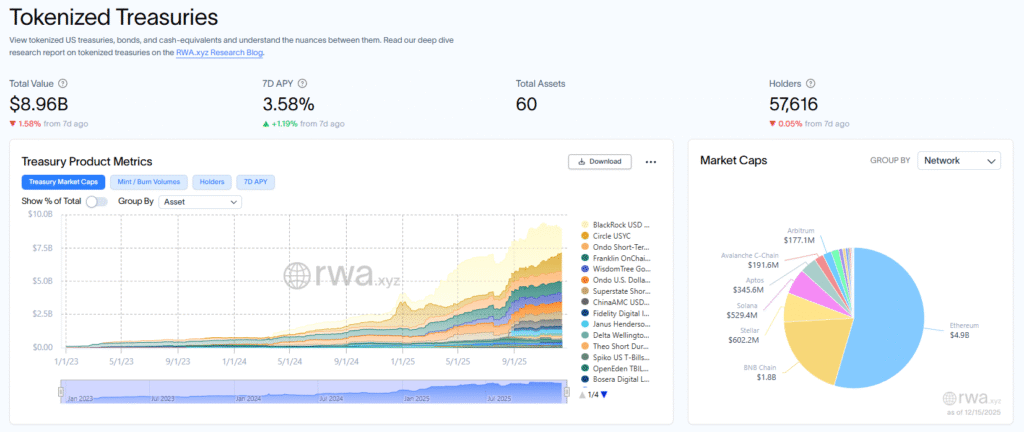
Franklin Templeton was an early mover in the space with the launch of its BENJI fund in 2021. BlackRock followed in 2024 with its BUIDL fund, developed in partnership with tokenization firm Securitize, which has since attracted roughly $2 billion in assets, according to data from RWA.xyz.
Tokenized treasuries market (Source: RWA.xyz)
Money-market funds have emerged as a leading use case for tokenization because they offer a familiar, relatively low-risk product that can benefit immediately from blockchain features such as faster settlement and continuous trading.
Also read: DeFi Fires Back at Citadel as Wall Street Pushes SEC to Rein In Tokenized Markets
Why Institutions Are Turning to Tokenization
Tokenized money-market funds allow investors to park idle cash directly on blockchain networks while earning yield, mirroring the function of traditional money-market funds but with added efficiencies.
The products offer near-instant settlement, 24/7 trading, and real-time visibility into ownership, features that are increasingly attractive to institutional investors operating across global markets.
Beyond yield generation, tokenized funds are also finding new roles within decentralized finance. They are being used as reserve assets for DeFi protocols and as collateral in trading and asset management strategies, further blurring the line between traditional finance and onchain markets.
Also read: Crypto Asset Manager CoinShares Sees Bitcoin and Tokenization Reshaping Finance by 2026
A Rapidly Expanding Market
The growth of tokenized money-market funds has been swift.
According to RWA.xyz, the asset class has expanded to approximately $9 billion, up from about $3 billion a year ago. More broadly, the market for tokenized real-world assets could reach $18.9 trillion by 2033, according to a joint report from Boston Consulting Group and Ripple.
“There is a massive amount of interest from clients around tokenization,†said John Donohue, head of global liquidity at JPMorgan Asset Management, in comments to the Wall Street Journal.
Also read: BlackRock CEO Larry Fink Compares Tokenization’s Impact to the Early Days of the Internet
Built on JPMorgan’s Kinexys Platform
MONY is built on Kinexys Digital Assets, JPMorgan’s in-house tokenization platform. The fund is expected to serve as a test case for expanding the bank’s suite of onchain investment products and exploring how traditional asset management offerings can operate on public blockchains at scale.
“Tokenization can fundamentally change the speed and efficiency of transactions, adding new capabilities to traditional products,†Donohue said in a statement. “We believe that financial products will increasingly transact this way, and we’re excited about the opportunities this creates for our clients and for the whole industry.â€


