
Bitcoin’s Biggest Shift Yet? Cathie Wood Says Institutions Have Changed Everything
Ark Invest CEO Cathie Wood is challenging one of Bitcoin’s longest-standing assumptions: that the crypto asset still follows a predictable four-year cycle driven by its halving events.
Speaking with Fox Business on Tuesday, Wood argued that a new era of institutional adoption is fundamentally changing how Bitcoin behaves, from its volatility to the depth of its market corrections.
Wood said Bitcoin’s historically severe crashes—often between 75% and 90% during earlier bear markets—are becoming increasingly unlikely as major financial players accumulate the asset.
“The volatility’s going down,†she noted, adding that institutions “are going to prevent much more of a decline.†She went as far as to suggest that “we may have seen the low a couple of weeks ago,†signaling confidence that the worst of Bitcoin’s recent downturn is behind it.
Her comments represent a sharp break from more than a decade of market tradition.
Bitcoin’s price cycles have long been viewed as tightly correlated with its halving events, which occur roughly every four years and reduce miner rewards. The most recent halving on April 20, 2024, cut the block reward to 3.125 BTC, a shift historically associated with supply squeezes and powerful rallies. But Wood argues that those dynamics no longer dominate Bitcoin’s long-term direction.
Also read: $10 Million Bitcoin Is Possible, Saylor Says — If Corporations Keep Buying
Instead, she said, Bitcoin is now trading more like a risk-on asset that responds to macroeconomic forces. In contrast, she described gold as “more of a risk-off asset,†one that investors increasingly rely on to hedge geopolitical risks.
Ark Invest has continued expanding its crypto footprint regardless of near-term price swings, recently adding to positions in Coinbase, Circle, and the Ark 21Shares Bitcoin ETF (ARKB).
A Growing Debate Over Whether the Cycle Still Exists
Wood’s remarks land at a time when the industry is already locked in a heated discussion about whether Bitcoin’s halving rhythm has been neutralized.
Standard Chartered suggested this week that ETF demand has significantly reduced the halving’s influence, calling the once-reliable pattern of peaks occurring 18 months post-halving “no longer valid.†The bank lowered its 2025 Bitcoin price target from $200,000 to $100,000.
Others have gone further. Bitwise CIO Matt Hougan and CryptoQuant founder Ki Young Ju both insist the cycle has been erased entirely.
For years, Bitcoin followed a familiar pattern: a quiet accumulation phase, halving-driven supply tightening, a euphoric rally to new highs, and then a prolonged multi-year bear market. But this time, after Bitcoin peaked at $122,000 in July, the behavior appears different—steadier, slower, and less dependent on retail speculation.
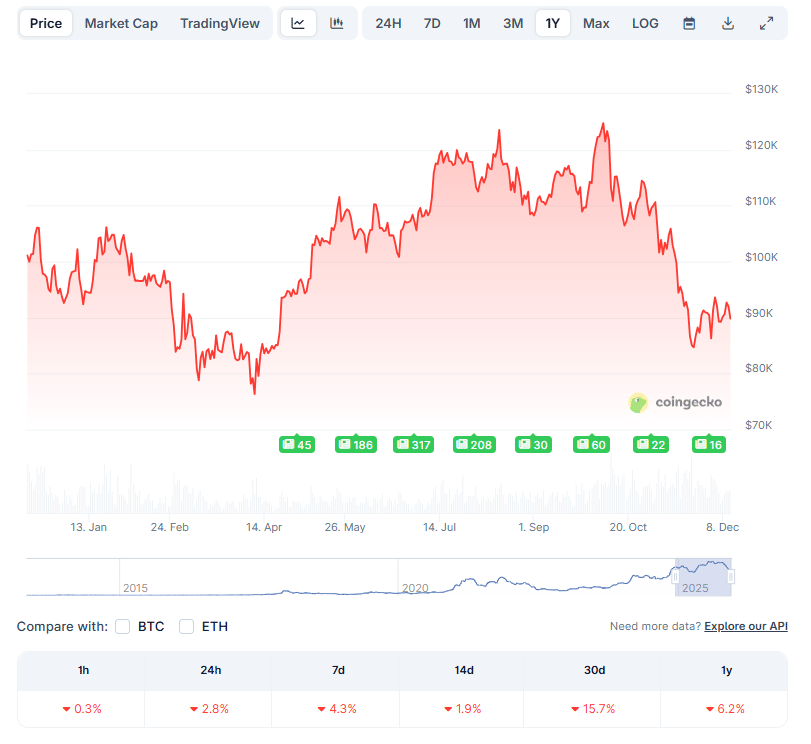
BTC price performance in the last year (Source: CoinGecko)
Some point to long-term models like the Bitcoin Power Law, which suggests that price growth follows a broad trajectory influenced largely by time rather than fixed four-year windows.
Sentora executive Patrick Heusser said halvings still matter, but only as “interruptions within a broader trend.†He added that reducing daily supply by 450 BTC is minor in the context of a trillion-dollar market and the billions flowing into spot ETFs.
Also read: World’s ‘Smartest Man’ Says Bitcoin Will Replace the Dollar by 2026 — Economists Push Back
That institutional accumulation is widely considered the biggest force reshaping Bitcoin’s structure. ETF providers, corporate treasuries, and regulated funds tend to buy and hold rather than trade aggressively, removing liquidity from the market and dampening both volatility and the scale of downturns.
Why Some Analysts Still Believe the Cycle Is Alive
Not everyone agrees with Wood’s outlook.
Analytics firm Glassnode argues that, even with new market participants, Bitcoin’s long-term structure remains consistent with past cycles. In an August report, the firm said long-term holder behavior still mirrors prior market peaks and that the timing of current trends tracks closely with earlier multi-year trajectories.
While opinions diverge, many experts now suspect that the four-year cycle is not disappearing but evolving. Instead of dramatic crashes and euphoric peaks, analysts expect longer, smoother trends—both upward and downward. Drawdowns may be shallower, around 30% to 50% rather than the brutal collapses of earlier cycles, though rallies may also take more time to materialize.
Macro strategist Lyn Alden recently said Bitcoin lacks the euphoric sentiment typical of tops, making a severe collapse less likely. She expects the asset to reclaim $100,000 by 2026 but cautioned that the journey will be uneven, shaped less by halvings and more by macro trends, liquidity conditions, and institutional flows.
As the debate intensifies, one thing seems clear: Bitcoin is no longer the same market it was a decade ago, and the assumptions that defined it may be slipping into the past. Whether the cycle is dead or merely transforming, investors appear headed for an era where long-term forces overshadow four-year predictability.


