
Twenty One Capital Stumbles Out of the Gate as Shares Drop 20%
Shares in Twenty One Capital (XXI), one of the most anticipated crypto-linked public debuts of the year, tumbled nearly 20% in their first full trading session after the company completed its merger with blank-check firm Cantor Equity Partners.
The new company opened trading on Tuesday at $10.74, well below Cantor’s prior closing price of $14.27 before the merger. By Wednesday’s close, the stock had settled at $11.42, representing a 19.97% decline over 24 hours.

Twenty One Capital share price (Source: Yahoo Finance)
A modest rebound in after-hours trading later lifted the price about 2.2% to roughly $11.92, giving the company a market capitalization near $4 billion based on outstanding shares.
A High-profile Launch Meets Market Reality
Twenty One entered the public markets with substantial fanfare, backed by a powerful trio of crypto and financial heavyweights, including stablecoin issuer Tether, crypto exchange Bitfinex, and Japan’s SoftBank Group.
Leadership is held by Jack Mallers, the founder and CEO of Bitcoin payments platform Strike, who now also serves as Twenty One’s chief executive.
Despite the stock’s weak debut, the company brings one of the largest Bitcoin balance sheets of any publicly traded firm.
Twenty One holds more than 43,500 BTC—worth over $4 billion at current prices—making it the third-largest corporate holder of Bitcoin behind mining giant MARA Holdings.
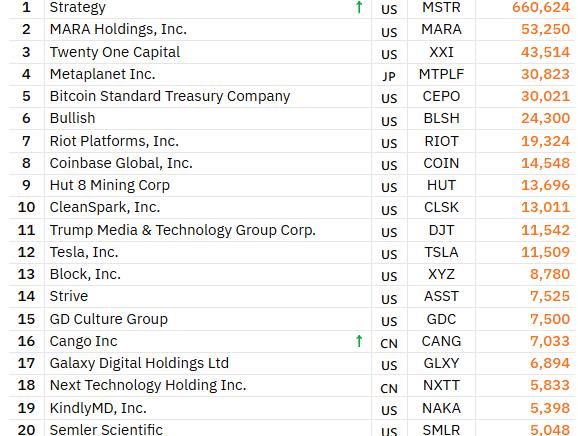
Top 20 largest corporate BTC holders (Source: Bitcoin Treasuries)
Not Just Another Bitcoin Treasury, Mallers Says
Even with its massive digital asset hoard, Twenty One is pushing back against being grouped with the growing wave of so-called crypto treasury companies.
Appearing on CNBC’s “Money Movers,†Mallers emphasized that the firm should not be valued simply as a passive Bitcoin holder.
“We don’t want the market to think of us and price us as just a treasury asset,†Mallers said. “We do have a lot of Bitcoin, but we’re also building a business.â€
He added that the company is developing a full operating platform with the goal of generating recurring cash flow, pointing to potential moves into brokerage services, exchange infrastructure, and Bitcoin-based credit and lending.
However, Mallers declined to provide detailed timelines or specific product announcements, saying only that more clarity would come “sooner rather than later.â€
Crypto Treasury Companies Feel the Market Shift
Twenty One’s debut comes amid a growing number of U.S.-listed companies adopting Bitcoin-centric balance sheet strategies, following the model popularized by Strategy under Michael Saylor.
For much of the year, those firms benefited from surging Bitcoin prices and strong speculative interest as BTC climbed to a new high in October.
That enthusiasm has since cooled. A broader pullback in the crypto market has dragged down shares of companies with heavy digital-asset exposure, including miners, exchanges, and treasury-style firms. The sharp decline in Twenty One’s first trading session reflects that shift in sentiment, even in the face of significant backing and large BTC holdings.
Investors also appear cautious about the uncertainty surrounding Twenty One’s actual operating model.
While Mallers maintains the firm will expand well beyond holding Bitcoin, the absence of specific product roadmaps has left the market to largely value the company as a leveraged bet on BTC’s price movements—for now.
Bitcoin Still Central to the Strategy
Despite the early volatility, Mallers made clear that Bitcoin remains the company’s foundational thesis.
“We see Bitcoin as the forest through the trees,†he said on CNBC. “It is the opportunity, and no one is seemingly focused on it. The story of this equity is to focus solely on Bitcoin and deliver value to shareholders primarily through Bitcoin.â€
His comments echo the broader narrative driving many of the latest crypto treasury firms, including a recent move by Vivek Ramaswamy’s firm Strive to pursue a $500 million capital raise aimed at expanding Bitcoin exposure.
For Twenty One Capital, the coming months will be critical. With one of the largest corporate Bitcoin reserves in the world and a high-profile leadership team, expectations remain elevated. But after a rocky market debut, investors will be watching closely for concrete evidence that the firm can deliver on its promise to become a revenue-generating Bitcoin operating company—rather than just another vault tied to crypto price cycles.


