
SUI Price Falters at Local Lows—Here’s What the Chart Says Next
Sui (SUI) is showing signs of exhaustion on the 1-day chart after several sessions of muted price action and gradually declining momentum.
Traders have been unable to push above short-term moving averages, while broader trend indicators continue to lean bearish. This tightening structure reflects a market stuck between heavy overhead supply and weakening buyer interest, setting the stage for a decisive directional move in the coming days.
Momentum Indicators Point Toward Ongoing Weakness
SUI’s daily candles have been unable to reclaim the short-term momentum zone represented by the 9-day EMA, which continues to slide sideways to slightly lower. This indicates that buyers are failing to establish control even on short timeframes.
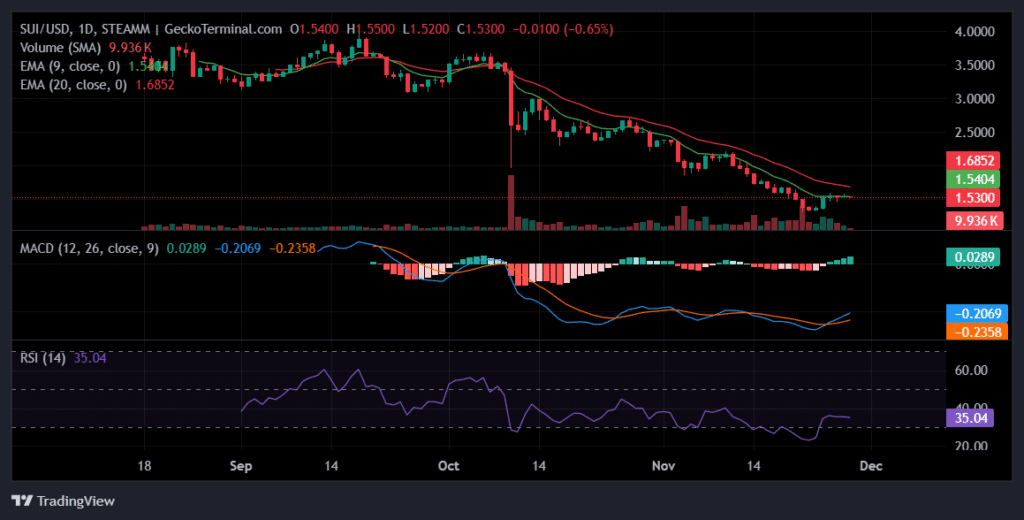
Daily chart for SUI/USD (Source: GeckoTerminal)
At the same time, the 20-day EMA remains meaningfully above current price levels, showing that the broader trend structure continues to shift downward.
The MACD also reinforces that directional bias. While its histogram has been showing incremental improvements — a sign that bearish momentum is losing force — the indicator remains in negative territory. This typically signals that even though selling pressure may be slowing, the market has yet to generate a convincing bullish catalyst capable of reversing the prevailing trend.
The RSI hovering in the mid-30s further confirms a zone of weakness. Although not deep into oversold territory, it reflects a market where buyers are cautious and sellers remain slightly in control. Historically, this range often precedes either a relief bounce or continued grinding lower if structural support gives way.
Critical Resistance Zones Could Cap SUI Rallies
If SUI attempts a recovery, it will immediately face a dense cluster of overhead supply. The nearest resistance sits at $1.743, followed by $1.856 and a larger macro barrier at $2.0828. All of these levels coincide with prior breakdown areas where traders previously distributed tokens, making them psychologically and technically significant.
A sustained move above the first resistance zone would be needed to meaningfully shift sentiment. Without such a break, rallies are likely to be short-lived and potentially used as opportunities for sellers to re-enter.
Support Levels and Market Vulnerabilities
On the downside, SUI’s most important supports rest at $1.3451, $0.8117, and $0.7606. The top of this stack is especially critical because losing it would place the price deep into a high-risk zone.
The market has already been showing difficulty establishing higher lows, suggesting that any break of structural support may accelerate downside momentum.
These levels also align with major order-book walls, which are currently holding back a sharper decline.
SUI Order Book Analysis: Key Walls Defining Short-Term Movement
The order book shows buyers attempting to defend the current range, but the weight of sell-side liquidity above the price continues to restrict upside movement.
Bid Walls (Support Liquidity)
• A major bid wall at $1.35000 contains over 350k SUI. If this wall breaks, the price could quickly shed nearly 12%, sending SUI toward deeper support territory.
• A secondary bid wall at $1.49000 and a near-term wall at $1.52520 show buyers attempting to hold the SUI price above recent lows, but the liquidity here is lighter and more vulnerable to a sell-side push.
Ask Walls (Resistance Liquidity)
• Two nearby ask walls at $1.53960 and $1.54210 continue to cap the price. Clearing both would provide a small window for a short-term bounce.
• A larger ask wall at $1.65000 is positioned to halt any mid-range rally. If broken, it could unlock a move of nearly 8% toward the next resistance cluster.
The overall balance of the order book suggests sellers have the advantage until the closest ask walls are removed.
Potential Trade Setups
Bullish (Long) Scenario
A safer long setup would require SUI to reclaim and hold above the dense sell-side liquidity between $1.539–$1.543. Clearing this area would signal renewed short-term momentum and open the door toward the $1.650 zone.
More conservative traders may wait for a daily close above $1.743 — the first major resistance — which would confirm a more meaningful shift in structure.
Bearish (Short) Scenario
Short opportunities may emerge if the price fails to break above the nearby ask walls or if the $1.49000 bid wall collapses.
A breakdown beneath $1.35000 would be a high-conviction signal of extended downside continuation, targeting the deeper supports around $0.8117 and $0.7606. The weakening momentum indicators support caution for longs until these downside risks clear.
Outlook
SUI currently leans bearish, but fading downside momentum hints that a short-term bounce is possible if immediate sell-side liquidity is absorbed.
Nevertheless, the broader trend remains under pressure, and unless key resistance levels flip, the market is vulnerable to deeper declines.
Disclaimer: The information presented in this article is for informational and educational purposes only. It does not constitute financial advice. Ecoinimist is not responsible for any losses incurred. Readers should exercise caution before acting on this content.


