
Bernstein Says Bitcoin’s 25% Crash Isn’t a Peak — ‘This Cycle Is Different’
Bitcoin’s roughly 25% decline from its Oct. 6 all-time high of around $126,000 has rekindled fears of a deeper reversal reminiscent of past crypto market peaks. But analysts at research and brokerage firm Bernstein argue that the current selloff looks far more like a brief reset than the beginning of another severe bear cycle.
In a note to clients on Monday, Bernstein’s crypto research team — led by Gautam Chhugani — said the market is being weighed down by investor anxiety around bitcoin’s historical four-year cycle pattern.
Previous peaks in 2013, 2017, and 2021 have conditioned market participants to expect late-cycle weakness heading into the fourth quarter, particularly in the year before a U.S. presidential election. That fear, the analysts say, is helping drive a self-fulfilling wave of profit-taking.
Yet despite the historical comparisons, Bernstein believes today’s environment looks fundamentally stronger than in previous cycles. Instead of signaling a looming 60%–70% collapse — the magnitude of drawdowns seen in earlier eras — the firm said current data points to “a relatively shallow correction†that could soon establish a new local bottom.
Also read: Bitcoin Weakens on the Charts but Extreme Fear Sparks November Rally Hopes
Supply Absorption and Institutional Buyers Take Center Stage
One of the strongest arguments behind Bernstein’s optimistic view is the market’s ability to absorb large amounts of long-term holder supply.
According to the note, roughly 340,000 BTC (around $38 billion) sold by investors who held their coins for at least a year has been almost entirely matched by inflows into spot bitcoin ETFs and corporate treasuries. About $34 billion of new demand has come through these channels in the last six months — evidence, the analysts argue, that institutional buyers are stepping in aggressively.
That dynamic stands in stark contrast to previous cycle tops, when new supply overwhelmed demand and long-term holders sharply reduced their exposure. This time, the analysts said, selling pressure appears to be counterbalanced by buyers with stronger, more durable conviction.
Bitcoin is currently flat on the year but remains up roughly 100% over the past three years, according to CoinMarketCap data.
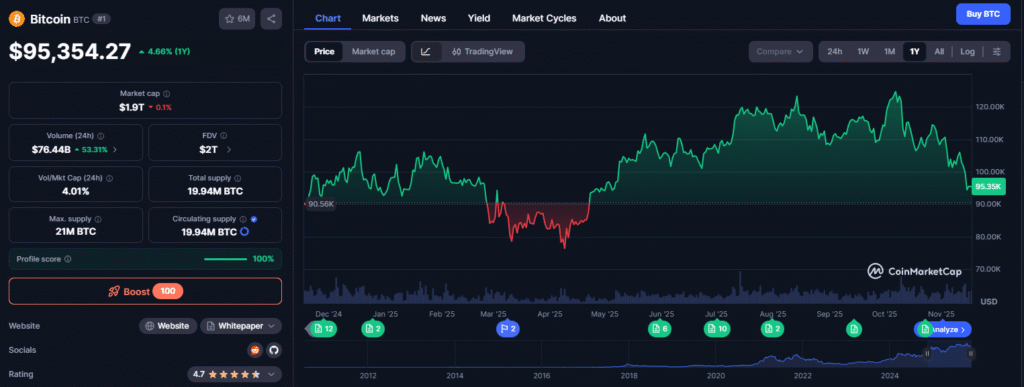
BTC price performance over the past year (Source: CoinMarketCap)
Despite the recent turbulence, its longer-term trajectory remains intact — a key point the Bernstein team emphasized in arguing that the market is not repeating its prior boom-and-bust patterns.
ETF Ownership Becomes More ‘Consistent’
Bernstein highlighted another structural shift: the rising institutional ownership of bitcoin ETFs.
Institutional investors held about 20% of ETF supply at the end of 2024. Today, according to the analysts, that share has risen to 28%, even as the products saw approximately $3 billion in net outflows over the last three weeks.
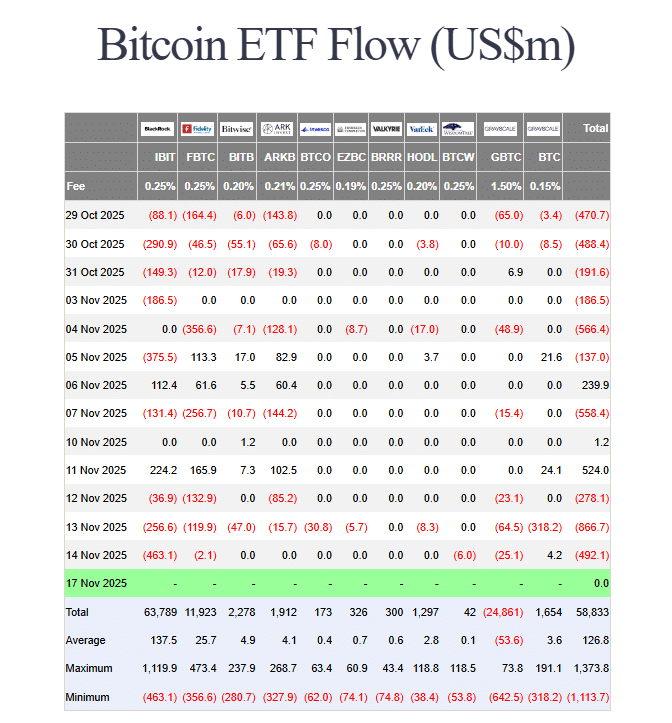
US spot BTC ETF flows (Source: Farside Investors)
Total ETF assets under management remain near $125 billion — a level the firm described as a sign of “higher quality and consistent ownership.â€
In their view, these holders are less sensitive to short-term volatility, meaning the probability of a cascading selloff appears lower than in previous cycles dominated by speculative retail flows.
Strategy’s Balance Sheet Remains Intact Despite Market Worries
Bernstein also addressed a growing topic among traders: concerns that Strategy — the publicly traded bitcoin-treasury company formerly known as MicroStrategy — may be forced to sell some of its holdings if bitcoin continues to fall.
The analysts dismissed those fears. Citing the company’s management, they reiterated that Strategy does not intend to sell a single bitcoin.
The firm currently carries about $8 billion in debt against $61 billion in bitcoin holdings, a leverage profile Bernstein described as conservative. They added that the company’s dividend is “well covered†by its treasury, and that it still has options to raise additional capital through its at-the-market equity programs.
“We expect Strategy to continue buying more bitcoin through this market correction,†they wrote, framing the company’s strategy as a source of continued structural demand.
Also read: Morgan Stanley Warns Bitcoin Entering ‘Fall Season’ — Says It’s Time to Harvest Profits
Stronger Political and Regulatory Tailwinds Ahead
Beyond market flows, Bernstein pointed to macro and policy dynamics that could provide meaningful support for digital assets in the coming year.
The analysts noted that the Trump administration has signaled strong political backing for crypto, calling it a strategic priority. They also expect federal market-structure legislation — including the Clarity Act — to advance in late 2025 or early 2026.
Meanwhile, they said the liquidity environment is becoming more favorable as interest rates continue to trend lower, reducing pressure on risk assets and improving funding conditions across the industry.
Crypto-related equities also performed strongly in the third quarter. Companies including Coinbase, Robinhood, Figure, and Circle all beat estimates — a trend Bernstein interprets as a reflection of robust institutional engagement.
The analysts described tokenization and stablecoins as the “two mega trends of this crypto cycle,†both of which continue to attract corporate adoption and venture-capital interest.
A Bottom Near $80,000?
Looking ahead, Bernstein said the market “does not feel like a cycle-peak†but instead appears to be following a multi-year trend characterized by expanding institutional participation, periodic corrections, and steadier overall market structure.
They are watching closely to see whether bitcoin establishes a new bottom near the $80,000 range — the level seen after last year’s U.S. presidential election.
If that occurs, the analysts argue, the current pullback may ultimately be viewed as a buying opportunity. With demand from ETFs, corporates, and long-term institutional allocators remaining firm, they believe bitcoin and crypto-equity valuations could see renewed strength as 2026 approaches.
For now, the message from Bernstein is clear: despite elevated fear and familiar market narratives, this correction does not look like the start of a long winter — but rather a recalibration in an increasingly mature, institution-driven market.


