BlackRock’s $2.5B BUIDL Fund Expands to Binance and BNB Chain in RWA Breakthrough
BlackRock’s fast-growing tokenized U.S. Treasury fund, BUIDL, has taken another significant leap into mainstream crypto finance.
The fund — issued by tokenization platform Securitize — will now be accepted as collateral for institutional trading on Binance, the world’s largest cryptocurrency exchange by volume, the companies announced in a Friday press release.
The integration marks one of the clearest signals yet that tokenized real-world assets (RWAs) are moving from experimental finance to core trading infrastructure.
By enabling BUIDL to function as off-exchange collateral, Binance is giving institutional traders a compliant way to deploy yield-bearing assets without locking them directly on the exchange.
A Shift Toward Off-Exchange Collateralization
Traditionally, traders must post collateral directly on centralized exchanges, exposing them to custody risks and limiting their ability to earn yield while assets sit idle.
Binance’s new setup allows institutions to custody BUIDL with a third-party provider and still use it as live margin for trading activity on the platform.
Also read: BlackRock CEO Larry Fink Says We’re Entering the Tokenized Age of Finance
This separation of trading activity from custody — a structure increasingly favored by regulators and institutions — offers a way to reduce counterparty risk while improving capital efficiency.
“Our institutional clients have asked for more interest-bearing stable assets they can hold as collateral while actively trading on our exchange,†said Catherine Chen, head of VIP & Institutional at Binance. “Being able to post BUIDL achieves both goals.â€
Expanding Across Chains and Into DeFi
Alongside the Binance announcement, Securitize revealed that BUIDL will also be expanding to BNB Chain, the blockchain ecosystem closely linked to the exchange. The move significantly increases interoperability, allowing BUIDL to plug directly into decentralized finance applications across the BNB Chain ecosystem.
This opens new possibilities for institutions and advanced users to deploy the asset in lending protocols, on-chain liquidity systems, or as a reserve asset in DeFi designs.
Tokenized U.S. Treasuries have quickly become one of the fastest-growing categories in on-chain finance.
As more protocols and trading venues integrate them, these instruments are turning into a new layer of financial plumbing for the blockchain economy — a digital equivalent of the traditional “cash-like†collateral markets that underpin global finance.
RWAs Move From Concept to Core Market Infrastructure
From tokenized credit to tokenized sovereign debt, real-world assets have surged in popularity as crypto platforms search for stable, yield-bearing instruments.
In 2024 and 2025, tokenized funds, bonds, and lending structures have increasingly become essential components of DeFi protocols, market-making strategies, and institutional custody products.
Treasury-backed RWAs, in particular, have stood out because they mirror one of the most established foundations of traditional finance: U.S. government debt.
“By enabling BUIDL to operate as collateral across leading digital market infrastructure, we’re helping bring foundational elements of traditional finance into the onchain finance arena,†said Robbie Mitchnick, BlackRock’s global head of digital assets.
BUIDL’s Rapid Growth Makes It a Dominant RWA Product
Launched in March 2024, BUIDL has become the largest tokenized money market fund on public blockchains.
According to data from RWA.xyz, it has already accumulated $2.5 billion in assets, outpacing other major tokenized treasury products by a wide margin.
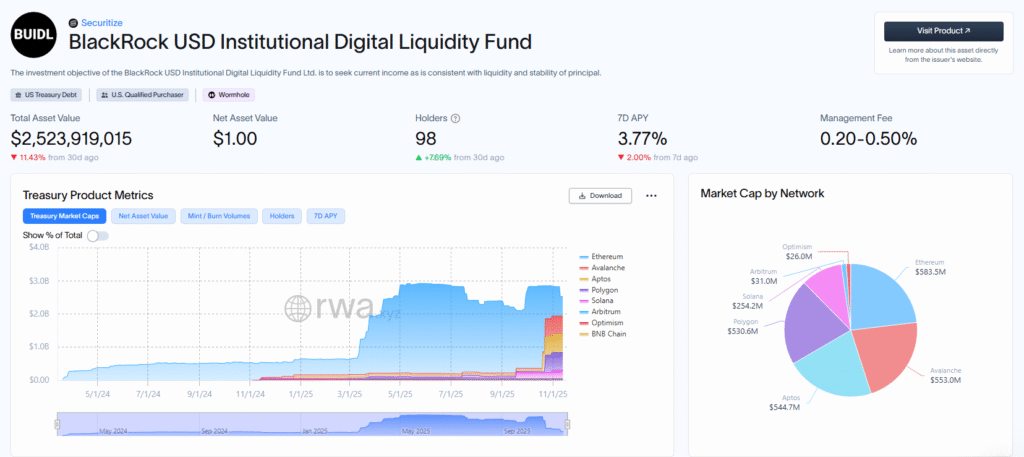
BUIDL overview (Source: RWA.xyz)
BUIDL pays out yield from the underlying U.S. Treasury holdings directly to token holders, making it attractive to institutions and crypto-native entities seeking low-risk returns without leaving the blockchain environment.
Its new role as Binance collateral is expected to further accelerate adoption as institutional desks look for ways to unlock capital efficiency while remaining compliant with strict custody and risk-management requirements.
A Defining Year for Tokenized Finance
BlackRock’s entrance into the tokenized asset ecosystem has been one of the strongest signals of institutional validation in the sector’s history. The combination of traditional asset reliability and blockchain interoperability is rapidly reshaping expectations around what modern finance can look like.
With Binance and BNB Chain now integrating BUIDL more deeply into their trading and DeFi ecosystems, tokenized treasuries are poised to become even more embedded across crypto markets.


