Bitfarms Says AI Could Outperform Bitcoin Mining as It Begins 2026–2027 Wind-Down
Publicly traded Bitcoin miner Bitfarms has announced a landmark strategic shift: it will wind down its Bitcoin mining operations and pivot into high-performance computing (HPC) and artificial intelligence (AI) infrastructure.
The decision, revealed on Thursday alongside the firm’s third-quarter earnings report, marks one of the most significant transformations yet among legacy crypto-mining companies as the industry faces rising operational costs and tightening margins.
The move follows another challenging quarter for Bitfarms. The company posted a net loss of $46 million in Q3 2025, nearly double the $24 million loss it recorded during the same period in 2024.
Executives attributed the worsening performance to ongoing pressures in the Bitcoin mining market, including heightened network difficulty, energy price volatility, and intensifying competition for block rewards.
A Strategic Pivot Toward AI Compute
Bitfarms CEO Ben Gagnon said the firm’s future lies not in mining Bitcoin, but in powering AI.
“We continue executing on our HPC/AI infrastructure development strategy with a fully funded supply chain and plan to convert our Washington site to support Nvidia GB300s with state-of-the-art liquid cooling,†Gagnon said in a statement.
Gagnon described the Washington facility—currently only a small fraction of the company’s total real estate footprint—as a proof point for the transformative economics of AI compute.
Also read: Fred Thiel Warns Bitcoin Mining Will Become a Battle for Cheap Power
“Despite being less than 1% of our total developable portfolio, we believe that the conversion of just our Washington site to GPU-as-a-service could potentially produce more net operating income than we have ever generated with Bitcoin mining,†he added.
The company will wind down its Bitcoin mining business over a multiyear period, with decommissioning expected to unfold gradually throughout 2026 and 2027. The shift places Bitfarms among a growing cohort of miners diversifying into GPU infrastructure as demand for AI computing surges and the economics of Bitcoin mining become increasingly strained.
A Strong Energy Portfolio Positions Bitfarms for the Transition
Bitfarms operates 12 data centers across North America, with a combined energy capacity of 341 megawatts (MW). Its extensive, low-cost energy footprint—previously its main competitive advantage in Bitcoin mining—has now become a powerful asset for entering the AI sector, where compute-hungry workloads require vast, reliable power supplies.
On the company’s Q3 earnings call, Gagnon emphasized confidence in the firm’s ability to redeploy its infrastructure.
“With consistent inbound demand for our sites, we have high conviction in the value of our unique energy portfolio, the demand for our power, and our ability to develop next-generation HPC and AI infrastructure,†he said.
In October, Bitfarms secured a $300 million debt facility to finance the build-out of its Panther Creek, Pennsylvania site, which it aims to transform into a high-density AI compute center. Management said the newly converted financing package will accelerate its efforts to meet rapidly rising demand for AI infrastructure across the United States.
Crypto Miners Face Market-Wide Sell-Off
Bitfarms’ announcement coincided with a broader downturn in crypto-related equities. Shares of BITF finished Thursday down roughly 18%, closing at $3.62. The decline extends what has been a brutal month for the stock, which has shed more than 51% of its value over the past 30 days.
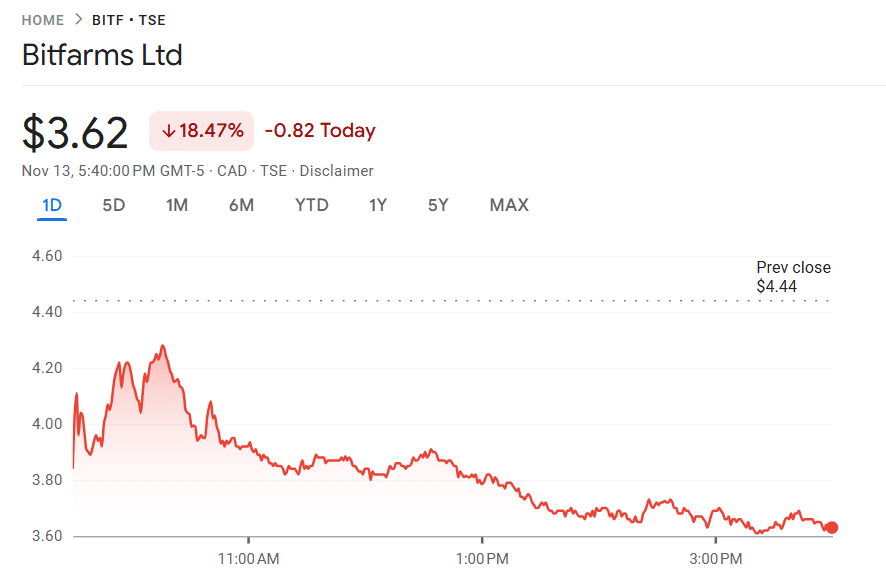
Bitfarms share price (Source: Google Finance)
Bitcoin miners have been among the hardest hit in the recent market dip, as BTC prices retrace and investor appetite for risk assets weakens. Rising mining difficulty and shrinking profit margins have amplified concerns about long-term sustainability among operators that remain committed solely to mining.
Bitfarms’ pivot sheds light on an increasingly common calculus among miners: the infrastructure required to mine Bitcoin can, in many cases, be more profitably applied to the rapidly expanding AI sector. Rather than dedicating compute power to securing the Bitcoin network, firms like Bitfarms are betting on the explosive growth of AI-driven demand for HPC resources.
Also read: Hive Digital Capacity Surges to 23 EH/s as It Prepares for AI Super Cycle
A New Identity for a Legacy Bitcoin Miner
While Bitfarms is far from the only mining company diversifying into AI, its decision to wind down Bitcoin mining altogether marks one of the most decisive shifts in the sector to date. The company is effectively redefining its core business model as it chases what it sees as a far more lucrative opportunity.
If the transition succeeds, Bitfarms could emerge as one of the more formidable players in the emerging AI compute infrastructure landscape—leveraging the same low-cost power strategy that once made it a competitive Bitcoin miner.
For now, however, investors appear cautious as the company navigates an inflection point. The coming quarters will reveal whether Bitfarms’ bet on AI can reverse its financial trajectory and position the company for a new era of growth beyond Bitcoin.


