
Hive Digital Capacity Surges to 23 EH/s as It Prepares for AI Super Cycle
HIVE Digital Technologies Ltd. (TSX.V: HIVE, Nasdaq: HIVE) has reached a defining milestone at the intersection of Bitcoin and artificial intelligence, announcing that it has achieved 23 Exahash per second (EH/s) in global Bitcoin-mining capacity — a staggering 283% increase year-to-date. The figure firmly establishes HIVE among the world’s top mining companies in 2026.
At the same time, the Vancouver-based company revealed the acquisition of an additional 32.5 acres of land in Grand Falls, New Brunswick, adjacent to its existing operations. The site will become the cornerstone of HIVE’s next phase of growth — a Tier III+ high-performance computing (HPC) and AI data-center campus capable of housing more than 25,000 next-generation GPUs.
The Future Belongs to Compute
The timing could not be more strategic.
The world is entering what HIVE calls the “AI super cycle†— a phase defined by insatiable demand for compute power. From generative AI to real-time data processing, organizations across every sector are scrambling for scalable, energy-efficient infrastructure to train and deploy increasingly powerful models.
Traditional data centers, designed for web hosting and storage, are struggling to keep up. The industry now requires liquid-cooled, high-density environments built specifically for GPUs — and that’s where HIVE sees its opportunity.
With years of experience in deploying and maintaining energy-intensive mining hardware, the company believes it already has the blueprint for next-generation AI facilities.
Frank Holmes, HIVE’s Co-Founder and Executive Chairman, described the transformation as a natural evolution.
“HIVE is a pioneer in repurposing stranded and surplus renewable energy for digital infrastructure,†he said. “We’re now turbocharging the transition from Bitcoin mining Tier I to Tier III+ HPC data centers in Canada and Sweden.â€
Grand Falls: The Heart of HIVE’s Next-Gen Expansion
The newly acquired Grand Falls property sits within one of Canada’s clean-energy corridors, powered largely by renewable hydroelectric resources. Purchased for CAD $2.3 million, the 32.5-acre site neighbors HIVE’s existing facility, which already operates 70 megawatts of Bitcoin-mining capacity with an 80 MW on-site substation owned outright by the company.
The strategic location — close to the Maine border — positions Grand Falls as a potential colocation hub for North American hyperscalers seeking reliable and affordable compute power.
Craig Tavares, President and COO of HIVE’s wholly-owned subsidiary, BUZZ HPC, called Grand Falls “the ideal convergence of Tier I and Tier III+ HPC data centers with clean power, scalability, and community partnership.†He emphasized that the facility is designed not just to expand HIVE’s infrastructure, but to anchor the company’s Canadian presence as it builds sustainable, high-density compute infrastructure for the AI economy.
From Bitcoin to AI: The Dual-Engine Model
For HIVE, Bitcoin mining remains the cash-flow engine that funds its larger ambitions. The company’s mining efficiency currently averages 17.7 J/TH, a strong performance given that global network difficulty has reached a record 156 trillion. With Bitcoin prices hovering near $102,000, HIVE reports mining margins exceeding 50% after electricity costs.
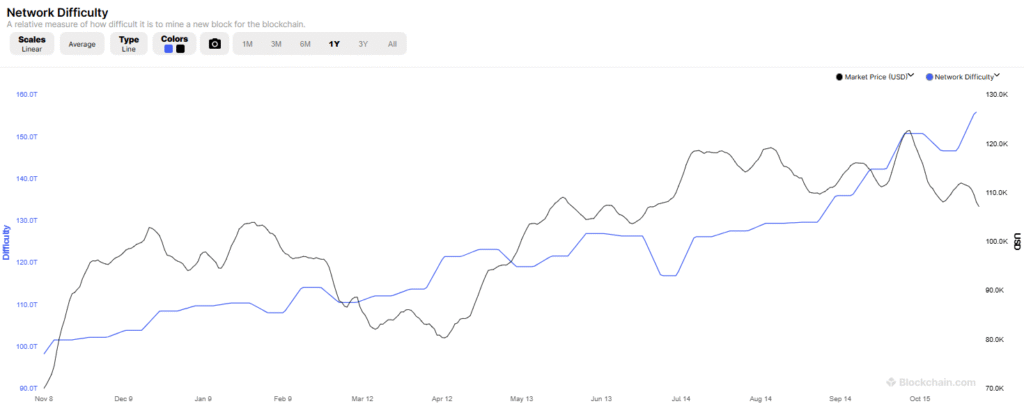
Bitcoin network difficulty (Blockchain.com)
Much of that production strength stems from its Valenzuela, Paraguay facility — a 100 MW green campus powered by the Itaipú Dam, the Western Hemisphere’s largest hydroelectric plant. All ASICs and hydro-cooling containers have been deployed, with commissioning underway. HIVE expects to reach 25 EH/s by U.S. Thanksgiving, hitting its full 2025 hashrate target on schedule.
According to President and CEO Aydin Kilic, this synergy between mining and HPC forms the foundation of HIVE’s future.
“Bitcoin miners like HIVE were early visionaries, sourcing stranded or surplus energy to build the foundational infrastructure that now fast-tracks hyperscalers in the AI industrial revolution,†he said. “With 23 EH/s already secured, we’re generating robust cash flows today while scaling green HPC tomorrow.â€
Kilic’s vision is echoed by COO Luke Rossy, who added that HIVE’s Valenzuela expansion is already generating incremental cash flow to fund growth across both its mining and AI divisions. “This approach maximizes return on invested capital and reinforces HIVE’s position as a renewable-powered, high-performance digital-infrastructure leader in the AI era,†Rossy said.
Retrofitting for the AI Era
Beyond Canada, HIVE is transforming its Boden, Sweden facility from a Tier I Bitcoin-mining site into a liquid-cooled Tier III+ HPC campus — a retrofit that will deliver 2,000 high-performance GPUs for European AI workloads within 9 to 12 months. This accelerated turnaround, compared to multi-year greenfield builds, reflects the company’s agility in repurposing its mining assets for AI compute.
Complementing that, HIVE’s BUZZ data-center acquisition will add another 2,000 GPUs in 2026, complemented by a Bell colocation partnership that introduces 2,000 more over the next nine months. By year-end 2026, HIVE expects to have roughly 6,000 GPUs operational across its new facilities, in addition to its existing fleet of 5,000.
Once Grand Falls is fully converted to HPC operations, its projected capacity of 25,000 additional GPUs will push HIVE’s long-term data-center potential to nearly 36,000 GPUs — a scale that could make it one of North America’s most significant renewable-powered AI infrastructure providers.
Global Operations and Shareholder Alignment
HIVE’s global momentum continues to build, with operations now spanning Canada, Sweden, and Paraguay. The company’s model remains fully funded, and every incremental EH/s increase directly boosts Bitcoin output under stable, fixed hydro-energy costs.
To align its growing global workforce with long-term goals, HIVE recently granted 2.72 million restricted share units (RSUs) to employees, executives, and consultants. The awards, subject to a one-year vesting period, are designed to reward innovation and commitment across nine time zones and five languages.
Financially, HIVE reported raising C$100.2 million in gross proceeds from its ongoing at-the-market equity program during the quarter ended Sept. 30, 2025, selling more than 30 million shares at an average price of C$3.32. The capital supports its global expansion and HPC retrofits while keeping balance-sheet flexibility intact.
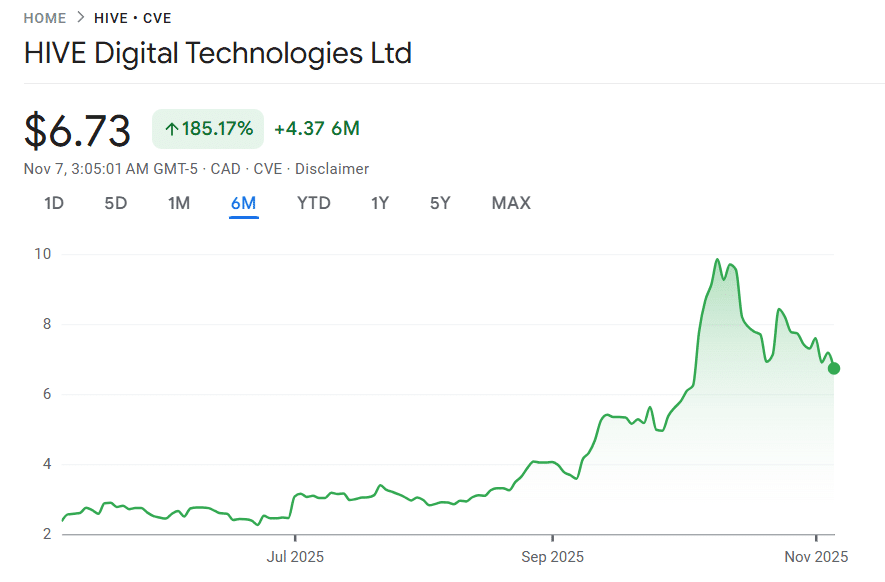
Hive Digital share price (Source: Google Finance)
The Convergence of Bitcoin and AI
HIVE Digital’s transformation is part of a broader narrative sweeping through the technology sector: the convergence of crypto infrastructure and artificial intelligence. What began as warehouses of ASICs securing a decentralized network has evolved into a global compute backbone capable of powering next-generation neural networks.
In this sense, HIVE’s strategy reflects a pragmatic adaptation — using the consistent revenue and infrastructure of Bitcoin mining to finance the build-out of renewable-powered HPC centers that meet the surging needs of the AI industry. The result is a virtuous cycle where surplus energy powers both blockchain security and computational innovation.
A New Chapter for HIVE Digital
For HIVE, 2025 represents not just another year of mining growth, but the beginning of a structural transformation. The company’s rise to 23 EH/s, coupled with its strategic land acquisition in Grand Falls, signals a long-term bet on the future of green, scalable compute power.
As the AI super cycle accelerates and hyperscalers race to deploy the next wave of GPU clusters, HIVE Digital’s blend of renewable energy, operational efficiency, and blockchain expertise may give it an edge in bridging two of the most powerful trends shaping the global economy.
With its dual-engine model now fully in motion, HIVE Digital is no longer just a miner — it’s becoming an AI-era infrastructure company poised to fuel both Bitcoin and the next generation of intelligent technology.


