Nvidia Becomes World’s First $5 Trillion Company as AI Boom Accelerates
Nvidia (NASDAQ: NVDA) made history on Wednesday, becoming the first company ever to surpass a $5 trillion market capitalization.
The milestone came after the stock climbed more than 4% at the market open, extending a rally driven by its continued dominance in artificial intelligence (AI) infrastructure and chip manufacturing.
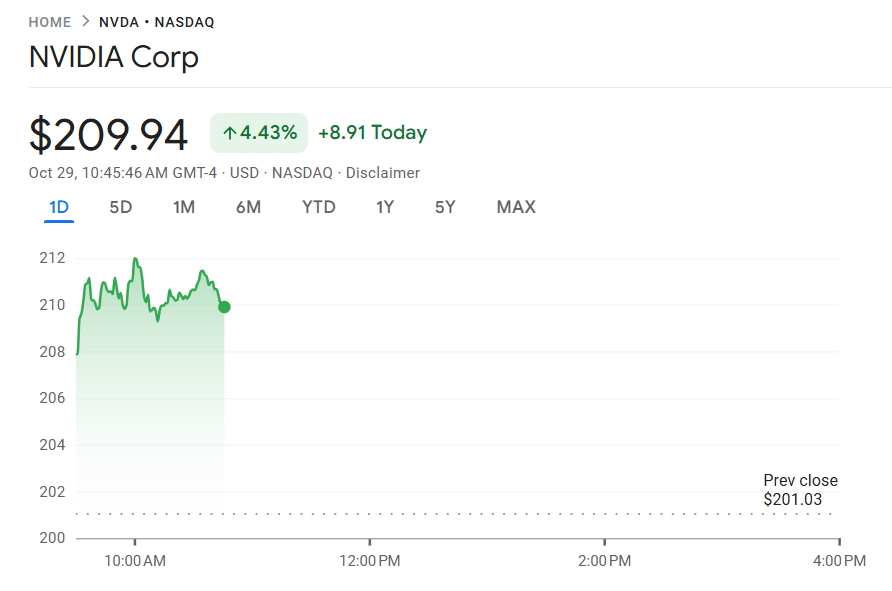
NVDA price (Source: Google Finance)
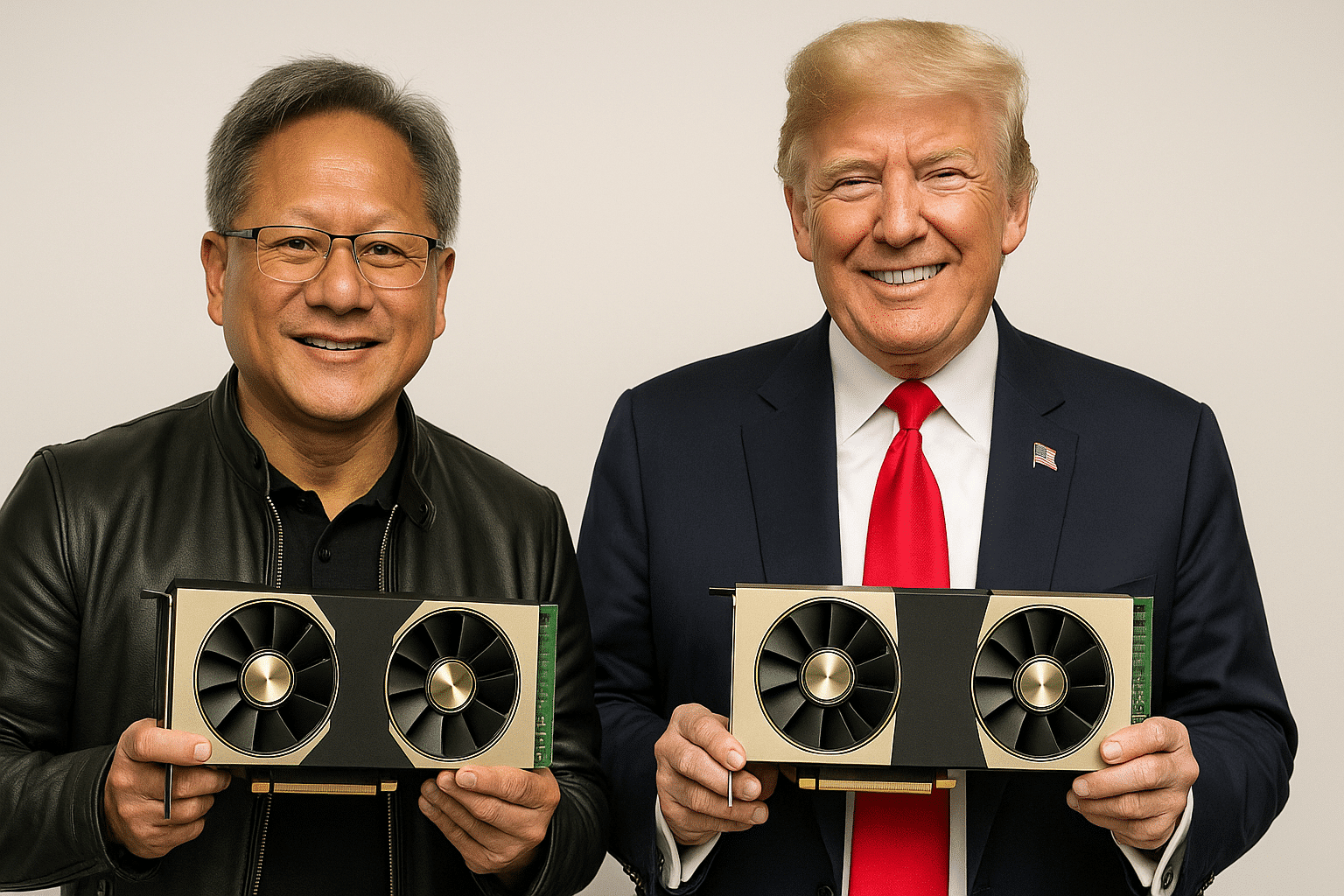
The surge followed comments from President Donald Trump, who said he would meet with Nvidia CEO Jensen Huang to discuss “Blackwells,†the company’s newest generation of AI chips. Investors took the remark as a sign of potential regulatory flexibility around chip exports to China—one of Nvidia’s most significant but restricted markets.
Trump’s remarks, reported by Bloomberg, boosted optimism that the chip manufacturer could soon resume limited exports of its advanced chips, following months of trade-related uncertainty.
China Market Prospects Back in Focus
In its most recent quarterly report on Aug. 27, Nvidia confirmed it had made no sales of its H20 chips in China, despite an earlier U.S. government agreement that would have allowed limited exports in exchange for a 15% revenue cut to the White House. Nvidia noted that the arrangement had not yet been formalized, leaving its China strategy in limbo.
Wednesday’s developments reignited speculation that U.S. regulators might approve an export-friendly version of the company’s Blackwell chips, potentially opening a lucrative revenue stream in one of the world’s largest AI hardware markets.
Big Wins at Nvidia’s GTC Event
The record-setting market cap came on the heels of a 5% rally on Tuesday, sparked by major announcements during the company’s GTC conference in Washington, D.C.
Huang revealed that Nvidia is collaborating with the U.S. Department of Energy to build seven new supercomputers, one of which will feature 10,000 Blackwell GPUs. The company also announced partnerships with Uber to develop self-driving cars, Eli Lilly for AI-driven drug discovery, and Nokia to advance next-generation 6G networks.
Further alliances with Palantir, Oracle, Cisco, and T-Mobile highlight Nvidia’s expanding influence across cloud computing, telecommunications, and AI infrastructure. Huang also unveiled NVQLink, a new open systems architecture designed to accelerate the development of quantum supercomputers in partnership with Rigetti and IonQ.
The AI Industrial Revolution
During his keynote, Huang described how AI factories—data centers powered by Nvidia GPUs—are fueling what he called a “new industrial revolution.†He projected that Nvidia could achieve $500 billion in GPU sales by the end of 2026, a dramatic increase from the company’s roughly $100 billion in total revenue during the first half of this year.
The company’s stock has surged over 50% year-to-date and more than doubled since April, when Trump’s unexpected tariff announcements temporarily rattled global markets.
Competition Heats Up
While Nvidia remains the undisputed leader in AI chips, competition is accelerating.
AMD recently signed a deal with OpenAI to supply up to 6 gigawatts of AI processors and agreed to provide 50,000 GPUs to Oracle. Meanwhile, Qualcomm is entering the AI data center race with new accelerator chips, and major Nvidia customers like Amazon, Google, and Microsoft are increasingly developing in-house AI silicon.
Still, demand for Nvidia’s GPUs continues to far outstrip supply. From Big Tech giants to national research labs, organizations are buying every chip they can to power data centers and AI-driven applications.
The $5 Trillion Era
With its historic valuation, Nvidia has cemented its position as the defining company of the AI age. Its technology underpins the global arms race in artificial intelligence, quantum computing, and autonomous systems—fields poised to reshape the world economy.
For now, Jensen Huang’s company stands not just as the backbone of AI, but as the most valuable enterprise in human history, driven by an insatiable demand for computing power.


