
Stablecoins Quietly Transform the Global Economy, Says a16z
The cryptocurrency market in 2025 is undergoing a profound transformation, driven by institutional adoption and the rapid rise of stablecoins, according to venture capital firm Andreessen Horowitz (a16z).
In its latest State of Crypto report, the firm highlighted how stablecoins have evolved from niche trading tools into a core pillar of the global financial system.
Institutional Adoption Accelerates
The report underscores how established financial institutions — including BlackRock, Visa, Fidelity, JPMorgan Chase, Stripe, PayPal and Robinhood — are expanding their roles in the digital asset economy. These firms are no longer viewing crypto as a speculative frontier but as an essential technological layer in global finance.
Advancements in blockchain infrastructure have played a major role in this shift. With some networks now processing over 3,400 transactions per second — a 100-fold increase in throughput in just five years — crypto systems have reached the speed and efficiency needed to support real-world financial activity.
Stablecoins Lead the Way
At the heart of this evolution are stablecoins, fiat-pegged tokens designed to move across the internet without traditional banking rails.
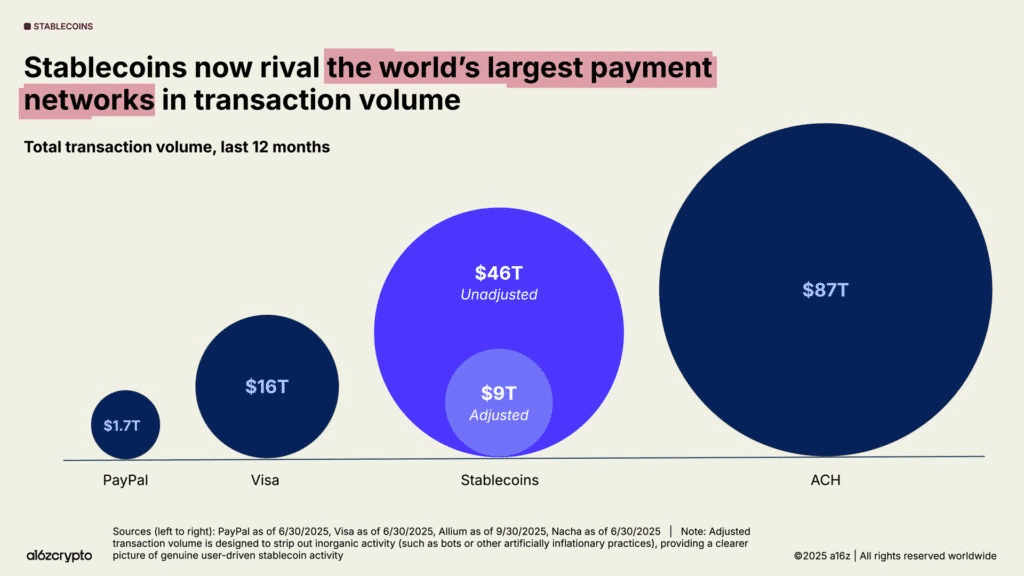
Stablecoins have quickly emerged as one of the most practical use cases in crypto (Source: a16z Crypto)
Over the past 12 months, stablecoin transactions have totaled $9 trillion, up 87% from the previous year, while unadjusted figures reach as high as $46 trillion.
“In years past, stablecoins were used mostly to settle speculative crypto trades; as of the last couple years, they have become the fastest, cheapest, and most global way to send a dollar,†a16z wrote.
The firm’s report describes stablecoins as the “clearest example of crypto’s real-world utility,†noting their expanding use in cross-border payments, remittances, and digital commerce.
Regulatory Momentum Builds
Regulatory clarity is also boosting the sector.
In the United States, the GENIUS Act — passed earlier this year — establishes a robust framework for stablecoin issuers, requiring transparent reserves and regular audits. Across the Atlantic, the United Kingdom is working toward finalizing its own stablecoin rules by the end of 2026, seeking to balance innovation with consumer protection.
Such regulatory advances are critical in legitimizing stablecoins as mainstream financial instruments and paving the way for banks, fintechs, and asset managers to integrate them into their core operations.
A Global Macroeconomic Shift
According to a16z, stablecoins have become a “global macroeconomic force.†More than 1% of all U.S. dollars now exist as stablecoins on public blockchains — a remarkable testament to their growing monetary relevance.
Collectively, stablecoin issuers hold over $150 billion in U.S. Treasurys, making them the 17th-largest holder of U.S. government debt, surpassing several sovereign nations. Market leader Tether (USDT) accounts for the lion’s share, holding about $127 billion in Treasury bills. Meanwhile, Circle’s USDC continues to dominate in the regulated segment, and Ethena’s synthetic dollar (USDe) has gained traction with a circulating supply of $11 billion.
The total stablecoin market now stands at approximately $316 billion, according to CoinMarketCap data.
The Next Frontier of Finance
Beyond stablecoins, a16z notes growing participation across the broader crypto landscape.
The rise of spot exchange-traded funds (ETFs) and digital asset services from major institutions like Citigroup, Morgan Stanley, and Fidelity points to an accelerating fusion between traditional finance and blockchain technology.
As monthly crypto users swell to between 40 million and 70 million, stablecoins are likely to remain the backbone of this transformation — offering speed, transparency, and a bridge between the digital and traditional economies.


