
Coinbase Says Big Finance Is Finally Coming for Crypto Derivatives
Coinbase (COIN), the Nasdaq-listed crypto exchange, is setting its sights on a new wave of institutional adoption in the digital asset derivatives market.
Earlier this year, the company made headlines with its $2.9 billion acquisition of Deribit — the world’s largest crypto options exchange — a move that marked a turning point in Coinbase’s ambitions beyond spot trading.
Usman Naeem, the firm’s global head of derivative sales, said in an interview that Coinbase expects traditional finance (TradFi) institutions, particularly asset managers in the U.S. and Europe, to begin using digital asset derivatives for investment and hedging purposes.
Those institutions, he explained, are fundamentally different from market makers and have fiduciary duties that go beyond providing liquidity.
From Asia’s Dominance to Western Participation
Historically, most crypto derivative activity has been centered in Asia, with perpetual futures dominating trading volume.
“Looking back, the vast majority of activity, probably more than three quarters, was in Asia,†Naeem said. But that trend, he added, is shifting. “I think that’s going to rebalance a bit and we’re going to see U.S. and Europe-based, non-market maker institutions really step into derivatives.â€
This evolution could represent a major rebalancing in global crypto markets. Coinbase, which started in 2012 as a simple on- and off-ramp for bitcoin (BTC), expanded into an exchange that captured much of the U.S. spot market.
Yet by 2017, the explosive growth of perpetual futures had moved roughly 85% of global crypto volume outside the U.S., mainly into the Asia-Pacific region.
Coinbase Building a Regulated Bridge for Institutions
Coinbase’s strategy to capture institutional participation began in 2022 with its acquisition of FairX, a Commodity Futures Trading Commission (CFTC)-regulated derivatives platform that enabled U.S.-compliant futures trading. Its purchase of Deribit in May added a global dimension, combining regulatory oversight with deep liquidity in options and perpetuals.
Naeem said this shift toward regulated crypto derivatives will bring a new style of participation from asset managers. Instead of buying millions of dollars’ worth of bitcoin directly, these firms prefer to scale up their exposure through hedged positions.
“As more long-term holders come in who are risk managed, I think we’re going to start seeing a volatility service that replicates more what’s happening in traditional finance,†he said.
He described how institutions may use strategies such as selling upside to fund downside protection, creating more sophisticated volatility structures. This, Naeem added, will help bring greater liquidity and stability to the crypto derivatives market, aligning it closer to the frameworks of traditional finance.
Managing Risk and Responding to Market Shocks
Recent market turbulence has shown that crypto still carries extreme short-term volatility. The “flash crash†earlier this month saw about $7 billion in liquidations occur within minutes, an event that might have discouraged some institutions from entering the space.
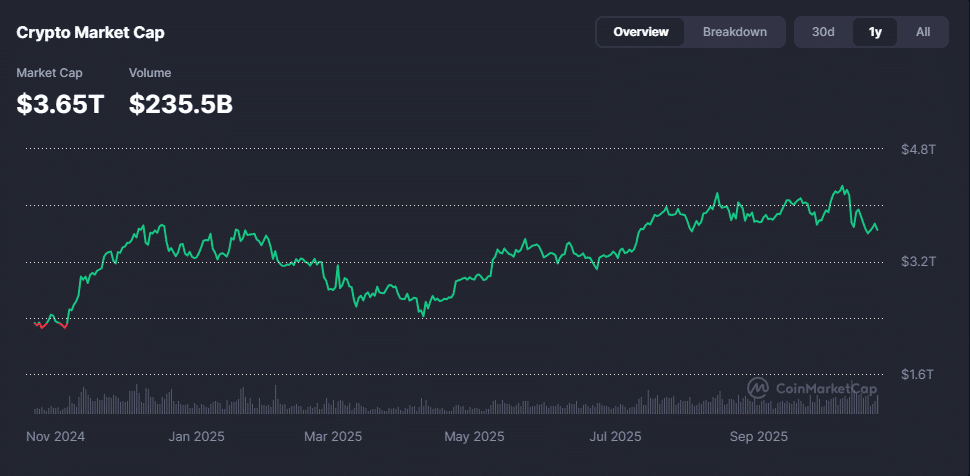
Crypto market cap dropped with the flash crash (Source: CoinMarketCap)
However, Naeem pushed back on the idea that such incidents undermine institutional confidence. He argued that flash crashes are not unique to crypto and that, in this case, the market’s risk infrastructure functioned as intended.
“The liquidations were there; the waterfalls kicked in as designed,†he said. “Keep in mind everything happened in a window of 12 minutes or thereabouts.â€
Naeem also noted that perpetual futures behave differently from centrally cleared products and require tighter controls to unwind positions efficiently — another reason why the move toward regulated derivatives platforms is so important for institutional trust.
A More Mature Market on the Horizon
Coinbase’s derivative expansion reflects a broader industry maturation.
As digital assets evolve beyond speculative trading toward structured, risk-managed investment vehicles, traditional finance firms are beginning to view crypto as a legitimate asset class rather than a fringe market.
With its twin acquisitions of FairX and Deribit, Coinbase is building the infrastructure to bridge that gap — creating a globally regulated ecosystem where institutional capital can enter the crypto derivatives market with greater confidence.
Naeem’s message was clear: the next chapter of crypto growth will be defined not by retail speculation, but by disciplined participation from the world’s largest financial institutions — and Coinbase intends to lead that transformation.


