NYDIG Calls Stablecoin ‘Peg’ a Myth After Market Rout Exposes Price Fluctuations
The myth that stablecoins are always pegged to the U.S. dollar has been shattered, according to NYDIG.
In the aftermath of last week’s $500 billion crypto market sell-off, the bitcoin-focused financial services firm released a report highlighting how leading stablecoins failed to maintain their dollar parity when panic swept through the market.
NYDIG Challenges the Stablecoin Narrative
Greg Cipolaro, NYDIG’s Global Head of Research, said in a post-mortem analysis that the sudden volatility in assets like USDC, USDT, and Ethena’s USDe revealed the fragile reality behind the “peg†narrative.
On Binance, USDe plunged to as low as $0.65, while even the largest dollar-backed tokens deviated from $1 amid intense market pressure.
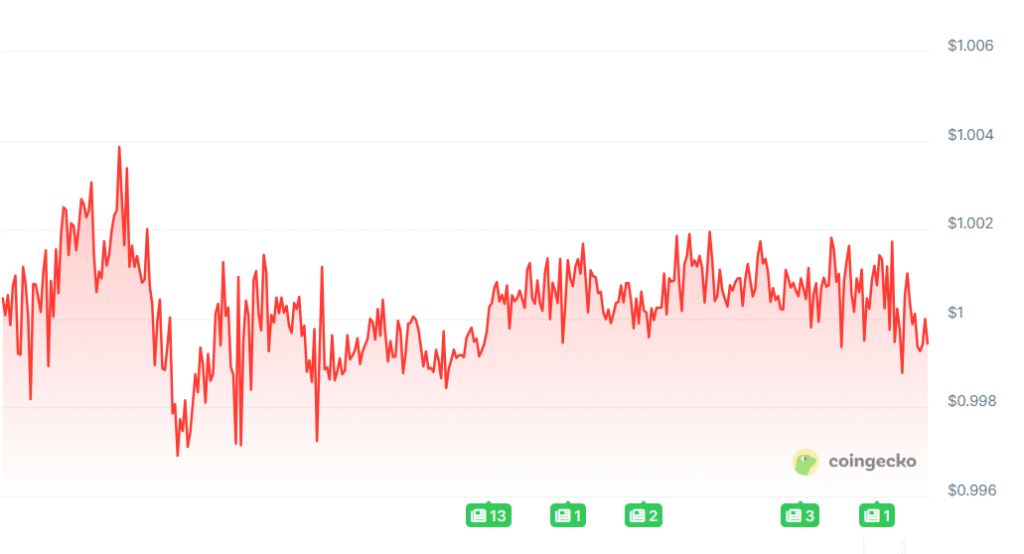
USDe price (Source: CoinGecko)
“Stablecoins are not pegged to $1.00. Period,†Cipolaro wrote. “In reality, stablecoins are market-traded instruments whose prices fluctuate around $1.00 due to trading dynamics.â€
Arbitrage, Not Guarantees
According to NYDIG, what appears to be price stability is merely the result of arbitrage activity—where traders buy when the token dips below $1 and sell when it rises above. Issuers such as Circle and Tether facilitate this through mint-and-burn mechanisms that create or redeem tokens based on market flows.
However, when liquidity dries up or panic sets in, this balancing act can break down. During the sell-off, USDT and USDC briefly traded above $1, while USDe collapsed, exposing the systemic differences in how stablecoins maintain their value.
Fragmentation and Risk Misunderstanding
Cipolaro emphasized that these discrepancies highlight a fragmented ecosystem where user confidence often rests on misunderstanding.
The report adds that Binance compensated affected users after the USDe incident, but the event reinforced the idea that not all stablecoins are equal—and that “stability†depends as much on exchange behavior and liquidity as on collateral composition.
Lending Markets Showed Resilience
Despite the chaos, lending protocols held up remarkably well. NYDIG highlighted that Aave, a leading DeFi lending platform, liquidated just $180 million, or about 0.25% of its total value locked (TVL), showing the resilience of decentralized credit systems during market stress. NYDIG itself reported no losses.
As stablecoins underpin trillions in crypto transactions and DeFi operations, NYDIG’s findings present a sobering reminder that these instruments are not risk-free digital dollars—but market products subject to volatility, liquidity shocks, and trust dynamics.
Cipolaro’s conclusion is blunt: Stablecoins don’t hold pegs. They trade around them.


