
Stablecoin Market Smashes $318 Billion Record as USDC and USDT Dominate
The stablecoin market has reached a historic milestone, with its total capitalization surpassing $318 billion, according to data from TradingView.
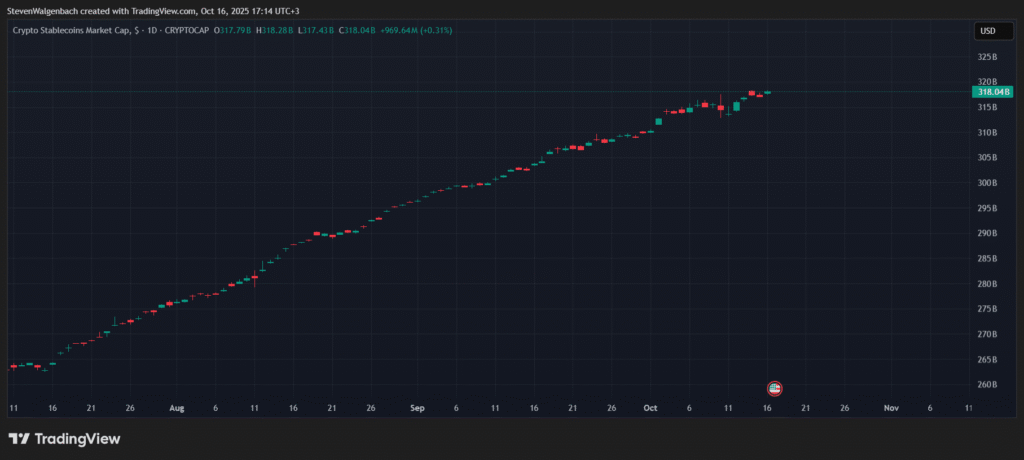
Stablecoin market cap (Source: TradingView)
The surge is being driven by the continued growth of Tether’s USDT and Circle’s USDC, both of which have benefited from increasing institutional confidence following the implementation of the GENIUS Act — a landmark U.S. regulation that treats compliant stablecoins as equivalents to cash.
GENIUS Act Fuels Stablecoin Market Confidence and Legitimacy
The GENIUS Act has been a game-changer for the stablecoin ecosystem.
By granting regulatory parity with traditional fiat cash, the legislation has provided a new level of clarity and legitimacy to the stablecoin market. Canaccord Genuity analysts led by Joseph Vafi described this as a pivotal moment that strengthens the medium-term case for stablecoins to serve as the “money layer†of the internet.
Stablecoins — cryptocurrencies pegged to assets like the U.S. dollar or gold — have long served as a critical payment infrastructure in digital markets, enabling traders and businesses to move funds quickly without exposure to price volatility.
Now, with regulatory backing, they are positioned to expand far beyond crypto exchanges into mainstream commerce, remittances, and global settlement systems.
Room for Growth Beyond Crypto Trading
Despite the surge, analysts note that the stablecoin market remains underpenetrated compared to the vast U.S. M2 money supply — suggesting massive headroom for adoption through 2026.Â
A recent report by Canaccord projects continued expansion as new entrants and use cases emerge, including stablecoin-backed credit products, tokenized treasuries, and on-chain settlement tools used by traditional financial institutions.
Canaccord also pointed to a rapidly evolving competitive landscape. In the third quarter, Tether announced plans to launch a U.S.-regulated dollar stablecoin, dubbed USAT, by the end of 2025. With roughly 70% market share, Tether aims to raise between $15 billion and $20 billion to support its expansion and reinforce its dominance.
However, other global players are moving fast to challenge Tether’s lead. Citigroup is exploring its own stablecoin initiative, while Visa has revealed plans for a stablecoin pilot slated for April 2026. Meanwhile, Circle’s USDC continues to gain traction, growing faster than analysts expected and signaling mounting competition within the sector.
The Broader Crypto Catalyst
While stablecoins have no direct mechanical link to Bitcoin (BTC), Canaccord’s analysts argue that their adoption acts as a powerful catalyst for the wider crypto economy.
As stablecoins become more embedded in global payments and settlement flows, they are driving renewed investment in core digital infrastructure — from wallets and custodial solutions to the next wave of decentralized finance (DeFi) applications.
That dynamic, the report suggests, creates a positive feedback loop: the more stablecoins are used for real-world transactions, the more robust and interconnected the overall crypto ecosystem becomes.


