
Stablecoin Showdown Heats Up as Congress Faces Lobbying Crossfire
The battle over the future of stablecoin rewards in the United States has escalated as Stand With Crypto, a pro-digital asset advocacy group originally founded by Coinbase, mobilized its members to push back against Wall Street’s efforts to limit yields on the assets under the GENIUS Act.
According to the organization, its members have sent more than 250,000 messages to U.S. senators, urging them to resist banking lobbyists’ attempts to rewrite portions of the new law that would effectively ban yield-bearing stablecoin products.
Stand With Crypto’s Grassroots Offensive
The coordinated campaign represents one of the largest grassroots lobbying efforts in the short history of digital asset regulation. The letter drafted by Stand With Crypto urges lawmakers to “ignore banking advocates†who have called for restrictions that would “stop consumers from earning value on fully backed digital dollars.â€
The advocacy group argues that traditional banks are protecting their own interests — especially as they continue to offer credit card rewards and high-yield accounts — while seeking to suppress competition from blockchain-based financial products.
“Lawmakers chose to protect rewards because you know they are for consumers,†the letter reads.
“A ban on rewards would stop consumers from earning value on fully backed digital dollars, even as banks lobbied to protect their credit card rewards as recently as last year.â€
Wall Street’s Push for Tight Controls Around Stablecoins
Major banking institutions, including the American Bankers Association, Bank Policy Institute, and Financial Services Forum, have called on Congress to “close the stablecoin payment of interest loopholeâ€, arguing that allowing stablecoin-linked yield could drain deposits and destabilize the traditional financial system.
These groups claim that competition from yield-bearing stablecoin products could shift liquidity away from money market funds and conventional bank savings — both critical to the flow of credit in the economy.
The GENIUS Act and Its Implications
The GENIUS Act, passed earlier this year, is the first major federal crypto law in the United States. While it prohibits stablecoin issuers themselves from offering direct yield or interest, it permits affiliated exchanges and intermediaries to provide such rewards.
This framework was intended to balance innovation and consumer protection — giving users access to on-chain financial tools while ensuring that stablecoin issuers remain fully backed and regulated.
However, the banking lobby’s August campaign to amend the law reignited tensions between traditional finance and the crypto sector, which views yield-bearing stablecoins as a bridge between decentralized finance (DeFi) and everyday savings products.
Political Gridlock Delays Implementation
Despite growing momentum for stablecoin adoption, regulatory implementation has been delayed by the ongoing U.S. government shutdown, which has left much of the Treasury Department and financial regulators unable to advance rulemaking under the new act.
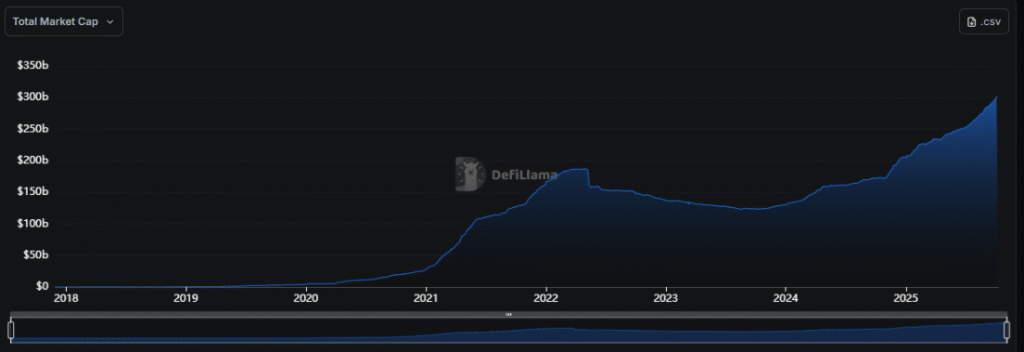
Stablecoin market cap (Source: DefiLlama)
For now, both sides — banking institutions and crypto advocates — are waiting for the government to reopen so the regulatory process can continue.
Stand With Crypto, which now boasts over 2.7 million members, has pledged to “defend innovation and consumer rights†as federal agencies finalize the rules governing stablecoin operations.


