Ethereum Faces Dilution Risk as $135B Treasury Boom Grows: VanEck
Digital asset treasuries (DATs) have ballooned to roughly $135 billion in total holdings, but investment firm VanEck has issued a stark warning for Ethereum (ETH) investors.
The firm’s latest report cautions that ETH holders who do not stake their tokens face increasing dilution risk as Ethereum transitions from a fee-driven yield model toward a more monetary asset framework.
With declining Layer 1 fee revenues and greater staking participation, VanEck argues that the long-term value proposition for non-stakers is eroding. The concern stems from the network’s shifting economics, where staking rewards continue to compound for active validators while passive holders see their share of total supply diminish.
The DAT Boom and Its Fragile Foundation
VanEck’s September market report highlighted how firms such as Bitmine Immersion Technologies and Strategy have spearheaded the explosion in digital asset treasuries. However, the firm raised concerns about the sustainability of this boom, noting that DATs rely heavily on volatility-driven funding mechanisms.
The report labeled these entities “volatility reactors,†explaining that they depend on persistent market turbulence to finance continued cryptocurrency purchases. But with Bitcoin’s 30-day volatility steadily declining over the past decade, VanEck questioned whether this engine of growth can persist in calmer markets.
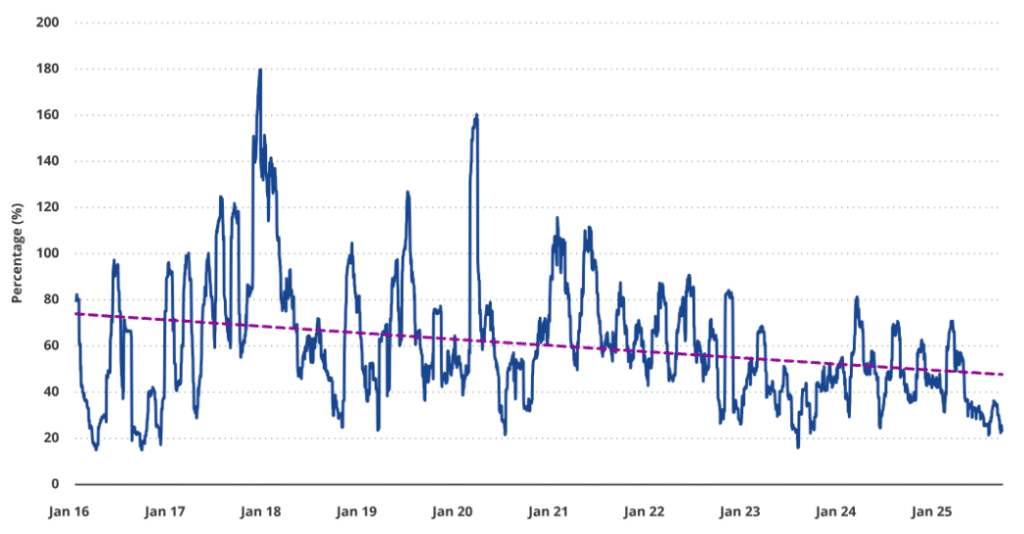
Bitcoin 30-day volatility (Source: VanEck)
Adding to the uncertainty, several major DATs — including Semler Scientific, Strive, KindlyMD, and Empery Digital — are now trading below their net asset values (NAVs). This disconnect signals that the speculative enthusiasm underpinning the DAT model may be weakening, with VanEck citing a recent Bitmine capital raise at a steep 75% discount to NAV as evidence.
Ethereum’s Fusaka Upgrade Could Deepen Dilution Divide
Compounding these economic headwinds is the upcoming Fusaka upgrade, scheduled for Dec. 3, which promises to reshape Ethereum’s scalability and validator dynamics.
Co-founder Vitalik Buterin described Fusaka as Ethereum’s most ambitious scaling initiative to date. It will introduce PeerDAS, a novel data-availability sampling system that lets validators verify smaller, random segments of data instead of full blocks. This innovation aims to more than double Ethereum’s blob capacity within weeks, boosting throughput while lowering costs for Layer 2 networks.
Yet, VanEck warned that increased Layer 2 adoption could further erode mainnet fee revenue, accelerating dilution for non-staking ETH holders. With more transactions moving off-chain, Ethereum’s direct fee income — the source of yield for non-stakers — is poised to shrink even as staking rewards remain concentrated among validators.
Institutional Accumulation Accelerates Despite Risks
Despite these warnings, institutional interest in Ethereum remains strong. Bitmine expanded its holdings by another $69 million in ETH via Galaxy Digital’s OTC desk on Sept. 19, bringing its total to roughly 1.95 million ETH (valued around $8.66 billion).
Other entities are following suit. SharpLink Gaming has accumulated 838,152 ETH, generating more than 3,200 ETH in staking rewards since June, while The Ether Machine recently added 150,000 ETH ahead of its planned merger with Dynamix Corporation. These corporate acquisitions collectively account for nearly 3.1% of Ethereum’s circulating supply, underscoring growing confidence in ETH as a long-term reserve asset.
Contrasting Views: Standard Chartered Sees Opportunity
While VanEck raised alarms over dilution, Standard Chartered analysts offered a more optimistic view, arguing that Ethereum could outperform Bitcoin within the DAT ecosystem.
The bank’s Geoffrey Kendrick, head of digital assets research, said Ethereum’s staking yields justify higher market-to-NAV premiums than those of Bitcoin-based treasuries, thanks to its yield-bearing nature and evolving role as “digital infrastructure.â€
Kendrick noted that Ethereum treasuries have already absorbed 3.1% of total supply since June — a sign that institutions may be viewing ETH not merely as a volatile investment but as a productive digital asset capable of compounding returns through staking.
The Road Ahead
As the Fusaka upgrade approaches, Ethereum finds itself at a critical crossroads. The network’s evolution toward scalability and Layer 2 efficiency is undeniably bullish for usability and adoption — yet, it also reshapes the economic incentives underpinning ETH ownership.
For stakers, the future may look increasingly lucrative. For non-stakers, however, the VanEck warning serves as a reminder that Ethereum’s transition into a monetary settlement layer could come at the cost of passive value retention.


