
Solana’s Alpenglow Upgrade Promises Lightning-Fast Speeds and Greater Efficiency
Solana is gearing up for one of the most ambitious overhauls in its history — a sweeping upgrade called Alpenglow that could make its already high-speed blockchain dramatically faster, more efficient, and easier to maintain.
According to global asset manager VanEck, which highlighted the update in its Crypto Monthly Recap for September 2025, Alpenglow represents “the largest upgrade to Solana’s consensus in its history.â€
A Major Step Forward for Solana
Alpenglow fundamentally reworks how Solana’s thousands of validators reach agreement on valid transactions. This consensus redesign promises a combination of higher speed, lower costs, and better reliability — all crucial for scaling decentralized finance (DeFi), gaming, and tokenized asset ecosystems.
VanEck’s report points out that Alpenglow slashes transaction finality time from around 12 seconds to roughly 150 milliseconds, about the time it takes to blink. This improvement could make Solana transactions feel as instantaneous as browsing the web, setting a new industry standard for blockchain responsiveness.
Key Innovations in the Alpenglow Upgrade
The overhaul introduces a series of deep architectural changes aimed at increasing throughput and decentralization:
1. Off-chain voting for efficiency
Currently, validators vote on every new block by sending thousands of small on-chain transactions.
Alpenglow moves this process off-chain, allowing votes to be shared privately before posting a single proof. This dramatically reduces bandwidth congestion and transaction costs.
2. Simplified validator participation
Validators will now submit a single Validator Admission Ticket per cycle instead of paying transaction fees for each vote.
This change lowers operational costs, allowing smaller operators to participate and strengthening the network’s decentralization.
3. Streamlined node communication
Solana’s nodes constantly “gossip†messages to stay synchronized.
Alpenglow cuts this chatter, allowing validators to run more efficiently — even with slower internet connections — while improving network stability under load.
4. Bigger blocks and greater capacity
Block capacity will increase by 25% before the end of the year, enabling the network to process more transactions per block and reduce wait times during periods of high activity.
5. The Firedancer client and dynamic scaling
Jump Crypto’s Firedancer — an independent validator client set to go live in late 2025 — will provide redundancy and resilience.
It also incorporates a new proposal (SIMD-0370) that removes the blockchain’s fixed block size limit, allowing the blockchain to scale automatically with hardware improvements.
6. P-tokens for performance
Solana’s new P-token standard will replace the resource-heavy SPL token format.
VanEck says this could cut computing demand by about 95%, freeing up block space and improving efficiency by roughly 10% overall.
Under the Hood: What Solana Engineers Are Building
VanEck’s report only scratches the surface of what’s changing. According to Solana Labs’ Alpenglow white paper, the upgrade includes several deeper improvements aimed at long-term stability and scalability.
A major enhancement is Rotor, a new broadcast layer that replaces Solana’s Turbine system for distributing data among validators. Rotor reduces duplicated packets and speeds up block propagation, ensuring faster confirmation times even under heavy traffic.
Another addition, local signature aggregation, lets validators combine multiple transaction signatures before sharing them across the network. This significantly cuts the computational load of verifying transactions while maintaining security.
Furthermore, Alpenglow introduces enhanced fault tolerance, ensuring that Solana can remain fully functional even if up to 40% of its validators go offline. This resilience is critical for a network handling global financial traffic.
Lastly, the shift to a ticket-based voting system makes validator participation more predictable and accessible, promoting a fairer ecosystem and greater decentralization.
Building for the Future
Taken together, Alpenglow transforms Solana from a fast blockchain into a next-generation infrastructure for real-time finance, social applications, and tokenized economies. By cutting finality times to milliseconds, reducing computational costs, and simplifying validator participation, Solana is positioning itself as the blockchain most capable of handling web-scale demand.
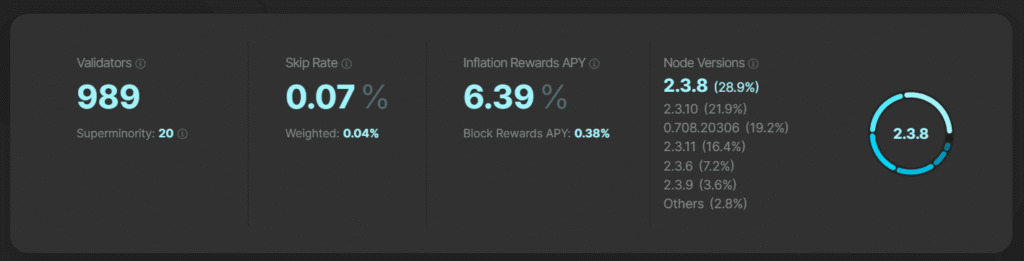
SOL validator statistics (Source: Solana Beach)
As VanEck summarized, the Alpenglow upgrade is more than just a technical milestone — it’s a strategic move that could cement Solana’s position as the fastest, most efficient blockchain in the world.


