Circle Extends Tokenized U.S. Treasury Market Reach to Solana
Circle (CRCL), the issuer of the USDC stablecoin, has taken another step in broadening its tokenized asset offerings.
On Wednesday, the company announced that its tokenized U.S. Treasury fund, USYC, is now live on Solana, adding to its existing presence on Ethereum, Near, Base, and Canton networks, with plans for BNB Chain next.
Circle Brings Tokenized Treasuries to Solana
USYC is a tokenized representation of a short-duration U.S. government money market fund. It is fully redeemable in real time into USDC, Circle’s widely used dollar-backed stablecoin. Unlike most tokens in decentralized finance (DeFi), USYC is permissioned, meaning it is restricted to non-U.S. institutional investors who complete KYC checks.
The move to Solana gives institutions access to tokenized U.S. Treasuries on a blockchain recognized for ultra-fast settlement speeds and low transaction costs, potentially expanding use cases in collateralized lending, derivatives trading, and yield strategies.
Tokenized Treasuries See Rapid Growth
The broader market for tokenized Treasuries has exploded in the past year. Data from RWA.xyz shows the sector has ballooned from $2.4 billion to nearly $8 billion in just twelve months. This surge reflects a growing institutional appetite for real-world assets (RWAs) on blockchain infrastructure, with yield-bearing securities like Treasuries now seen as prime candidates for tokenization.
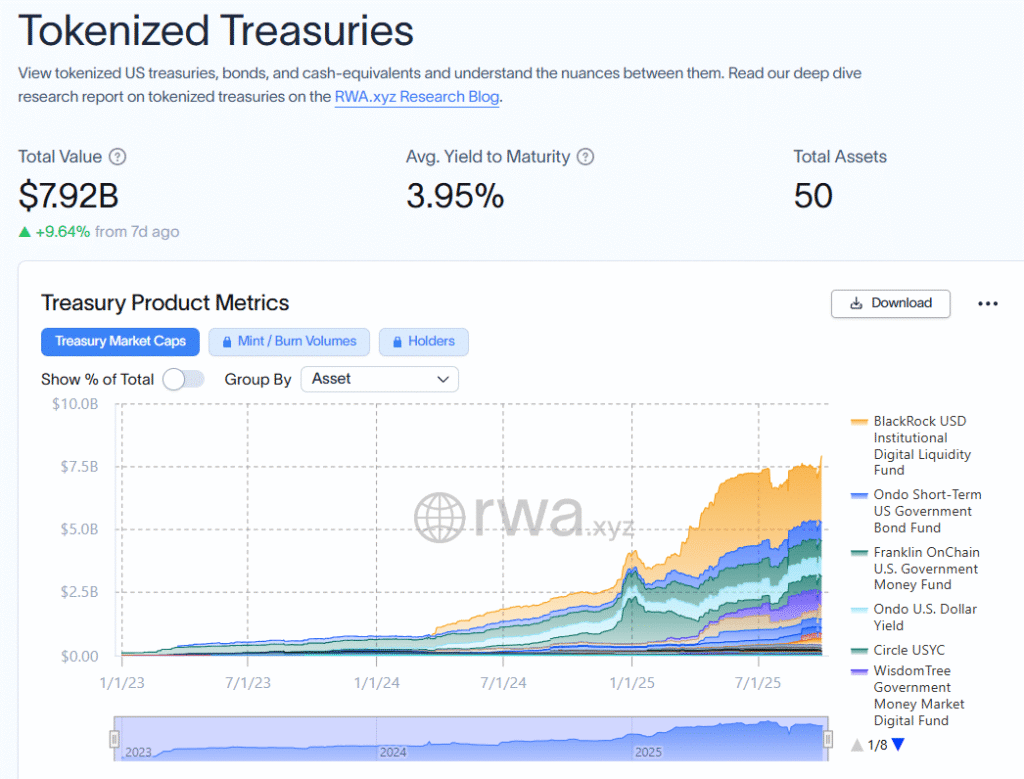
Tokenized treasury market (Source: RWA.xyz)
Circle’s USYC is already a major player in this market, with a $635 million market cap, ranking it the fifth-largest tokenized treasury fund. The firm sees Solana integration as a way to deepen adoption, particularly in DeFi platforms looking for stable, yield-generating collateral.
Solana Integration: Opportunities and Challenges
Bringing USYC to Solana opens the door for innovative use cases such as using tokenized Treasuries as margin collateral for trading or embedding them into DeFi strategies. However, the permissioned nature of USYC presents a hurdle: protocols must integrate wallet allow-listing and eligibility checks to support the asset.
While this compliance requirement limits accessibility compared to permissionless tokens, it also signals Circle’s regulatory-first approach to scaling tokenized assets for institutional investors.
Why It Matters
Circle’s latest expansion highlights the accelerating trend of tokenizing traditional assets on blockchain rails. As institutions look for compliant ways to gain blockchain-based exposure to U.S. Treasuries, USYC’s presence on Solana could boost both stablecoin utility and DeFi adoption.
With the tokenized treasury market already one of the fastest-growing segments in crypto, Circle’s move underscores the growing convergence between traditional finance and blockchain-based infrastructure.


