
SEC Advances Pro-Crypto Policy With Custody Relief for Trust Firms
The U.S. Securities and Exchange Commission (SEC) has signaled a major shift in its approach to cryptocurrency oversight, granting state-chartered trust companies the green light to custody digital assets on behalf of SEC-registered advisers and funds.
The move, delivered through a no-action letter issued Tuesday by the Division of Investment Management, marks one of the most crypto-forward steps the regulator has taken in years.
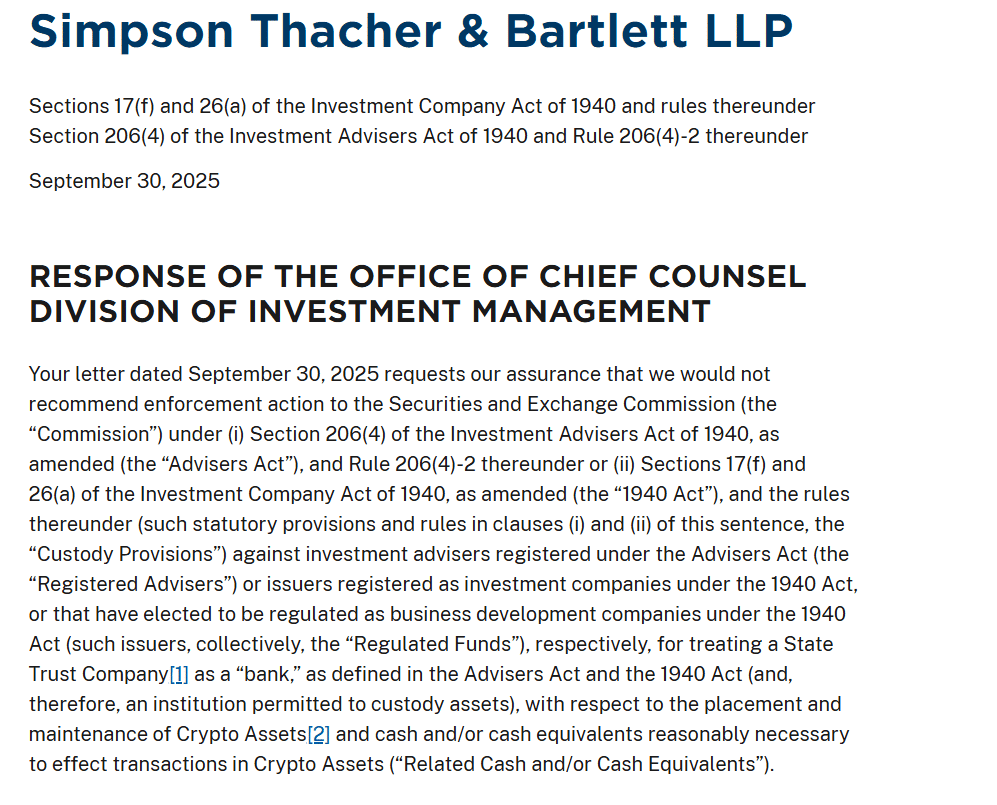
No-action letter issued by the Division of Investment Management (Source: SEC)
No-Action Relief for Crypto Custody
The no-action letter provides assurance that the SEC will not pursue enforcement action against registered advisers and regulated funds that place digital assets with state trust companies. This directly benefits the trust affiliates of leading crypto firms such as Coinbase and Kraken, allowing them to expand institutional custody services without immediate regulatory risk.
The SEC clarified that a state trust company could be treated as a “bank†under federal custody rules, a designation that had long been contested. This development eases compliance concerns that had persisted since former chair Gary Gensler pushed a restrictive proposal that would have limited which firms could act as qualified custodians.
A Break from Gensler’s Approach
Gensler, along with Democratic Commissioner Caroline Crenshaw, had argued that crypto custodians lacked sufficient safeguards to qualify as risk-free custodians under existing rules. While his proposal was ultimately abandoned, it created lasting uncertainty for investment advisers who feared enforcement if they held client crypto assets with state-regulated custodians.
Under new Chairman Paul Atkins, however, the agency has pivoted toward a more pro-crypto stance, aligned with President Donald Trump’s broader support of digital asset innovation. Atkins has made it clear that “establishing industry policies†is now the agency’s top priority, part of his broader “Project Crypto†initiative.
Divided Opinions Inside the SEC
Not all commissioners agree with the agency’s new course. Commissioner Hester Peirce, long known as “Crypto Mom,†welcomed the move but urged the agency to go further.Â
Speaking in Singapore on Tuesday, she said the SEC should update its rules to reflect technological advancements in custody solutions and even consider allowing some firms to self-custody their assets.
Meanwhile, Commissioner Crenshaw criticized the no-action letter as a regulatory shortcut. She argued that the SEC is “leaving investors and the markets to gamble in an unnecessary game of 50-state regulatory roulette†rather than pursuing a more uniform federal framework. Crenshaw warned that making such a significant policy shift without public consultation or economic analysis may violate the Administrative Procedure Act.
What It Means for the Crypto Industry
While the no-action relief is not a formal rule, it carries substantial weight by reducing immediate compliance risks for advisers and funds engaging in crypto custody through state-chartered trust companies. The decision could accelerate institutional adoption, as firms like Coinbase Custody and Kraken Trust Company gain clearer footing under SEC oversight.
The letter also suggests that the agency is preparing for broader rulemaking. Chairman Atkins has promised to issue formal crypto custody rules in the coming months, while Congress continues to advance comprehensive legislation to regulate the digital asset market.
For now, the SEC’s decision provides a much-needed reprieve for investment advisers navigating regulatory uncertainty — and it signals a significant turning point in the U.S. government’s evolving relationship with the crypto sector.


