
Zondacrypto CEO Warns New Poland Crypto Law Could “Destroy†Industry
Poland’s crypto industry faces a regulatory storm as lawmakers move forward with the country’s most restrictive digital asset legislation to date.
The sharpest criticism has come from Zondacrypto, one of Europe’s largest exchanges, which warns that the new rules risk criminalizing innovation and driving businesses out of Poland.
Zondacrypto: Poland Took It Too Far
In a statement sent to Ecoinimist, Zondacrypto’s CEO PrzemysÅ‚aw Kral said Poland’s interpretation of the EU’s Markets in Crypto-Assets Regulation (MiCA) is a “major step backwardsâ€, arguing that the new framework is unnecessarily harsh compared to other member states.
“While regulation is necessary for consumer protection, it can be counterproductive. Poland has taken it too far and its domestic crypto industry will suffer as a result,†the exchange said.
Zondacrypto’s CEO highlighted several pain points:
- The rules impose excessive restrictions that treat crypto as a threat rather than an opportunity.
- Basic activities like smart contract development could be criminalized, stifling blockchain innovation.
- Startups will face barriers to market entry, leaving the field dominated by a few large players.
- Companies may relocate to friendlier jurisdictions, taking jobs and tax revenue with them.
Despite being founded in Poland in 2014, Zondacrypto is now headquartered in Estonia, where it contributes more than €6 million in VAT annually. The firm said the new act will make it even less attractive to expand in its home country.
What Poland’s Crypto Bill Does
The lower house of parliament, the Sejm, voted 230–196 in favor of the Crypto-Asset Market Act (Bill 1424), sending it to the Senate for final consideration. The act:
- Establishes the Komisja Nadzoru Finansowego (KNF) as the sector’s dedicated regulator.
- Requires all crypto asset service providers (CASPs) — including exchanges, issuers, and custodians — to obtain a KNF license.
- Demands detailed applications covering corporate structure, capital adequacy, AML policies, and risk management.
- Introduces severe penalties for violations, including fines up to 10 million PLN ($2.8M) and prison terms up to two years.
If signed into law, CASPs will have six months to comply, or face forced closure.
Political Backlash and Warnings
The legislation has ignited fierce criticism inside Poland. Janusz Kowalski, a member of the Sejm from the opposition Law and Justice (PiS) party, called it “the largest and most restrictive cryptocurrency law in the EUâ€, pointing to its 118 pages of rules compared with shorter frameworks in Germany and the Czech Republic.
Pro-crypto politician Tomasz Mentzen warned the KNF’s slow pace — with average licensing processes taking 30 months — could effectively shut down blockchain and stablecoin projects in Poland.
Meanwhile, President Karol Nawrocki, who won elections in June after pledging to support crypto and resist “tyrannical regulations,†now faces pressure to decide whether to sign or veto the bill.
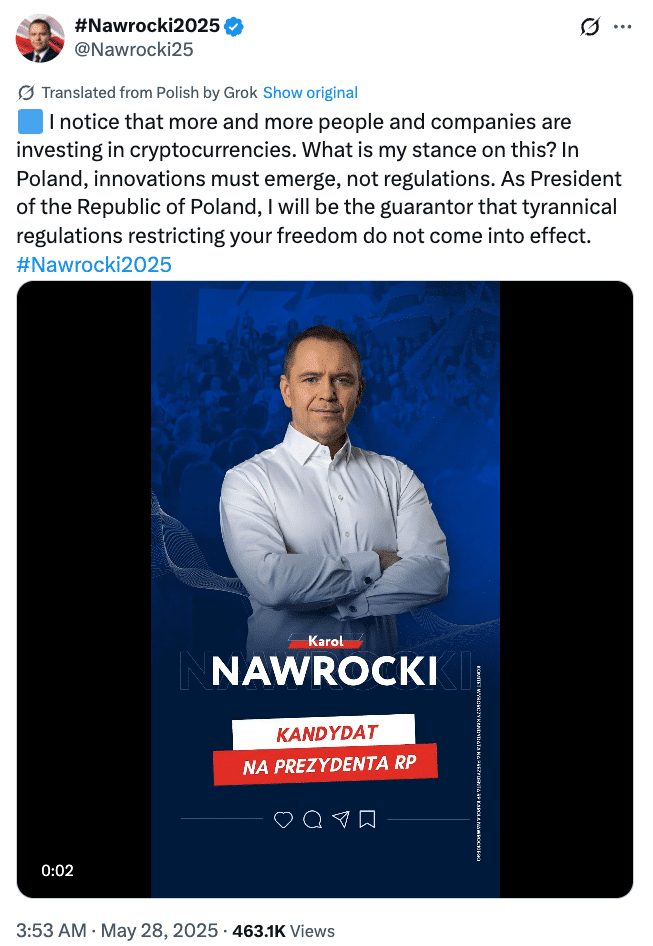
Poland’s President Karol Nawrocki (tweet translated by Grok)
Outlook: An Exodus on the Horizon?
For Poland’s three million crypto holders, the act could mark a turning point. Industry leaders say the law risks suffocating growth in one of Europe’s most active digital asset markets.
Zondacrypto’s warning underscores the stakes: unless softened, the law may transform Poland from a crypto innovator into a net exporter of talent and capital.


