Circle’s USDC at Risk? JPMorgan Warns of Intense Stablecoin War Ahead
Circle, the issuer of the USDC stablecoin, is under mounting pressure as rivals like Tether, Hyperliquid, and major fintech firms prepare to launch new stablecoins, according to a new report from JPMorgan analysts.
The competition comes at a pivotal moment as the U.S. implements new stablecoin legislation that could reshape the market.
Tether’s USAT: A Compliance-Focused Challenger
Tether is preparing to roll out USAT, a U.S.-compliant stablecoin designed to meet the requirements of the newly enacted GENIUS Act. Unlike its flagship USDT, which analysts estimate is only about 80% compliant, USAT will fully adhere to the new rules.
Tether plans to custody USAT’s reserves with Anchorage Digital, a federally chartered bank. JPMorgan’s team, led by Nikolaos Panigirtzoglou, noted this approach could build institutional trust, reduce dependency on traditional banks, and avoid risks similar to those Circle experienced during the Silicon Valley Bank collapse in 2023. By directly managing reserves, Tether also hopes to cut costs and improve profit margins.
Hyperliquid and Fintech Entrants
Meanwhile, Hyperliquid is developing USDH, its own native stablecoin, moving away from reliance on Circle’s USDC. The JPMorgan analysts highlighted that Hyperliquid’s exchange already accounts for about 7.5% of total USDC usage, meaning Circle’s market share could shrink further once USDH goes live.
Other fintech players are also joining the race. Both Robinhood and Revolut are reportedly working on launching their own stablecoins, intensifying competition for liquidity and user adoption.
Circle’s Countermove: Arc Blockchain
Circle is not standing still.
The company is building Arc, a dedicated blockchain designed to optimize USDC’s role in the crypto ecosystem.
Arc is expected to prioritize speed, interoperability, and security—features intended to keep USDC at the center of digital finance despite growing competition.
A Zero-Sum Market?
The JPMorgan analysts cautioned that the stablecoin industry may be evolving into a “zero-sum game†for U.S. issuers unless the broader crypto market expands significantly. Historically, stablecoin supply has closely mirrored the overall crypto market cap, which has kept stablecoins’ share of total market value relatively flat—hovering below 8% since 2020.
Today, the global stablecoin market is worth about $291 billion, but without strong growth in the crypto sector, Circle and its rivals may be forced to fight over existing market share rather than expand the pie.
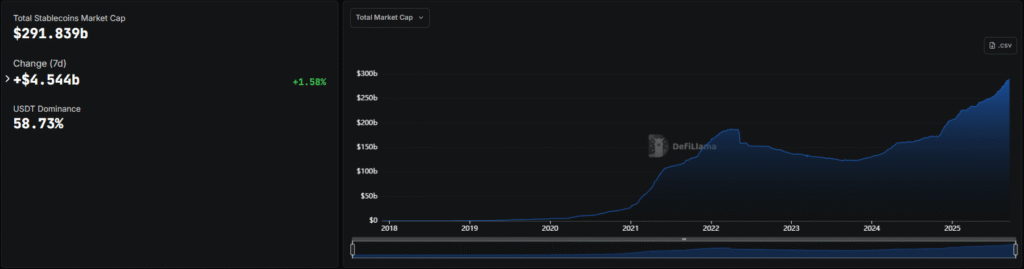
Stablecoin market cap (Source: DefiLlama)


