
XRP vs. World Liberty Financial – Supply Discipline vs. Hype?
Cryptocurrency markets frequently reward hype and speculation, yet the long‑term winners tend to be those projects with clear use‑cases, transparent supply dynamics and real adoption.
Two tokens that could not be more different are XRP, the digital asset that powers the XRP Ledger (XRPL), and World Liberty Financial (WLFI), the token associated with the Trump family’s crypto venture.
Below we explore how the two projects differ in technology, supply and governance – and why those differences matter to investors.
Understanding XRP
XRP was created to enable fast, low‑cost transfers on a permissionless network. Ripple Labs, the company closely associated with XRP, targets banks and payment providers looking to move funds cross‑border without the delays and fees associated with legacy systems. A few important points:
- Predictable supply: Ripple locked 55 billion XRP – 55 % of the total 100 billion supply – into a series of on‑ledger escrows to create predictability. Each month, up to 1 billion XRP is released, and any XRP not used goes back into a new escrow. This “drip‑feed†approach prevents large, sudden inflows of supply and signals that Ripple can’t dump huge amounts on the market.
- Deflationary pressure: Every transaction on the XRP Ledger burns 10 drops (0.00001 XRP) in fees. The burn amount automatically rises when the network is congested. While small, this mechanic ensures that XRP’s total supply will gradually decline as adoption grows.
- EVM compatibility & DeFi: In June 2025 Ripple launched the XRPL EVM sidechain. It connects to XRPL via the Axelar bridge and allows developers to deploy Ethereum‑compatible smart contracts while paying fees in XRP. This extends the ledger’s utility to decentralised finance (DeFi) without sacrificing XRPL’s speed or low fees.
- Stablecoins & tokenised assets: XRPL hosts multiple stablecoins, including Ripple USD (RLUSD) – a U.S. dollar‑pegged token fully backed by cash, Treasuries and bank deposits. RLUSD launched in December 2024 and is listed on exchanges such as Bitstamp and Bullish. The ledger is also being used for tokenising real‑world assets, from carbon credits to securities, demonstrating broader financial adoption.
Those features make XRP more than a speculative asset; it is a utility token embedded in a growing payments and DeFi ecosystem.
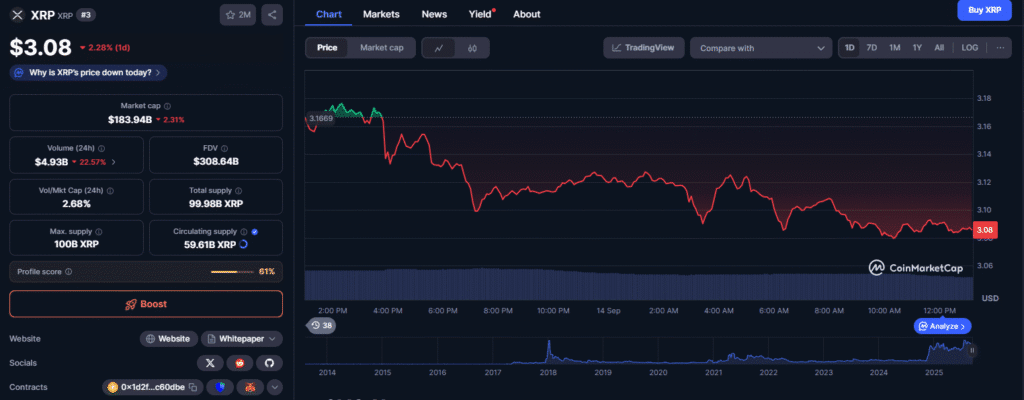
XRP price chart (Source: CoinMarketCap)
Understanding World Liberty Financial (WLFI)
World Liberty Financial is a crypto venture launched by the Trump family in 2024–2025. It includes the WLFI token and a USD1 stablecoin, but the structures behind these tokens differ significantly.
- USD1 stablecoin success: USD1 is marketed as a fully‑collateralised stablecoin backed by U.S. Treasuries and dollar deposits. It quickly reached a multi‑billion‑dollar market capitalisation after launching in early 2025 and is listed on major exchanges. Its transparency makes it attractive to institutions seeking compliant stablecoin exposure.
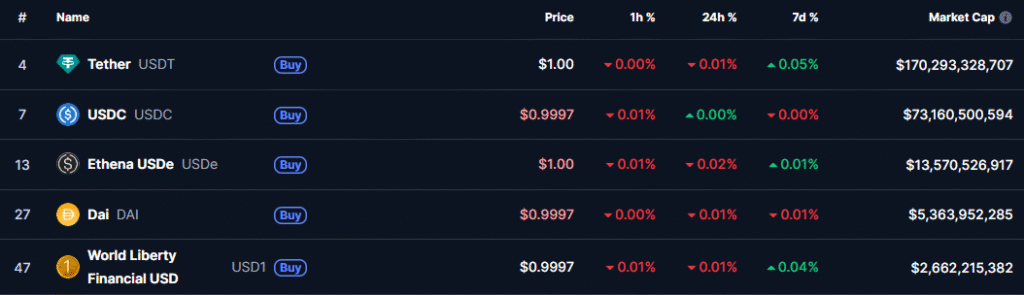
Top 5 stablecoins by market cap (Source: CoinMarketCap)
- Tokenomics of WLFI: The WLFI governance token has a fixed supply of 100 billion. According to The Motley Fool, 33.5 % of tokens were allocated to the co‑founders, 20 % set aside for past or future public sales, and the remainder reserved for internal funding and insiders. Governance rights exist in theory, but a 5 % cap on voting power per wallet plus the large insider holdings means outsiders effectively have no influence. The token does not confer dividends or revenue share.
- Investor risks: WLFI’s governance can restrict transfers. In early September 2025, major crypto investor Justin Sun said his WLFI tokens – worth roughly $75 million – were “unreasonably frozenâ€. World Liberty responded by saying it reviews wallets for “malicious or high‑risk activityâ€. Such discretion undermines WLFI’s claims to decentralisation.
- Limited utility: The WLFI token serves only as a governance token for the World Liberty protocol, which plans to offer a super‑app and lending features. Holders do not share in profits from USD1 or other services. Early investors can currently sell only up to 20 % of their holdings, further restricting liquidity.
The contrast between a thriving stablecoin (USD1) and a governance token with concentrated ownership highlights the project’s internal tension: investors may be attracted by the success of USD1, but that success does not translate into value for WLFI token holders.
Supply & Tokenomics Comparison
| Metric/Feature | XRP | World Liberty Financial (WLFI) |
| Total supply | 100 billion XRP | 100 billion WLFI tokens |
| Supply controls | 55 billion locked in escrows with monthly releases; unused XRP re‑escrowed | 33.5 % to co‑founders, 20 % to public sales, remainder to insiders |
| Deflationary mechanism | Base fee of 0.00001 XRP burned per transaction | None; supply could be expanded via governance since insiders hold super‑majority |
| Utility | Used for transaction fees, cross‑border payments, DeFi, tokenisation and as gas on the EVM sidechain | Governance token; voting power capped at 5 % per wallet and has no revenue sharing |
| Transfer restrictions | Transfers are permissionless; ledger rules enforced by consensus | Transfers can be frozen by administrators; early backers’ tokens were blacklisted |
| Adoption | Increasing adoption by banks (SBI Holdings, Santander, PNC), stablecoins (RLUSD, USDC) and over 2 million daily transactions | USD1 stablecoin has achieved a large market cap; WLFI token adoption limited to governance voting |
Use Cases & Adoption
XRP is being integrated into mainstream finance.
Ripple’s partnerships with banks such as Santander and SBI Holdings allow institutions to settle cross‑border payments quickly and cheaply. The ledger supports tokenised assets and micropayments for gaming and streaming services, and the new EVM sidechain gives developers access to Ethereum‑compatible decentralised apps. This ecosystem creates ongoing demand for XRP because users must hold the token to pay fees and interact with applications.
World Liberty Financial, by contrast, positions USD1 as its flagship product.
USD1’s success indicates demand for compliant stablecoins and could help World Liberty build a DeFi ecosystem. However, WLFI token holders don’t benefit directly from USD1’s revenues or adoption. The future value of WLFI depends on the platform delivering additional services – such as a lending app – and on whether governance decisions meaningfully impact the protocol. For now, WLFI functions more like a marketing tool than a utility token.
Controversies & Governance
World Liberty Financial is intertwined with U.S. politics. Trump family members have promoted the project, and Reuters noted that their holdings in WLFI have generated hundreds of millions of dollars.
Critics argue that presents conflicts of interest because President Trump’s administration shapes crypto regulation while his family profits from token sales.
The token freeze of Justin Sun highlights governance risks. When a major supporter complains that administrators can unilaterally freeze holdings, it raises questions about fairness and decentralisation. Combine this with a super‑majority of tokens controlled by insiders, and WLFI’s governance looks more like a traditional corporation than a decentralised protocol.
XRP is not without controversy. Ripple spent years fighting the U.S. Securities and Exchange Commission over whether XRP was a security. The case concluded in 2023 with a partial victory for Ripple, and the token is now sold on major exchanges. However, investors should recognise regulatory risk when considering any crypto asset.
Investment Considerations & Conclusion
From a long‑term perspective, XRP appears fundamentally stronger than World Liberty Financial’s token. XRPL offers a transparent supply schedule, built‑in deflation via fee burns, real‑world adoption in payments and DeFi, and innovations such as an EVM sidechain. Its value proposition is tied to usage of the network.
WLFI, on the other hand, has a tokenomics structure that concentrates power in insiders, lacks revenue sharing, and allows administrators to freeze wallets. While USD1 may thrive as a regulated stablecoin, owning WLFI does not grant exposure to that success. The project’s governance dynamics make the token look more like a meme coin than an investment vehicle.
Disclaimer: The information presented in this article is for educational and informational purposes only. It should not be considered financial or investment advice. Cryptocurrency markets are highly volatile, and you should always conduct your own research or consult with a licensed financial advisor before making any investment decisions. Ecoinimist does not take responsibility for any financial losses incurred based on the information provided.


