
Sergey Nazarov Says Chainlink Talks With Trump Agencies Go Beyond Commerce
Chainlink is extending its footprint in Washington after locking in a high-profile partnership with the U.S. Department of Commerce.
Co-founder Sergey Nazarov confirmed this week that the decentralized oracle network is now in active talks with other Trump administration agencies—and even state governments—about moving more public sector functions onto blockchain.
From GDP Data to Cross-Chain Initiatives
The Commerce Department is already piloting Chainlink to put GDP, inflation, and economic demand data on blockchains like Bitcoin, Ethereum, and Solana. Nazarov said in a recent interview that this “low-risk, efficient†step is just the start, with cross-chain initiatives and new federal use cases on the table.
“All of these agencies and departments have their own processes, which is unpredictable for approvals,†Nazarov explained. “But we’re definitely moving ahead into a set of next steps, at least on the data side.â€
Chainlink currently integrates with more than 14 blockchain ecosystems, allowing smart contracts to securely access verified off-chain data.
Ambitions for Elections and Identity
Beyond economic data, Nazarov highlighted an even more ambitious vision: bringing elections and identity verification on-chain. He said the technology is ready to support blockchain-based voting systems, which could enhance transparency and prevent disputes.
“It’s not a technology issue,†he stressed. “It’s a political issue.â€
The Trump administration has positioned itself as the most crypto-friendly in U.S. history, with the president recently suggesting he has the authority to reshape election processes, including ending mail-in voting.
Nazarov’s comments suggest Chainlink could become a critical infrastructure partner if Washington embraces blockchain-backed election verification.
State-Level Interest and Political Hurdles
Chainlink is also in talks with state governments, though details remain undisclosed. Widespread adoption, however, faces hurdles. Identity and privacy remain hot-button political issues, particularly as Republicans have opposed a U.S. central bank digital currency on privacy grounds.
Meanwhile, federal policies on immigration and identity verification have fueled debate over civil liberties, underscoring the challenges of introducing blockchain-based identity systems in such a polarized environment.
The Bigger Picture for Chainlink
For Chainlink, these early government deals represent both validation and opportunity. While initial deployments may look modest, Nazarov believes they are gateways to bolder experiments. “From my interactions in D.C., I can already see many steps beyond this happening,†he said.
By positioning itself as the trusted bridge between real-world data and blockchain systems, Chainlink could cement its role at the intersection of crypto, government, and public trust.
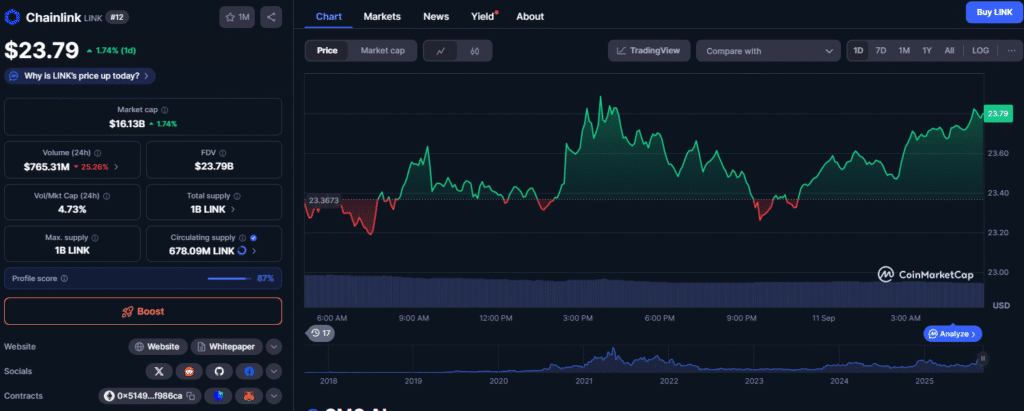
LINK price chart (Source: CoinMarketCap)
LINK rose 1% in the last 24 hours to trade at $23.79 at press time.


