Stablecoins to Reshape Post Trade Markets Within Five Years:Citi Report
The global post-trade industry, a backbone of financial markets, is on the cusp of a digital transformation that could see stablecoins and tokenized securities handle nearly 10% of turnover within the next five years, according to a new survey by Citi.
Stablecoins Take Center Stage
In its latest Securities Services Evolution report released Tuesday, Citi said bank-issued stablecoins are emerging as the preferred tool for enhancing collateral efficiency and supporting tokenized assets.
The findings point to a sharp increase in confidence around stablecoins, particularly after the United States passed legislation earlier this year to regulate their use in financial markets.
The report, which polled 537 custodians, banks, broker-dealers, asset managers, and institutional investors across the Americas, Europe, Asia Pacific, and the Middle East between June and July, sheds light on how traditional finance is now leaning into blockchain-based infrastructure.
Industry Nearing a Tipping Point
Citi noted that adoption of digital assets has shifted from “early experimentation to strategic implementation” since 2021. While the industry has yet to hit a definitive tipping point, the bank suggested it may be “tantalizingly close,†driven by demand for faster, cheaper, and more resilient settlement systems.
Respondents cited liquidity improvements and cost efficiencies as the key drivers for blockchain adoption in post-trade. Citi forecast that by 2028, distributed ledger technology (DLT) will play a transformative role in reducing funding costs, resource requirements, and operating expenses.
Regional Outlook and Regulatory Drivers
Expectations for digital asset growth were highest in the U.S., where survey participants predicted 14% of all post-trade market turnover would be conducted using digital or tokenized assets such as stablecoins by 2030. That compares to 10% in Europe and 9% in the Asia Pacific region.
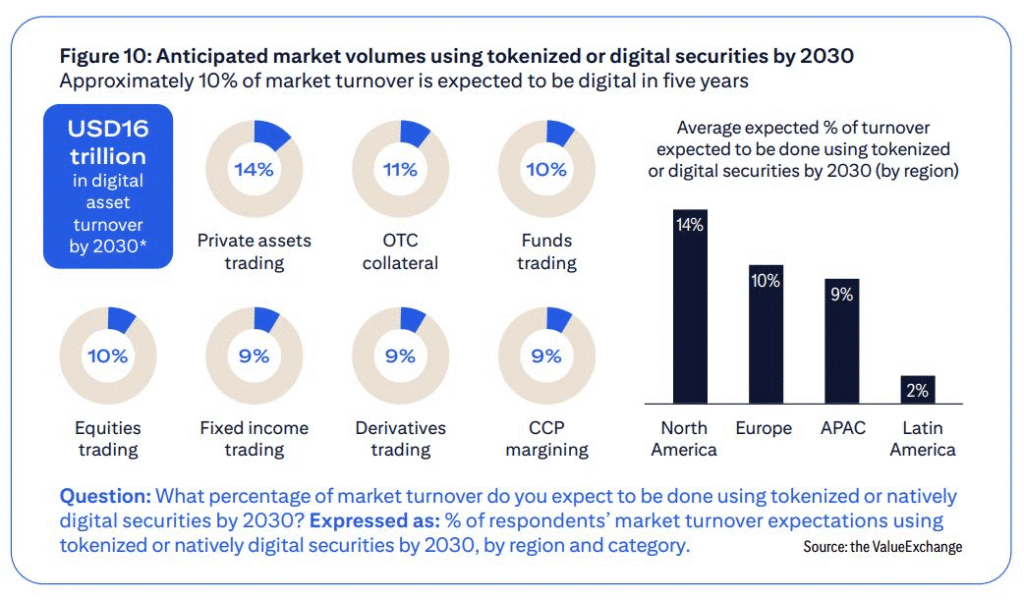
US markets were tipped to have the highest percentage of market turnover (Source: Citi)
Citi said American sentiment has shifted markedly in 2025, boosted by President Donald Trump’s signing of the GENIUS Act in July, which provides a regulatory framework for digital assets. Support from leading institutions such as Circle and BlackRock in scaling digital liquidity has also underpinned optimism.
GenAI’s Role in Post-Trade
Beyond tokenization, generative artificial intelligence (GenAI) is becoming a powerful force in post-trade modernization. The survey found 57% of organizations are piloting GenAI for post-trade operations, with nearly two-thirds of institutional investors using it in reconciliation, clearing, reporting, and settlements.
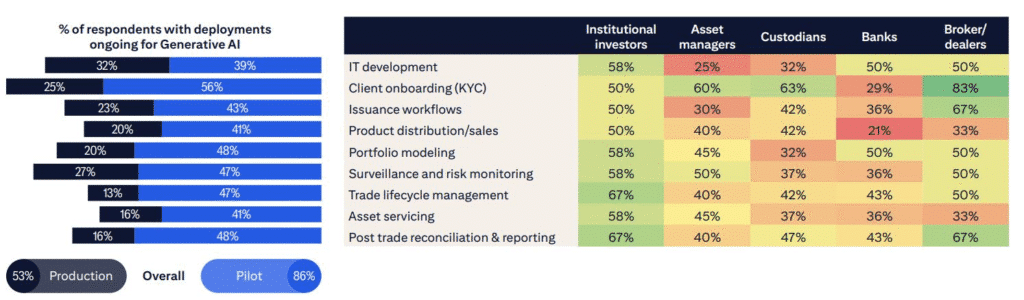
Over half the respondents said their organizations are piloting GenAI (Source: Citi)
The strongest adoption so far has been in onboarding, where 83% of brokers, 63% of custodians, and 60% of asset managers reported using GenAI to streamline client processes. Citi described onboarding as a “perfect starting point†that can bridge the gap between retail and institutional clients.
A New Era for Post-Trade Infrastructure
With momentum building around both stablecoins and AI, Citi believes the post-trade industry is entering a period of unprecedented change. “After years of groundwork, the global post-trade industry looks set for a period of transformation in speed, cost and resilience on an international scale,†the bank said.
If current forecasts hold, the next half-decade could mark one of the most significant shifts in financial infrastructure since the introduction of electronic trading.


