
Strategy May Add More Bitcoin, Narrowing the Gap to a 1 Million BTC Treasury
Michael Saylor has again signaled that Strategy is preparing to add more Bitcoin to its balance sheet, even as the company faces a market environment where many crypto treasury firms are trading closer to the value of their holdings rather than at the premiums seen during previous rallies.
On Sunday, Saylor posted the phrase “The Second Century Begins” on X together with Strategy’s Bitcoin accumulation chart, a move that investors now closely associate with pending purchase announcements.
The signal arrived while Bitcoin traded near $67,000, below the company’s average acquisition price and during a period when treasury-focused firms are under increased pressure from narrowing valuation gaps.
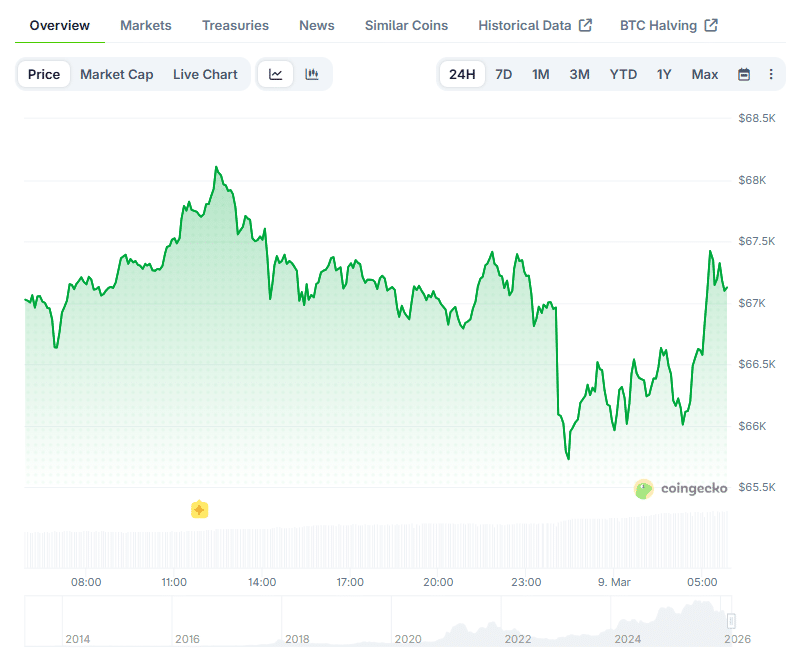
BTC price (Source: CoinGecko)
Strategy Continues Buying Despite Bitcoin Trading Below Average Cost
Strategy’s latest disclosed purchase came during the final week of February, when the company acquired 3,015 BTC for more than $204 million.
That purchase increased total holdings to 720,737 BTC, keeping Strategy firmly ahead of every other publicly listed corporate Bitcoin holder.
At current prices, the company’s Bitcoin treasury is worth roughly $48 billion. However, because Bitcoin remains below Strategy’s average purchase cost of around $75,985 per coin, the portfolio is still sitting under its aggregate acquisition level.
That has not altered the company’s long-standing accumulation plan. Strategy continues to use debt issuance and equity-related financing to expand its holdings, maintaining the same approach that has defined its treasury model for years.
Treasury Company Discounts Reflect Tougher Market Conditions
The broader environment for Bitcoin treasury companies has become more difficult in recent months. Firms built primarily around digital asset accumulation have seen net asset value premiums decline sharply, reducing the premium investors are willing to pay for indirect Bitcoin exposure through listed shares.
Strategy’s own basic net asset value ratio has now fallen to just below 1, meaning the company is trading at a slight discount to the market value of its Bitcoin reserves rather than above it.
That shift marks a significant contrast from earlier periods when Strategy’s stock frequently traded at a large premium because investors viewed it as one of the most accessible public-market Bitcoin vehicles.
Even with that discount in place, the company has not slowed its capital deployment. Strategy recently raised the monthly dividend on its STRC preferred shares to 11.5% for March 2026, a move aimed at sustaining investor participation while continuing treasury expansion.
Industry Leaders Expect Consolidation Among Treasury Firms
Some executives in the digital asset treasury sector believe 2026 could become a year of consolidation, particularly among firms whose only major asset is Bitcoin without supporting revenue-generating operations.
BTCS chief strategy officer Wojciech Kaszycki said companies trading below net asset value are increasingly vulnerable and may need to combine with stronger operators to improve survival prospects.
According to Kaszycki, firms that pair crypto treasury exposure with revenue streams such as blockchain validation services, mining operations, lending products, or unrelated operating businesses may be better positioned than companies that only accumulate Bitcoin.
Saylor Rejects Merger Strategy for Now
Despite growing discussion around consolidation, Saylor has dismissed the idea of buying distressed competitors or pursuing mergers.
He has argued that acquisitions often introduce uncertainty because they can take many months to complete, during which market conditions may change significantly.
In previous comments, Saylor said deals that initially appear attractive can lose strategic value by the time negotiations conclude, especially in a market where financing conditions and Bitcoin prices move quickly.
That position leaves Strategy focused on organic treasury expansion rather than sector consolidation.


