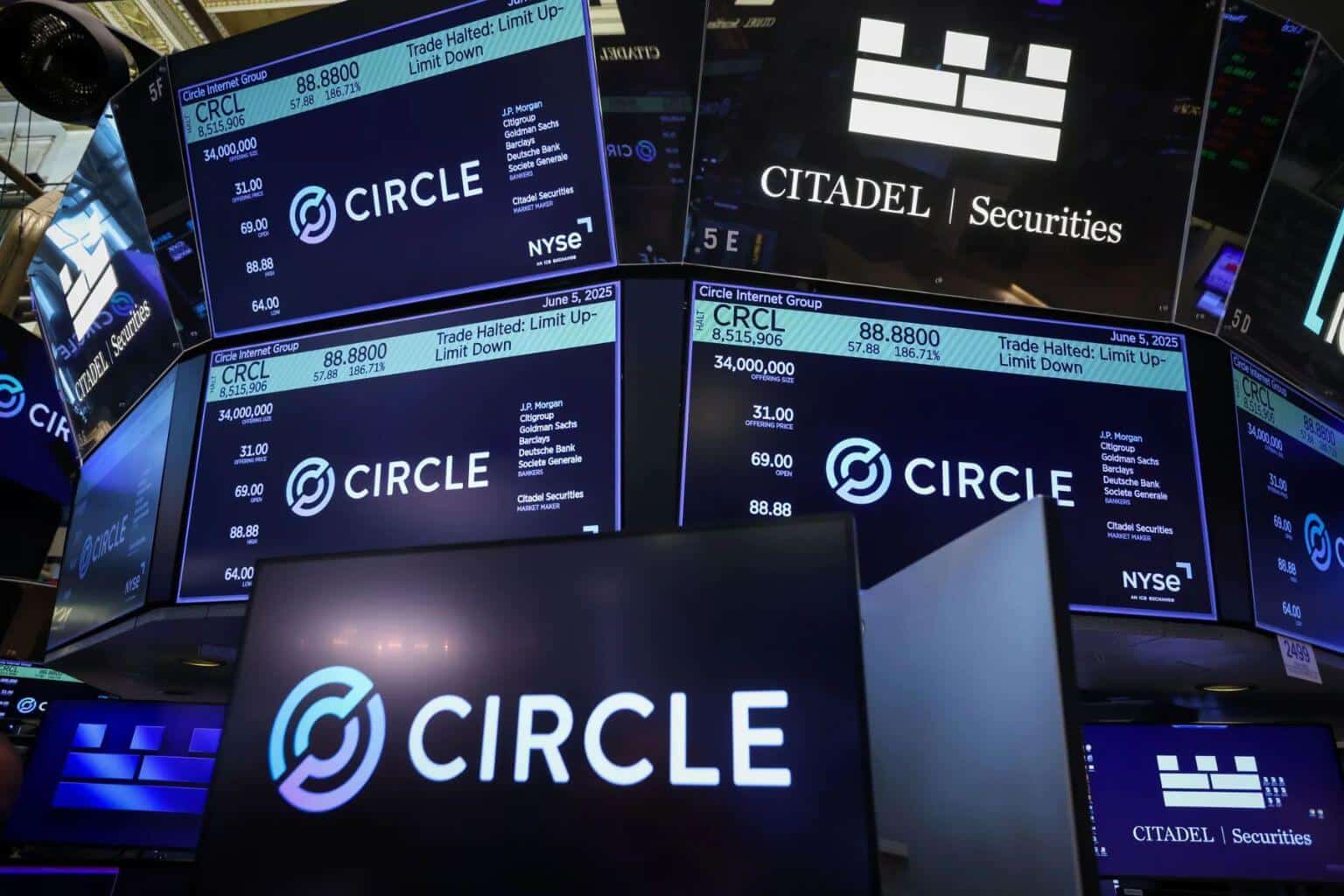
Circle Stock Soars 35% After Blowout Q4 as USDC Supply Jumps 72%
Stablecoin issuer Circle Internet Group delivered a fourth-quarter performance that exceeded Wall Street expectations, reinforcing the growing role of regulated stablecoins in global finance despite ongoing volatility across the broader crypto market.
Circle’s Fourth-Quarter Revenue and Profit Top Forecasts
For the quarter ended Dec. 31, 2025, Circle generated $770 million in revenue, representing a 77% increase compared with the same period a year earlier. Net income reached $133.4 million, or 43 cents per share, well above analyst projections of 16 cents per share on revenue of $747 million.
The earnings beat signals the strength of Circle’s core business model, which centers on issuing and managing fiat-backed digital currencies while building out payments and blockchain infrastructure services.
Investors reacted quickly to the results, sending shares of Circle (CRCL) up more than 20% in early Wednesday trading to nearly $74 after a strong pre-market rally. The company’s shares closed Wednesday’s session at $83.14, marking a more than 35% gain.

Circle share price (Source: Google Finance)
USDC Circulation Drives Growth
A major contributor to the quarter’s outperformance was rapid expansion in the circulation of USDC. By year-end, the stablecoin’s supply had climbed approximately 72% year over year to $75.3 billion.
The surge in circulation is a tell-tale sign of increasing institutional adoption of dollar-pegged stablecoins for liquidity management, trading collateral and cross-border settlements. As digital asset markets stabilize and regulatory clarity improves, USDC’s growth suggests that demand for transparent, fully reserved stablecoins remains resilient.
For the full year 2025, Circle reported revenue of $2.7 billion, up 64% from the prior year. Although the company posted a net loss of $70 million, executives attributed the result largely to $424 million in stock-based compensation expenses related to its 2025 initial public offering. Stripping out those IPO-related costs, Circle reported operating income of roughly $157 million, pointing to solid underlying performance.
Expansion of Payments and Blockchain Infrastructure
Beyond stablecoin issuance, Circle continued investing in infrastructure aimed at connecting traditional finance with blockchain-based systems.
During the quarter, the company launched a public testnet for Arc, a new blockchain infrastructure platform designed to help financial institutions develop tokenized financial applications.
Circle said more than 100 institutional participants have joined the Arc testnet, indicating early traction among banks and fintech firms exploring on-chain asset issuance and settlement.
The Circle Payments Network also expanded to 55 financial institutions. The network serves as a coordination layer enabling banks and payment providers to settle cross-border transactions using stablecoins. Additional companies are currently undergoing onboarding and eligibility reviews, suggesting continued pipeline growth.
EURC Posts Triple-Digit Growth
While USDC remains Circle’s flagship product, its euro-denominated stablecoin, EURC, recorded strong gains as well. EURC circulation reached 310 million euros, equivalent to roughly $365 million, representing a 284% increase year over year.
Though still significantly smaller than USDC, EURC’s expansion suggests growing interest in non-dollar digital settlement assets, particularly in European markets where regulatory frameworks for crypto assets have continued to evolve.
Regulatory Tailwinds and Lingering Policy Friction
Circle’s momentum comes amid a shifting regulatory landscape in the United States. The company has benefited from the passage of the GENIUS Act under President Donald Trump’s administration, which establishes a federal framework for payment stablecoins and clarifies oversight for issuers.
The clearer regulatory environment has been viewed as supportive for compliant issuers like Circle, helping to reduce uncertainty that previously weighed on the sector. However, not all legislative efforts have advanced smoothly. Progress on the CLARITY Act, a broader crypto market structure bill, has stalled amid tensions between crypto advocates and banking groups, particularly over stablecoin yield and reward mechanisms.
Despite those broader policy debates, Circle’s fourth-quarter results suggest that demand for regulated, dollar-backed stablecoins continues to expand. With USDC circulation rising sharply, payments partnerships deepening and new infrastructure initiatives underway, the company appears increasingly central to the evolution of digital dollar infrastructure.