
BBVA Joins Push for Regulated Euro Stablecoin Under MiCA
Spain’s BBVA, the country’s second-largest lender by assets, has joined a coalition of European banks seeking to launch a regulated euro-denominated stablecoin, marking a new push by traditional financial institutions to challenge the global dominance of dollar-pegged digital tokens.
The initiative, known as Qivalis, aims to build a bank-backed stablecoin designed specifically for the European market. With BBVA’s entry, the consortium now includes roughly a dozen major European Union banks, among them BNP Paribas, ING, and UniCredit.
BBVA alone manages about $800 billion in assets, making it one of the most prominent participants in the project so far.
Banks Target Dollar-Dominated Stablecoin Market
The Qivalis effort comes as stablecoins continue to play a central role in crypto markets and cross-border payments, but remain overwhelmingly tied to the U.S. dollar.
Of the roughly $300 billion global stablecoin market, only about $704 million is linked to the euro, highlighting a significant gap that European financial institutions now hope to fill.
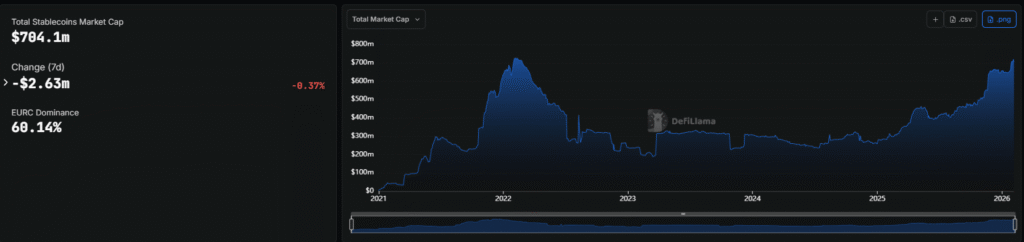
Euro stablecoin market cap (Source: DefiLlama)
Tether’s USDT, issued by a company headquartered in El Salvador, leads the sector with a market capitalization of about $185 billion. It is followed by Circle’s USDC, which is based in New York and carries a market cap of roughly $70 billion.
Together, dollar-denominated stablecoins account for the vast majority of the market, raising concerns in Europe about reliance on foreign-issued digital money.
By contrast, the proposed Qivalis token would be backed by a network of established banks and designed to operate under the European Union’s digital asset regulatory framework. The consortium’s stated goal is to offer a euro-native alternative that provides regulatory clarity, institutional trust, and closer alignment with the bloc’s financial system.
A Push for a European On-Chain Payment Rail
A euro-pegged stablecoin issued by major banks could enable businesses and consumers across the EU to settle payments on blockchain networks using euros, without depending on traditional banking rails or stablecoins issued outside the region.
Proponents argue that such an infrastructure could improve efficiency, reduce costs, and strengthen Europe’s financial sovereignty in the digital asset space.
“Collaboration between banks is key to create common standards that support the evolution of the future banking model,†said Alicia Pertusa, head of partnerships and innovation at BBVA Corporate & Investment Banking, in a statement announcing the move.
Jan-Oliver Sell, chief executive of Qivalis and a former Coinbase Germany executive, said BBVA’s participation shows growing institutional commitment to a shared European blockchain payments ecosystem.
“This step consolidates Qivalis’ standing as Europe’s foremost bank-supported stablecoin initiative,†Sell said. He added that the project is designed around the trust and compliance frameworks already embedded in the traditional banking system.
Regulatory Approval Under MiCA Framework
Qivalis is currently seeking authorization from the Dutch central bank to operate as an electronic money institution, a requirement for issuing stablecoins under the European Union’s Markets in Crypto-Assets (MiCA) regulation. The MiCA framework, which began taking effect in stages in 2024 and 2025, is widely seen as one of the most comprehensive digital asset regulatory regimes globally.
If approved, the consortium plans to debut the euro-backed token in the second half of 2026. The timeline reflects both regulatory procedures and the technical work required to integrate the stablecoin into banking systems and payment networks.
If successful, the Qivalis stablecoin could mark one of the first large-scale attempts by major European banks to jointly issue a blockchain-based currency, potentially reshaping how euros move across digital payment networks in the coming years.


