Tether Ends 2025 With $10B Profit and One of the Strongest Balance Sheets in Crypto
Tether, the issuer of the world’s largest stablecoin, reported more than $10 billion in net profit for 2025, capping a year marked by rapid growth in USDT circulation and a balance sheet increasingly anchored by U.S. Treasuries and gold.
According to its fourth-quarter attestation released Friday, Tether ended the year with $6.3 billion in excess reserves, comfortably exceeding its $186.5 billion in liabilities tied to issued tokens. The report was signed by BDO Italy and provides the most detailed snapshot yet of Tether’s financial position as stablecoins become more deeply embedded in global finance.
Record USDT Growth Drives Scale
USDT’s circulating supply expanded by roughly $50 billion over the course of 2025, climbing to more than $186 billion by year-end.
That growth reflects sustained global demand for dollar-pegged digital assets, particularly in crypto trading, cross-border payments, and regions facing currency volatility.
USDT has maintained its position as the dominant digital dollar, far outpacing rival stablecoins in circulation and on-chain usage. Market participants continue to rely on USDT as a primary source of liquidity across centralized exchanges, decentralized finance platforms, and peer-to-peer transfers.
Treasury Holdings Reach Historic Levels
A major contributor to Tether’s profitability has been its expanding exposure to U.S. government debt. The attestation shows the company holding $122 billion in direct U.S. Treasuries, with total exposure rising to $141 billion when overnight reverse repurchase agreements are included.
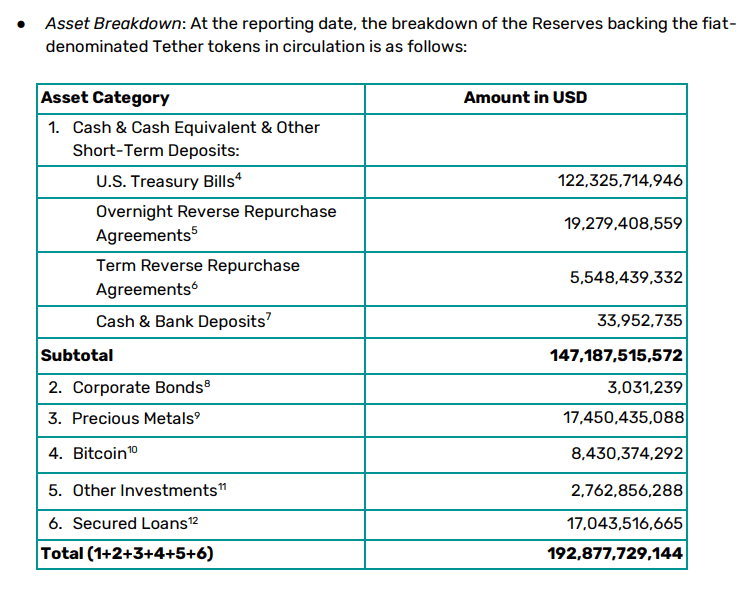
Assets backing USDT (Source: Tether)
That scale places Tether among the largest holders of U.S. government debt globally, alongside major sovereigns and institutional asset managers.
The growing Treasury portfolio has also allowed Tether to benefit from elevated interest rates, generating substantial yield while backing its dollar-denominated liabilities with highly liquid assets.
Gold and Bitcoin Add Hard-Asset Backing
In addition to Treasuries, Tether maintained sizable allocations to gold and Bitcoin. The company reported $17.4 billion in gold holdings and $8.4 billion in BTC at the end of the fourth quarter.
Gold has become an increasingly prominent component of Tether’s reserves. In a recent Bloomberg interview, CEO Paolo Ardoino said the firm has been acquiring physical gold at a pace of up to two tons per week, a rate that could translate into more than $1 billion in monthly purchases.
Investment Portfolio Separate From Reserves
Beyond assets backing issued stablecoins, Tether disclosed an investment portfolio valued at $20 billion. These investments are held separately from reserve assets and are not used to support USDT redemptions, but they contribute to the company’s overall profitability and capital strength.
“With USDT issuance at record levels, reserves exceeding liabilities by billions of dollars, Treasury exposure at historic highs, and strong risk management, Tether enters 2026 with one of the strongest balance sheets of any global company,†Ardoino said in a statement accompanying the report.
Regulatory Push And U.S. Expansion
The latest attestation comes as stablecoins face increasing regulatory scrutiny worldwide. Policymakers in the United States and Europe have intensified efforts to formalize oversight of stablecoin issuers, with a particular focus on reserve transparency and asset quality.
Against that backdrop, Tether has taken steps to strengthen its U.S. presence. Earlier this week, the company launched USAT, a new stablecoin tailored for the U.S. market, in partnership with Anchorage Digital, a federally chartered crypto bank.


