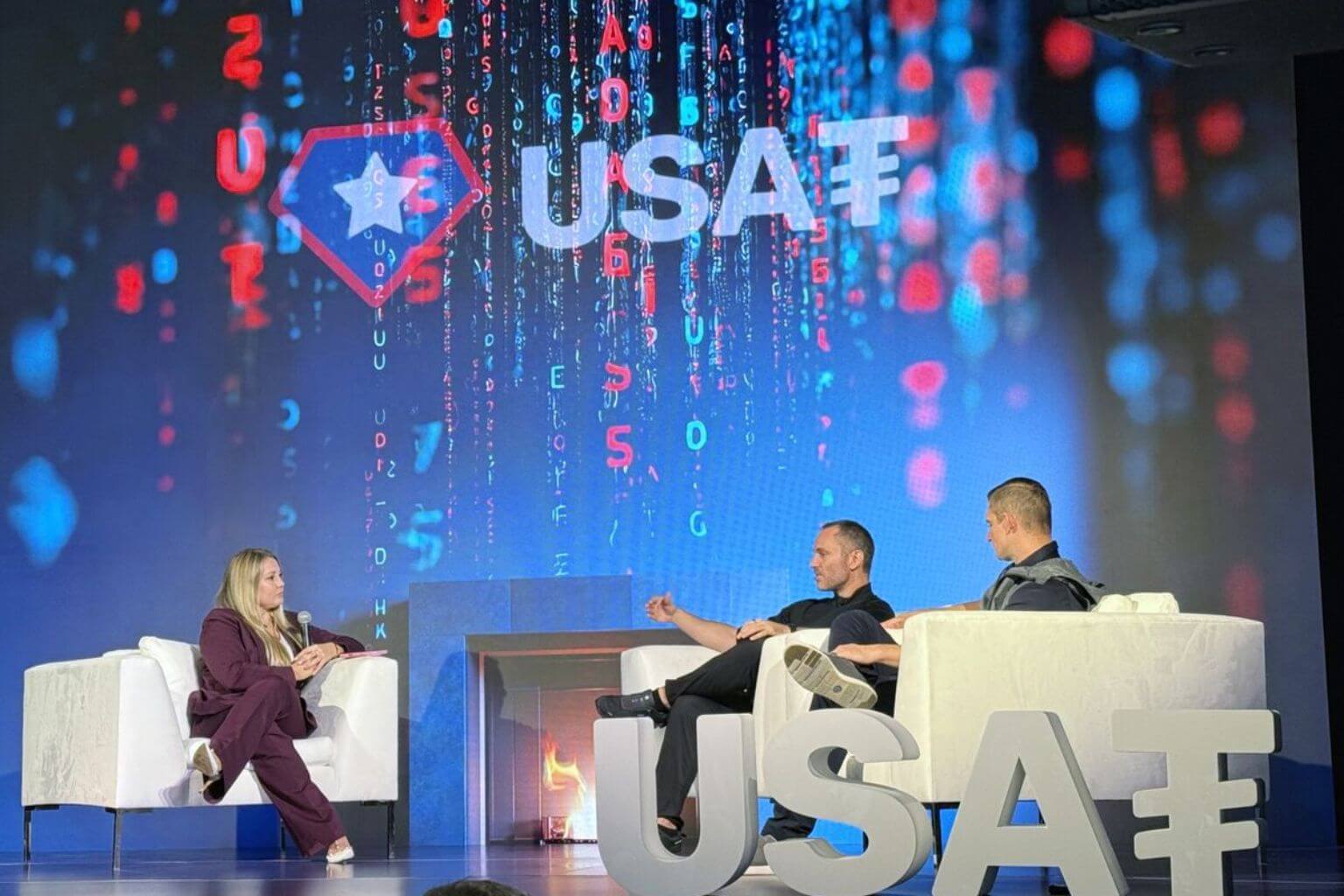
Tether Launches USA₮ — A Direct Shot at Circle’s USDC?
Tether has officially launched USA₮, a federally regulated, dollar-backed stablecoin built for the United States market and issued by Anchorage Digital Bank, N.A., the country’s first nationally chartered stablecoin issuer.
The debut marks the first stablecoin developed specifically to operate within the new federal regulatory framework created under the GENIUS Act, signaling a watershed moment for U.S. digital dollar infrastructure.
The release follows last year’s announcement naming Bo Hines, former Executive Director of the White House Crypto Council, as CEO of Tether USA₮.
U.S. users and institutions can now access USA₮ through major platforms including Bybit, Crypto.com, Kraken, OKX, and MoonPay, marking the first phase of market rollout.
A Digital Dollar Built for America’s New Regulatory Era
USA₮ represents a structural shift in the stablecoin landscape: the first token designed from inception to meet the federal expectations outlined in the GENIUS Act.
Unlike Tether’s global flagship USDT, which continues to operate internationally as the world’s most widely used stablecoin, USA₮ is purpose-built for regulated U.S. institutions seeking a compliant digital dollar issued through a nationally chartered bank.
Tether emphasized that USA₮ merges the operational maturity and scale of its global ecosystem with U.S.-specific oversight.
Cantor Fitzgerald serves as reserve custodian and preferred primary dealer—an arrangement analysts say provides instant credibility within traditional finance and guarantees transparent visibility into reserves from day one.
Anchorage Digital Bank provides the issuance and core banking infrastructure, including on-chain transparency, risk controls, and bank-grade compliance architecture. The companies framed USA₮ as not only compliant with federal rules, but engineered to function continuously within them at institutional scale.
“A Dollar-Backed Token Made in America”
Tether CEO Paolo Ardoino said the new stablecoin extends the company’s mission into a regulated domestic environment: “USA₮ offers institutions an additional option: a dollar-backed token made in America. USDT has proven for more than a decade that digital dollars can deliver trust and utility globally. USA₮ now provides a federally regulated product designed for the American market.”
Bo Hines, CEO of Tether USA₮, added that the digital dollar is designed to meet the highest levels of regulatory expectations: “Our focus is stability, transparency, and responsible governance, ensuring that the U.S. continues to lead in dollar innovation.”
A Direct Challenge to Circle’s USDC
USA₮ enters a U.S. market long dominated by Circle’s USDC, the $72 billion stablecoin favored by banks, payment processors, and fintechs operating under American oversight. While Tether’s USDT is far larger globally at $186 billion, analysts note that Tether has never before fielded a product engineered exclusively for U.S. regulatory compliance.
That changes with USA₮, and it could reshape domestic competition.
Noelle Acheson, author of Crypto Is Macro Now, said the new token is “a threat to USDC,” positioning itself squarely in the institutional arena Circle has occupied for years.
“USAT is designed to be institutional-grade, looking to attract clients that would otherwise be happy using USDC.”
Acheson cited several advantages: anchoring by a federally regulated bank, institutional partnerships through Cantor Fitzgerald, and the possibility of conversion pathways with USDT’s global liquidity. Acheson added that the presence of former White House official Bo Hines may help assuage longstanding concerns about Tether’s reserve governance.
Nicholas Roberts-Huntley, CEO of Blueprint Finance, argued that Tether’s entrance into the U.S. market sheds light on two major trends: growing institutional demand for regulated dollar tokens, and the shift in stablecoin competition from “size and utility” to “regulatory positioning and institutional trust.”
“USDC has operated without a credible domestic competitor… The launch of USAT could change that.”
A Strategic Move in the Global Stablecoin Race
The launch also reflects Tether’s broader macroeconomic ambitions.
With the Tether Group now ranking as the 17th-largest holder of U.S. Treasuries—ahead of countries like Germany and Australia—analysts view USA₮ as part of a larger strategy to reinforce the dollar’s digital dominance as geopolitical rivals explore alternatives.
USA₮, however, is not legal tender and does not carry FDIC or SIPC protections, a point Tether emphasized in its disclosure. The token is issued solely by Anchorage Digital Bank.
What Comes Next
With U.S.-regulated exchanges preparing to onboard USA₮ and Anchorage’s infrastructure enabling scalable institutional use, the token’s early trajectory will depend on adoption by banks, fintechs, and major payment networks—the domain where USDC has maintained a multi-year lead.
But for the first time, analysts say Circle faces a domestic challenger with global reach, deep reserves, and the largest stablecoin distribution network in the world.
Whether USA₮ reshapes the U.S. stablecoin hierarchy—or merely expands it—now becomes one of the defining market questions of 2026.


