
Vitalik Buterin Declares 2026 the Year Ethereum “Takes Back” Its Identity
Ethereum co-founder Vitalik Buterin says the network has strayed too far from its founding ideals of decentralization, privacy, and user sovereignty — and he wants 2026 to mark the beginning of a course correction.
In a post on X on Friday, Buterin warned that Ethereum has spent years compromising on core values in pursuit of mainstream adoption, and that the cost of those compromises has now become too high.
“2026 is the year that we take back lost ground in terms of self-sovereignty and trustlessness,†he wrote. “In 2026, no longer. Every compromise of values that Ethereum has made up to this point… we are making that compromise no longer.â€
His comments come at a time when Ethereum is grappling with growing pressure to scale, attract new users, integrate with traditional finance, and support increasingly complex applications — pressures that Buterin argues have pushed the ecosystem toward centralization and weakened user control.
Reversing a Decade of “Backslidingâ€
Buterin said that over the last ten years, Ethereum has gradually drifted away from the ideals that defined its early years.
“Nodes went from easy to run to hard to run. Dapps went from static pages to complicated behemoths that leak all your data to a dozen servers,†he wrote, criticizing the rise of centralized infrastructure and data-heavy Web3 applications.
To reverse this trend, Buterin outlined a number of priorities for the community, including:
- Improved private payments that better protect user identities
- Lower barriers for users to run full nodes, making Ethereum more trustless
- Decentralized apps that operate independently of centralized servers
- Better tools for users to control their own onchain data
- Enhanced social recovery wallets to reduce reliance on vulnerable seed phrases
Many of these areas, he said, have suffered from stagnation or regression as developers chased convenience, UX, and mainstream integration over technical purity.
Kohaku, Glamsterdam, and the Road Ahead
Buterin highlighted two upcoming upgrades — the Kohaku release and the Glamsterdam fork — as key steps toward restoring Ethereum’s decentralization.
“It will be a long road […] But it will make Ethereum into an ecosystem that deserves not only its current place in the universe, but a much greater one,†he said.
Ethereum Must Pass the “Walkaway Testâ€
Earlier in the week, Buterin also introduced a concept he calls the walkaway test. This is a measure of whether Ethereum could remain secure, functional, and decentralized even if all core developers stepped away.
“Being able to say ‘Ethereum’s protocol, as it stands today, is cryptographically safe for a hundred years’ is something we should strive to get to as soon as possible,†he said.
Achieving that level of resilience will require:
- Quantum-resistant cryptography
- A more scalable base-layer architecture
- A block-building model more resistant to centralization pressure
These improvements, he argued, are essential for Ethereum’s long-term survival and legitimacy.
A Call for Stronger Decentralized Stablecoins
Buterin also used this moment to push for more innovation in decentralized stablecoins, which is a sector he says has become overly dependent on dollar-pegged assets.
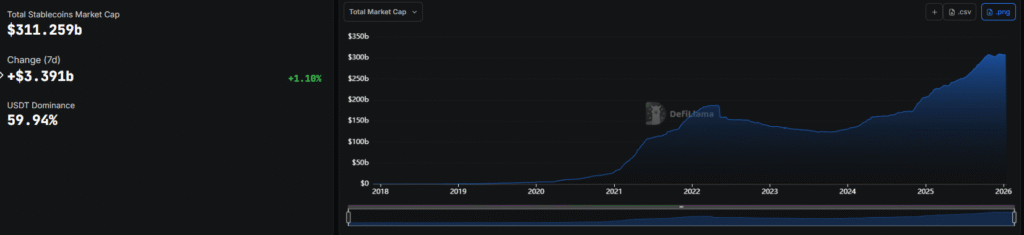
Stablecoin market cap (Source: DefiLlama)
Data from DefiLlama shows that the stablecoin market cap currently stands at over $311 billion. Of this total, tokens pegged to the greenback make up about $309 billion. Tether’s USDT stablecoin also dominates over 59% of the market.
To address that centralization, Buterin proposed a model backed by a diversified basket of assets and currencies, ensuring stability without relying on the financial strength or political stability of a single nation.
Such a stablecoin, he argued, would give people true independence from governments and the traditional financial system, bringing Ethereum closer to its philosophical foundations.
A Pivotal Year for Ethereum’s Identity
Buterin’s message carries a clear theme: for Ethereum to justify its global influence, it must once again prioritize trustlessness, censorship resistance, and long-term sustainability over short-term adoption metrics.
Whether the community will rally behind this renewed mission remains uncertain, but with major upgrades on the horizon and a growing cultural debate within the ecosystem, 2026 is shaping up to be a defining year for Ethereum’s direction.


