
CME Group Adds Cardano, Chainlink and Stellar Futures in Major Altcoin Push
CME Group, the world’s largest derivatives exchange, is expanding deeper into the altcoin market with the upcoming launch of futures contracts tied to Cardano (ADA), Chainlink (LINK) and Stellar (XLM).
The move marks one of the most significant steps yet in bringing regulated altcoin exposure to both institutional and retail traders.
The contracts, which are offered in both standard and micro sizes, are scheduled to go live on Feb. 9, pending regulatory approval. Industry analysts say the listings highlight growing institutional confidence in the price integrity of these assets, as well as rising demand for risk-management tools beyond bitcoin and ether.
A New Wave of Regulated Altcoin Futures
CME’s new futures lineup introduces several size options designed to meet the needs of a wide trading base.
Standard Cardano futures will be sized at 100,000 ADA per contract, while micro futures will represent 10,000 ADA. Chainlink contracts will contain 5,000 LINK in the standard version and 250 LINK in the micro format. Stellar futures will carry 250,000 XLM in standard contracts and 12,500 XLM in their micro counterparts.
“Given crypto’s record growth over the last year, clients are looking for trusted, regulated products to manage price risk as well as additional tools to gain exposure to this dynamic market,†said Giovanni Vicioso, CME Group’s Global Head of Cryptocurrency Products, in a statement.
He added that offering both micro and standard sizes will give market participants “greater choice with enhanced flexibility and more capital-efficiencies.â€
Micro contracts have proven especially popular among smaller traders and institutions testing market exposure without committing to the larger capital requirements of standard futures. For altcoins, which generally have higher volatility than bitcoin or ether, smaller-sized contracts may provide a more accessible entry point.
Strengthening Institutional Confidence
CME’s decision to list futures tied to ADA, LINK and XLM signals a deeper shift in institutional appetite. Adding these tokens, each with long-standing market presence and strong use-cases, indicates that major financial players are seeking regulated instruments to manage risk and gain directional exposure.
Historically, CME futures listings have helped pave the way for U.S. spot ETF approvals by reinforcing confidence in an asset’s market structure and price discovery.
That has proven true for bitcoin and ether, and industry observers believe the new altcoin futures could set the stage for future spot ETF discussions centered around these networks.
The assets being listed represent some of the most established projects in the crypto ecosystem. Cardano, a programmable blockchain known for its peer-reviewed development process, currently holds a market capitalization of $14.14 billion, making it the 10th-largest cryptocurrency globally.
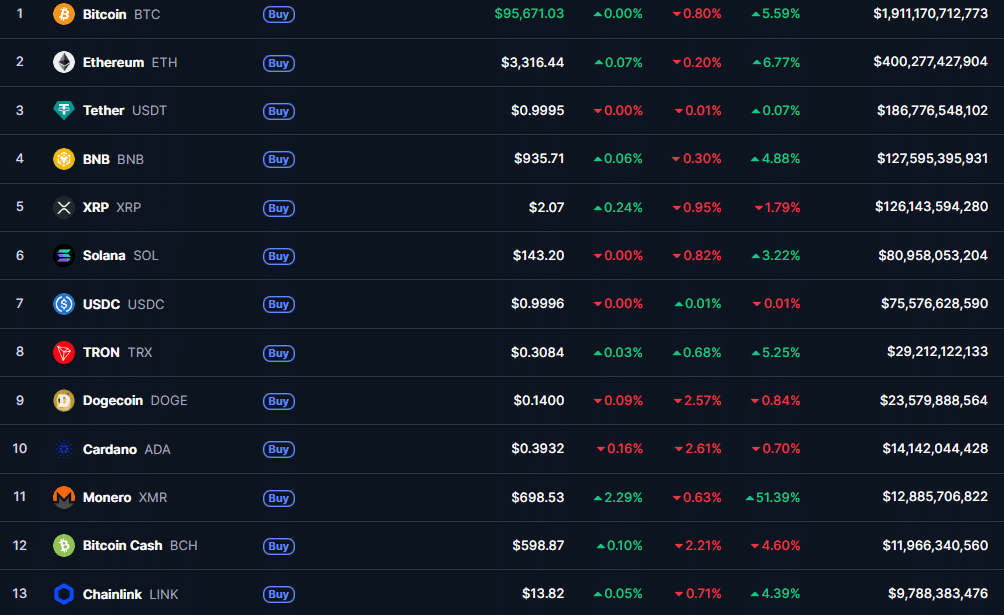
Top cryptos by market cap (Source: CoinMarketCap)
Chainlink, the leading oracle network powering real-world data feeds for smart contracts, has a $9.78 billion valuation. Stellar’s XLM token, supporting smart contracts and global payment rails, stands at a $7.38 billion market cap, placing both assets firmly among the top 25 cryptocurrencies.
CME’s Crypto Expansion Continues
Since pioneering mainstream crypto derivatives with its bitcoin futures in 2017, CME has steadily built out one of the most comprehensive regulated crypto derivatives markets in the world. Its current offerings include futures and options tied to bitcoin, ether, XRP and solana.
The exchange’s momentum accelerated sharply in 2025.
That year, CME recorded its strongest crypto derivatives performance to date, with average daily volume hitting 278,300 contracts — equivalent to roughly $12 billion in notional value. Average open interest climbed to 313,900 contracts, or $26.4 billion in notional terms, underscoring just how deeply institutional trading has penetrated the crypto sector.
The addition of Cardano, Chainlink and Stellar futures could push those records even higher by broadening CME’s customer base and offering new opportunities for hedging, arbitrage and speculative positioning.
A Sign of What Comes Next
With regulated altcoin tools becoming increasingly standard, CME’s latest expansion may represent the early stages of a wider shift. As more institutions seek diversified crypto exposure, exchanges and issuers may accelerate product development around high-liquidity altcoins.
If approved, the new futures will mark another milestone in merging traditional financial infrastructure with the broader digital asset economy — and could help shape the next chapter of institutional crypto adoption.


