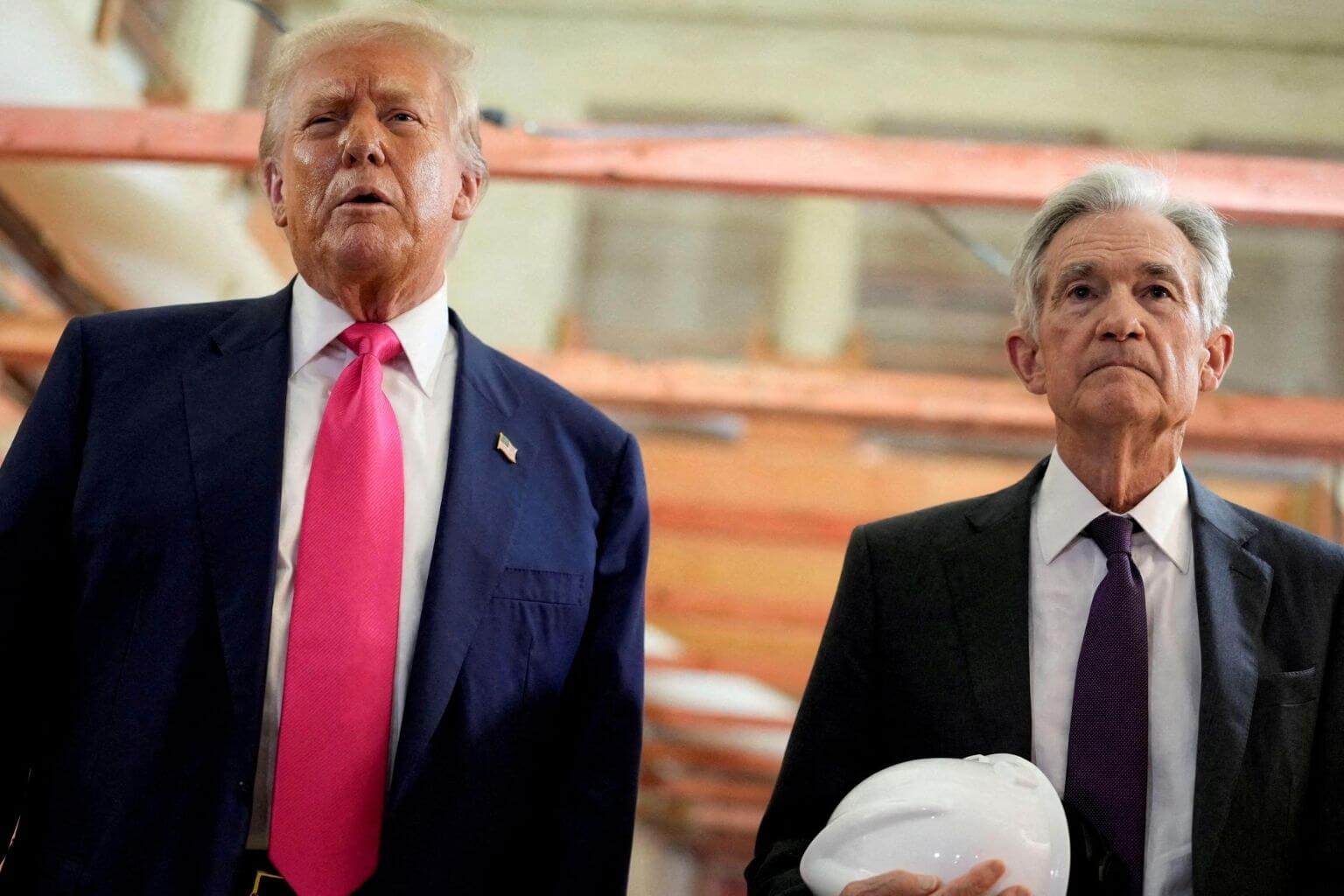
Trump Backs Off Firing Powell for Now as Fed Faces Criminal Probe and Stubborn Inflation
President Donald Trump said he does not currently plan to fire Federal Reserve Chair Jerome Powell, despite an ongoing Justice Department probe into the central bank’s headquarters renovation and rising political pressure around the Fed’s interest-rate decisions.
“I don’t have any plan to do that,” Trump told Reuters in an interview published Wednesday. Still, he signaled that the investigation could alter his stance, saying it is “too early” to determine whether the findings might give him grounds to remove Powell.
“Right now, we’re (in) a little bit of a holding pattern with him, and we’re going to determine what to do,” Trump said. “But I can’t get into it.”
Federal law allows the president to fire Federal Reserve governors only for cause, not over policy disagreements — a point that has drawn renewed scrutiny as the probe intensifies and Trump weighs whom to nominate as the Fed’s next chair.
Political Pressure Builds as Probe Widens
The Justice Department recently served the Federal Reserve with grand jury subpoenas related to its $2.5 billion headquarters renovation and Powell’s congressional testimony about the project. Powell has accused the administration of using the investigation as a pretext to pressure the central bank over interest-rate policy.
“This is about whether the Fed will be able to continue to set interest rates based on evidence and economic conditions — or whether instead monetary policy will be directed by political pressure or intimidation,” Powell said Sunday.
Trump dismissed Republican concerns that the investigation is intended to influence rate policy. “I don’t care,” the president said when asked about GOP lawmakers who called the probe politically motivated. “They should be loyal. That’s what I say.”
Despite the controversy, Trump said he plans to move ahead with nominating Powell’s successor “over the next few weeks,” even as Senator Thom Tillis, a retiring Republican on the Senate Banking Committee, has threatened to block Fed nominees until the investigation is resolved.
Trump praised two potential picks — White House economic adviser Kevin Hassett and former Fed Governor Kevin Warsh — calling them “very good.”
Inflation Data Keeps Rate Cuts at Bay
The political turmoil comes as new inflation data suggests the Fed is unlikely to cut interest rates in the near term.
Fresh readings from the Labor Department showed wholesale prices rising 3% in November and 2.8% in October — figures delayed by the recent government shutdown and released together on Wednesday.
Even after stripping out food, energy, and trade services, core wholesale prices climbed 3.5% over the past year, the steepest increase since March. Economists noted, however, that the hotter-than-expected reading was mostly driven by upward revisions to September data.
Consumer inflation was similarly sticky in December: the core Consumer Price Index rose 2.6% year-over-year, matching its pace from September to November and remaining above the Fed’s 2% target.
Using the latest consumer and wholesale price data, Capital Economics economist Stephen Brown estimated that the Fed’s preferred inflation gauge — the core Personal Consumption Expenditures index — could rise to 3%, up from an estimated 2.8% in recent months.
Tariffs Begin to Bite, Fed Officials Split on Timing of Cuts
The Fed’s latest Beige Book report showed tariff-related cost pressures emerging across the economy. Some companies that had initially absorbed the added costs have begun passing them on to customers, though retailers and restaurants remain hesitant. Businesses expect price growth to moderate later this year but remain elevated overall.
Still, the economic backdrop has improved modestly. Eight of the Fed’s 12 districts reported slight increases in activity in early January, with only one noting a small decline.
Fed officials, meanwhile, are sifting through the inflation data and diverging over how quickly price pressures will ease.
Philadelphia Fed President Anna Paulson said she expects tariff-driven goods inflation to fade by mid-year and sees a “decent chance” that three-month inflation will fall back to 2% by year-end. She anticipates “modest further adjustments” to interest rates later this year.
Fed Governor Stephen Miran projects a more aggressive path, penciling in 150 basis points of rate cuts in 2026 — far above the median expectation for one 25-basis-point cut — arguing that a lower neutral rate and slower population growth will push inflation down.
Minneapolis Fed President Neel Kashkari was more cautious, saying inflation is declining but its trajectory remains uncertain. He warned that cutting rates too quickly could unintentionally worsen inflationary pressures, particularly for lower-income households already strained by higher prices.
“Overall, the economy seems quite resilient,” Kashkari said. “That makes me question how tight policy is right now.”
The Fed is widely expected to hold rates steady at its Jan. 29–30 meeting, maintaining the current range of 3.5% to 3.75% as policymakers await clearer signals from both the economy — and the White House.


