
Stablecoins Are Still Fragile, Vitalik Buterin Says — Here’s What’s Broken
Ethereum co-founder Vitalik Buterin says the crypto sector has yet to overcome several foundational design flaws preventing the creation of durable, truly decentralized stablecoins.
In a post published on X on Sunday, Buterin outlined three core issues that remain unresolved, cautioning that many current models rely on assumptions that could break down under real-world economic or political stress.
Rather than proposing a new stablecoin design, Buterin framed his post as a technical critique of existing systems and a call for deeper architectural rethinking.
Dollar Dependence Remains a Systemic Weakness
Stablecoins, whether centralized or decentralized, are typically pegged to the U.S. dollar. Buterin argued that this approach contradicts the long-term resilience that decentralized systems aim to achieve. While tracking the dollar makes sense today, he warned that tethering decentralized stablecoins to a single national currency exposes them to inflation and long-term macroeconomic shifts.
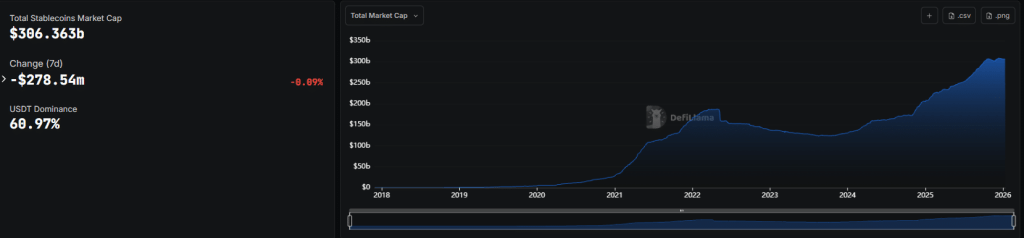
US-pegged stablecoins account for over $306B of the tokens’ $307.7B market cap (Source: DefiLlama)
Over decades, he said, even moderate inflation could erode the usefulness of a dollar peg. Instead, he suggested that future designs may need to track broader purchasing power metrics or consumer price indexes rather than relying solely on the dollar.
Oracle Vulnerabilities Undermine Decentralization
Another major concern raised by Buterin involves oracles — the infrastructure that delivers real-world price data to blockchain systems. Because blockchains cannot access external data independently, they rely on oracles to provide price feeds essential to maintaining a stablecoin’s peg.
Buterin warned that if an oracle can be manipulated by someone with enough financial firepower, the entire stablecoin risks failure. In such cases, protocols must defend themselves economically rather than technologically, which often means building systems where the cost of attack must exceed all value inside the protocol.
That dynamic, he argued, leads to “financialized governance,” where protocols compensate for weak defenses by imposing higher fees, inflation, or concentrated governance power — ultimately shifting risk onto users.
Staking Yield Creates Hidden Incentive Tensions
Buterin’s third critique focused on staking yield on Ethereum.
Today, many decentralized stablecoins use staked ether as collateral. But because staked ETH generates yield, stablecoin users are implicitly giving up returns they could otherwise earn — a structural imbalance he considers problematic.
To illustrate the narrow path available to designers, Buterin outlined three high-level approaches: lower staking yields to minimal levels, develop new forms of staking with lower risks, or shift staking risks — including slashing penalties — more directly onto stablecoin users. None of these outcomes are ideal, he stressed, and none represent actual proposals.
Misunderstood Slashing Risks Complicate Collateral Design
A recurring theme in Buterin’s post was slashing — the penalty imposed on validators for downtime, incorrect behavior, or even being on the losing side of a network-wide censorship dispute. He said slashing risk is widely misunderstood, noting that it can be triggered not only by malicious activity but by unforeseen events such as network outages or geopolitical conflicts.
Because slashing can reduce the value of staked collateral, Buterin argued that designing stablecoins around staked ETH introduces volatility that many builders underestimate.
Buterin also warned that decentralized stablecoins cannot rely on fixed collateral ratios. When markets move aggressively, systems must be able to rebalance in real time to remain solvent. Without dynamic adjustments, stablecoins risk losing their peg during periods of high volatility — precisely when stability is most needed.
A Call for Deeper Rethinking, Not Incremental Tweaks
Buterin’s post stands as one of his most pointed critiques of decentralized stablecoin architecture in recent years. While he did not advocate for a specific solution, his message was clear: without rethinking collateral models, oracle design and incentive structures, the industry remains far from achieving a censorship-resistant, long-lasting and truly decentralized alternative to traditional money.


