
Bitcoin Mining Difficulty Slips, But Profitability Crisis Still Looms Over Miners
Bitcoin’s mining landscape saw a modest but notable shift this week, as the network’s mining difficulty—an automatic measure that determines how hard it is for miners to add new blocks—eased slightly in its first adjustment of 2026.
The metric fell to 146.4 trillion on Thursday, offering a brief respite to miners after one of the toughest operating environments in the industry’s recent history.

Bitcoin network difficulty (Source: Blockchain.com)
According to data from CoinWarz, the network’s next scheduled difficulty adjustment is expected on Jan. 22, 2026, at approximately 04:08 UTC.
That update is projected to push difficulty upward again, from 146.47T to 148.20T, as the network recalibrates around current conditions. With average block times running at 9.88 minutes—slightly faster than Bitcoin’s targeted 10-minute interval—the system is signaling for a small increase to bring block production back in line.
Charts from Blockchain.com show that while mining difficulty reached a series of new highs throughout 2025, the year closed below the record peak of 155.9 trillion set in November. Even so, the overall trend remains upward, underscoring the mounting competitive pressures within the mining sector.
A Year of Record Hardship for Miners
Behind the numbers lies a broader story of strain and survival. Industry analysts have characterized 2025 as the harshest margin environment on record for Bitcoin miners, driven by a convergence of structural and macroeconomic factors.
The most significant blow came from the April 2024 halving, which cut the block subsidy from 6.25 BTC to 3.125 BTC, instantly reducing miners’ revenue by half. While the halving is a predictable event in Bitcoin’s monetary schedule, its effects were amplified by worsening external conditions.
A prolonged downturn in the crypto market—accelerating sharply after a flash crash in October—sent Bitcoin into a steep decline. By November 2025, BTC had lost more than 30% over the course of a month, briefly falling to just above $80,000. Although prices have since recovered to around $90,669, they remain far from the $125,000+ all-time high reached earlier in October.
For miners, the price slump was paired with another crippling metric: miner hash price, the industry’s primary gauge of profitability. This metric measures the expected revenue per petahash of computing power. Analysts widely consider $40 per PH/s per day the rough breakeven threshold. By November, hash price plunged below $35, hitting its lowest point in years and forcing miners to weigh whether keeping their rigs online was financially viable.
Charts from Hashrate Index show how dramatically miner revenue collapsed over the past 12 months, especially as difficulty remained elevated while bitcoin prices sank. The result was a compression in margins that pushed many operations toward cost-cutting, shutdowns, or strategic repositioning.
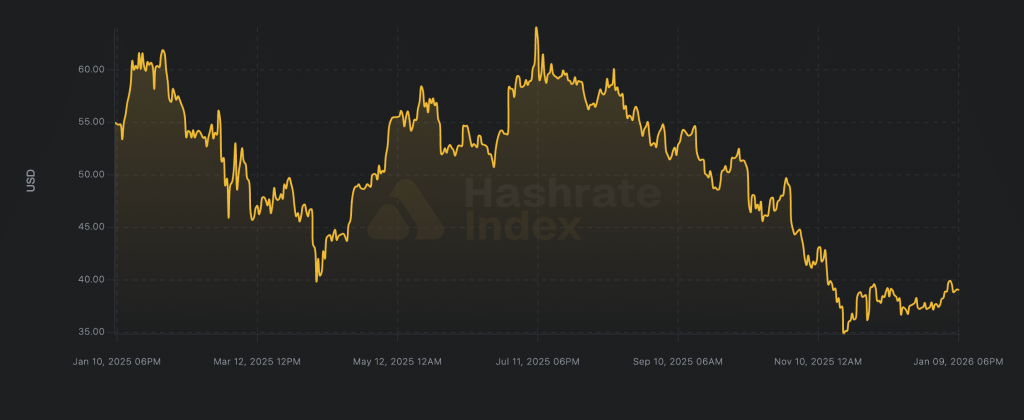
Miner hash price over a 1-year period (Source: Hashrate Index)
Tariffs, Supply Chains, and Global Pressure
Adding to the financial challenges were new tariffs imposed by U.S. President Donald Trump in 2025. These measures contributed to supply chain uncertainty, particularly for specialized hardware such as ASIC mining rigs, most of which are manufactured in Asia. Mining firms warned throughout the year that increased import costs and potential equipment shortages could undermine their ability to remain competitive.
Those pressures coincided with shifting energy markets, regulatory uncertainty in multiple jurisdictions, and heightened competition among industrial-scale mining companies—many of which expanded aggressively during the bull cycle.
A Difficult but Determined Industry
Despite the headwinds, Bitcoin’s mining sector has shown resilience. Network hashrate remains historically high, difficulty is poised to climb again later this month, and miners continue to innovate with new energy strategies, operational efficiencies, and diversification into adjacent technologies like artificial intelligence—an emerging theme expected to shape the sector’s evolution in 2026.
Still, profitability remains thin. Unless Bitcoin’s price rallies more convincingly or hash price improves, miners may face continued volatility throughout the year.
For now, the slight dip in difficulty offers a temporary reprieve—but the competitive climb looks set to resume within days.


