
Strategy Jumps 6% as MSCI Backs Away—For Now—From Crypto Treasury Crackdown
Shares of Strategy (MSTR) surged in after-hours trading on Tuesday after MSCI said it would not, for now, move forward with plans to exclude digital asset treasury companies from its major equity indexes.
The decision sparked an immediate relief rally across crypto-linked equities, easing fears that a rule change could force large institutional investors to divest.
Strategy shares climbed nearly 6% following the announcement, rebounding after spending much of the session under pressure as investors braced for a potentially adverse outcome.
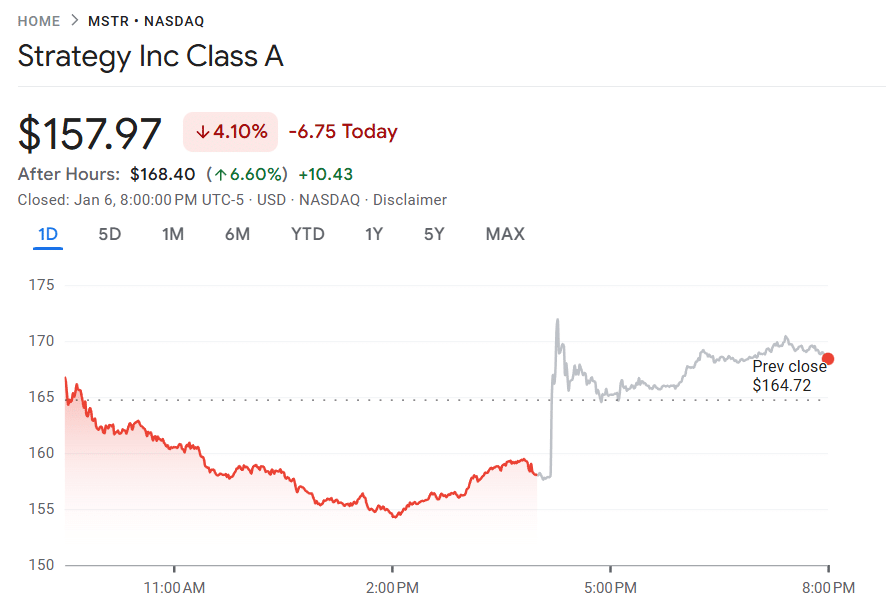
Strategy share price (Source: Google Finance)
The company is widely seen as the bellwether for digital asset treasury firms due to its outsized holdings of Bitcoin and its prominence in equity indexes tracked by passive investment funds.
Why MSCI Chose to Delay a Decision
In a statement released Tuesday, MSCI said it requires additional research and broader consultation before changing how it treats companies whose balance sheets are dominated by digital assets.
The index provider highlighted the complexity of distinguishing between investment companies and operating businesses that hold non-operating assets—such as cryptocurrencies—as part of their core treasury strategy rather than purely for investment purposes.
“Distinguishing between investment companies and other companies that hold non-operating assets, such as digital assets, as part of their core operations rather than for investment purposes requires further research and consultation with market participants,” MSCI said. The firm added that assessing eligibility across a range of such entities may require new inclusion criteria, potentially based on financial statements or other indicators.
For the time being, MSCI said the current index treatment of digital asset treasury companies—often referred to as DATCOs—will remain unchanged. These firms are generally defined as companies whose digital asset holdings account for 50% or more of total assets.
A Major Relief for Strategy and Its Peers
The announcement was closely watched by investors, as a negative decision could have had sweeping consequences for Strategy and other companies pursuing similar treasury strategies. Exclusion from major MSCI indexes would likely have triggered forced selling by index-tracking funds, cutting off a key source of passive capital inflows.
With that risk temporarily removed, sentiment improved quickly. Other digital asset treasury firms, including Bitmine Immersion, Sharplink, and Twenty One Capital, posted modest gains in post-market trading.
Analysts Welcome the Reprieve, But Stay Cautious
Equity analysts largely welcomed MSCI’s decision but warned that it may represent only a temporary pause rather than a definitive resolution.
Lance Vitanza of TD Cowen described the move as a positive surprise, noting that it was more favorable than many investors had expected.
“What remains to be seen is whether this represents a victory for the defense or merely a stay of execution,” Vitanza wrote. He reiterated a buy rating on Strategy shares with a $500 price target, according to FactSet data.
Benchmark analyst Mark Palmer, one of the most bullish voices on Strategy, also viewed the decision as a meaningful near-term positive. He said MSCI’s move suggested that Strategy’s arguments against exclusion may have resonated with the index provider. Palmer maintains a buy rating on the stock with a $705 price target.
However, Palmer echoed a more cautious tone on the longer-term outlook. He warned that MSCI’s broader review of non-operating companies means the issue is far from settled.
“This episode is not yet over,” he said, pointing to the possibility that revised rules could still emerge after further consultation.
Broader Implications for Crypto Treasury Companies
The outcome has significance beyond Strategy alone. As more publicly listed companies adopt Bitcoin and other digital assets as a core treasury strategy, index providers are under increasing pressure to clarify how such firms should be classified.
The debate strikes at the heart of what equity indexes are meant to represent: operating businesses, investment vehicles, or some hybrid of the two.
If MSCI ultimately revises its methodology to exclude companies deemed non-operating, digital asset treasury firms could face renewed scrutiny and potentially lose their place in key benchmarks. Such a move would likely reshape institutional exposure to the sector and could dampen enthusiasm for crypto-heavy balance sheets.
For now, however, the market is treating MSCI’s decision as a meaningful reprieve. With immediate exclusion risks off the table, at least temporarily, investors appear willing to re-engage with Strategy and its peers—while remaining keenly aware that the longer-term rules governing digital asset treasury companies are still under review.


