
Bitcoin Treasury Stocks Are Cracking as Discounts Replace Last Year’s Boom
Nearly 40% of major Bitcoin treasury companies now trade at discounts to their net asset value, according to data from BitcoinTreasuries.
At least 37 of the top 100 publicly listed firms that hold Bitcoin are valued by investors at less than the BTC sitting on their balance sheets — a sharp reversal from the premium-fueled boom that dominated most of last year.
For the first three quarters of 2025, Bitcoin treasury companies enjoyed a powerful tailwind. Shares routinely traded above the value of the Bitcoin they held, allowing firms to issue new stock at a premium, buy more Bitcoin, and repeat the cycle without diluting shareholders.
The strategy attracted scores of companies — many with no prior crypto exposure — eager to tap into rising demand for regulated Bitcoin exposure.
The result was a rush that swelled the ranks of Bitcoin-holding public firms to nearly 200, collectively amassing more than 1 million Bitcoin worth roughly $96 billion. But this playbook only works as long as equity trades above the underlying crypto.
That condition no longer holds.
Strategy, the sector’s pioneer, traded at more than double the value of its Bitcoin holdings last year. Today, it sits at a 17% discount.
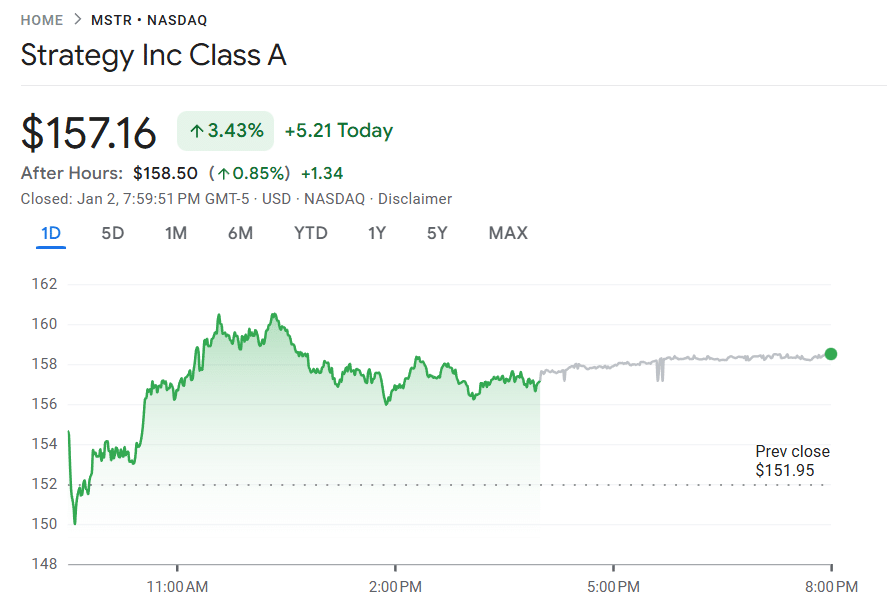
Strategy share price (Source: Google Finance)
The broader trade began to unravel in October, and by year-end, only one Bitcoin treasury company — France’s The Blockchain Group — managed to outperform the roughly 16% return of the S&P 500 in 2025.
Every other treasury underperformed the benchmark, and roughly 60% of firms spent more acquiring Bitcoin than those holdings are currently worth.
Echoes of the Grayscale era
For macro analyst Alex Kruger, the downturn has an uncomfortable historical parallel.
“When it comes to analogies across cycles and Bitcoin treasury companies, June 2025 is analogous to December 2020 and the Bitcoin Grayscale trade,†Kruger said.
In 2020, Grayscale’s flagship Bitcoin trust traded at a 40% premium because it was one of the only regulated vehicles available to institutions. This premium collapsed once spot Bitcoin ETFs launched, giving investors easy access through firms like BlackRock and Fidelity. Grayscale eventually flipped to a deep discount, trapping investors who were forced to exit at steep losses.
Kruger sees a similar dynamic emerging among Bitcoin treasury companies now that the novelty has worn off and equity markets are less willing to reward balance-sheet BTC with premium valuations.
Discounts, dilution, and consolidation
The list of companies trading below net asset value spans the spectrum.
Alongside Strategy, Twenty One Capital — another top-five treasury — also trades at a 17% discount. Smaller players fare far worse. Sweden-based H100 Group trades at a 32% discount, while Vanadi Coffee is valued at a 61% discount to its Bitcoin holdings.
Several others hover just above parity, including Brazil-based OranjeBTC. Any modest equity sell-off could push them below net asset value, cutting off access to capital markets.
That dynamic is fatal to the original treasury model. Companies trading below 1.0x mNAV cannot issue shares to buy more Bitcoin without destroying shareholder value. What was once a self-reinforcing growth loop becomes little more than buy-and-hold speculation.
“The model is an abomination,†Kruger said.
As weaker firms struggle, consolidation appears increasingly likely. In September, Bitcoin treasury Strive acquired Semler Scientific in an all-stock deal, signaling how distressed treasuries could become targets.


