Fed Minutes Flag a Quiet Risk: Why Liquidity, Not Rates, Has Officials on Edge
The minutes from the Federal Reserve’s December policy meeting reveal a growing concern that sits largely outside the public debate over inflation and rate cuts: whether the financial system could quietly run short of cash even if interest rates remain relatively stable.
Released on Dec. 30, the record of the Dec. 9–10 meeting of the Federal Open Market Committee shows policymakers broadly comfortable with the macroeconomic backdrop. Investors had largely expected a quarter-point rate cut at that meeting and were already pricing in additional reductions in 2026.
Rate expectations shifted little during the intermeeting period, suggesting no major surprise in the Fed’s policy direction.
Short-Term Funding Markets Show Signs of Strain
While rates dominated market expectations, the minutes show that officials devoted significant attention to conditions in short-term funding markets. These markets, where banks and financial firms borrow and lend cash overnight, are essential to daily financial operations and can become fragile quickly when liquidity tightens.
Participants noted that several indicators pointed to mounting pressure. Overnight repo rates were elevated and volatile, gaps between market rates and the Fed’s administered rates had widened, and usage of the Fed’s standing repo facility had increased.
Together, those signals suggested that liquidity conditions were becoming more sensitive to shifts in demand.
Reserves Enter a More Fragile Zone
At the core of the discussion was the level of reserves in the banking system. The minutes state that reserves had fallen to what the Fed considers “ample” levels. However, several officials emphasized that this designation marks a transition zone rather than a true buffer.
When reserves sit near the lower bound of comfort, even modest fluctuations in demand can push overnight borrowing costs higher and strain funding markets. Policymakers warned that the system becomes less forgiving in this range, increasing the risk of sudden disruptions.
Parallels Drawn With the 2019 Repo Shock
Some participants compared current conditions to the Fed’s 2017–2019 balance-sheet runoff, which ended with a sharp spike in repo rates in September 2019. Notably, officials suggested that present pressures may be building more quickly than they did during that earlier episode.
The comparison brought attention to the risk that funding stress could escalate rapidly if reserves continue to decline without offsetting measures, a scenario the Fed is keen to avoid.
Seasonal Drains Could Intensify Liquidity Pressures
Seasonal factors added another layer of concern.
Staff projections showed that year-end balance-sheet pressures, late-January shifts, and a large springtime drain tied to tax payments flowing into the Treasury’s account at the Fed could significantly reduce reserves.
Without intervention, those flows could push reserve levels below what policymakers consider comfortable, raising the likelihood of disruptions in overnight markets during periods of elevated demand.
Treasury Purchases Framed as a Technical Measure
To mitigate the risks, participants discussed initiating purchases of short-term Treasury securities to maintain ample reserves over time. The minutes stress that such purchases would support interest-rate control and smooth market functioning, not signal a change in the stance of monetary policy.
Survey respondents cited in the minutes expected these purchases to total roughly $220 billion over the first year, positioning the move as balance-sheet management rather than stimulus.
Standing Repo Facility May Be Normalized
Officials also explored ways to enhance the effectiveness of the Fed’s standing repo facility, which serves as a liquidity backstop. Participants discussed removing the facility’s overall usage cap and clarifying communications so market participants view it as a routine part of the Fed’s operating framework rather than a signal of distress.
The aim, according to the minutes, is to encourage earlier and smoother use of the tool before liquidity strains intensify.
Markets Turn to the January Policy Decision
Attention now shifts to the Fed’s next meeting. The federal funds target range currently stands at 3.50% to 3.75%, with policymakers scheduled to convene on Jan. 27–28, 2026.
As of Jan. 2, the CME Group’s FedWatch Tool showed traders assigning an 85.1% probability to rates holding steady, compared with a 14.9% chance of a quarter-point cut.
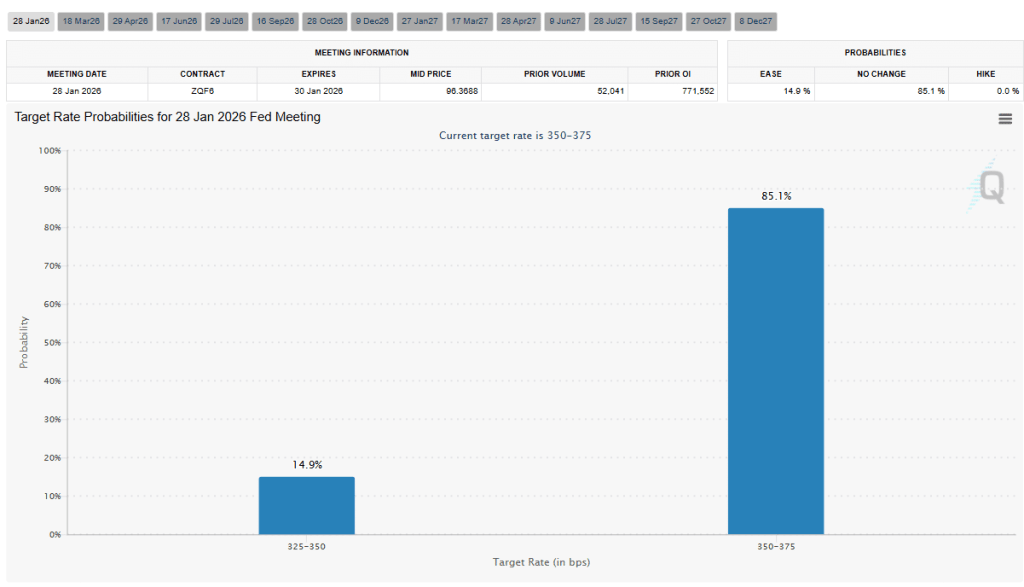
Chances that rates will remain steady (Source: CME FedWatch)
While markets remain focused on the timing of future rate moves, the December minutes highlight a quieter but critical priority for policymakers: ensuring the financial system has enough liquidity to function smoothly, even when interest rates themselves barely move.


