
Gold’s Record Run Pushes Tokenized Commodities Toward $4 Billion
Blockchain-based tokenized commodities are closing in on the $4 billion mark, buoyed by a fresh wave of record highs across global precious metals markets that is reinforcing investor interest in onchain representations of real-world assets.
Spot gold surged to as high as $4,530 per ounce on Friday, according to data from TradingView, extending a rally driven by inflation concerns, geopolitical uncertainty and renewed demand for alternative stores of value.
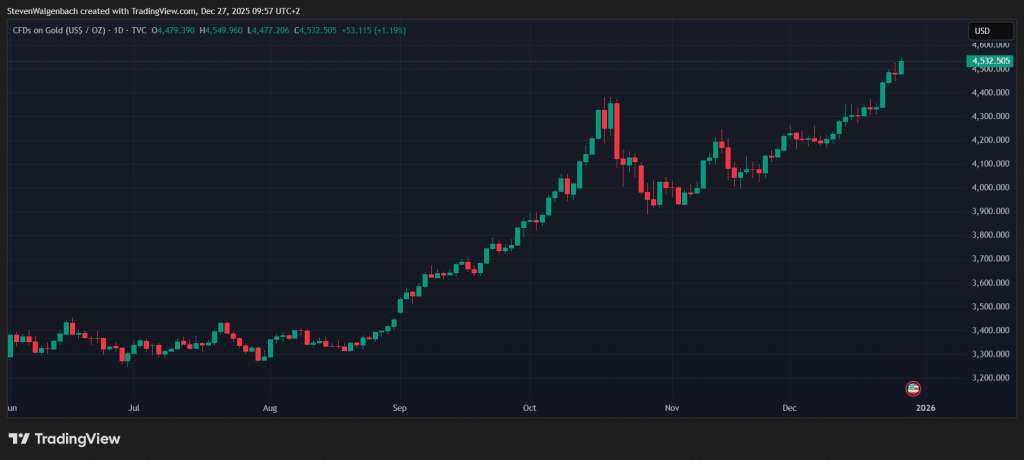
Gold price (Source: TradingView)
Silver briefly touched an all-time high of $74.56 per ounce, while platinum also set new records during the session. Despite silver’s dramatic move, gold continues to dominate the tokenized commodities market by a wide margin.
Tokenized Commodities Near A Key Milestone
The rally in precious metals has translated into renewed momentum for blockchain-based commodities.
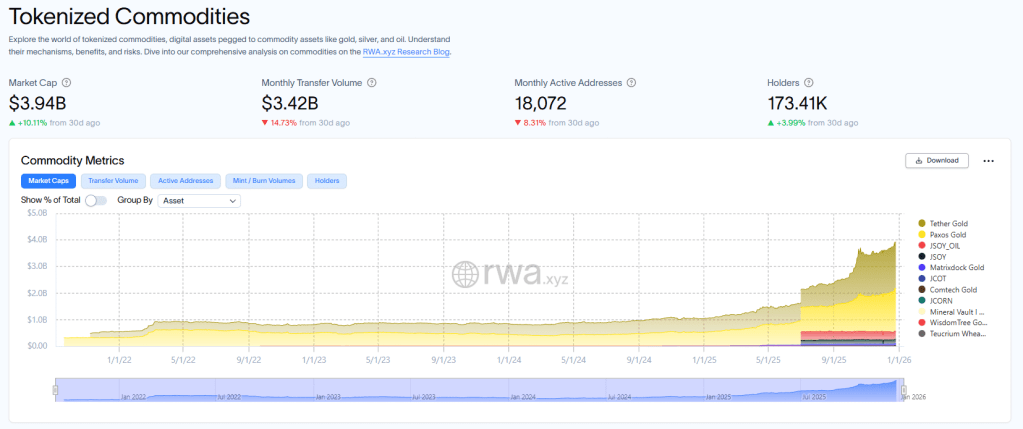
Tokenized commodities (Source: RWA.xyz)
Tokenized commodities rose 11% in the month leading up to Friday, reaching a combined market capitalization of $3.94 billion. The sector is now within striking distance of the $4 billion milestone, a level that would mark one of its strongest growth phases since tokenized gold products first gained traction.
Gold-backed tokens account for the overwhelming majority of this value. Tether Gold is currently the largest tokenized commodity, with a market capitalization of roughly $1.74 billion.
It is followed closely by Paxos Gold, which stands at approximately $1.61 billion.
Together, the two products represent most of the tokenized commodities market, showing gold’s role as the primary bridge between traditional commodities and blockchain infrastructure.
How Tokenized Precious Metals Work
Tokenized precious metals are designed to track the price of physical bullion held in custody, allowing investors to gain exposure through blockchain-based tokens rather than direct ownership of bars or coins.
These tokens can be transferred and traded onchain at any time, including outside traditional market hours, offering greater flexibility than conventional commodity markets.
However, the sector remains closely tied to legacy systems. Pricing, liquidity and redemption processes are still anchored to traditional bullion markets and custodians, meaning tokenization enhances accessibility and settlement efficiency rather than fully replacing existing infrastructure.
For many market participants, the appeal lies in fractional ownership, easier transferability and the ability to integrate commodities into decentralized finance ecosystems.
Tokenized Commodities Within The RWA Expansion
Tokenized commodities are part of the broader real-world asset (RWA) sector, which focuses on issuing blockchain-based representations of traditional financial assets to enable faster settlement, programmability and fractionalized ownership. Beyond commodities, the RWA universe includes tokenized bonds, private credit, real estate and money-market instruments.
Institutional forecasts suggest this trend is still in its early stages. Standard Chartered has projected that tokenized RWAs, excluding stablecoins, could grow to $2 trillion by 2028.
Of that total, around $250 billion is expected to flow into less liquid asset classes such as private equity and commodities, categories that have historically been difficult to access or trade efficiently.
Ethereum’s Dominance In RWA Tokenization
Ethereum has emerged as the dominant blockchain for RWA tokenization.
According to RWA.xyz data, Ethereum accounts for roughly 65% of the tokenized RWA market, representing about $12.7 billion in onchain asset value. BNB Chain ranks second with a 10.5% share, or $1.85 billion, while other networks trail further behind.
Advocates argue that continued growth in tokenization could eventually drive higher blockchain usage and fee generation on Ethereum, particularly as institutions explore onchain settlement and collateral management. For now, however, RWAs represent only a small portion of total blockchain activity.
Onchain Activity Still Led By Stablecoins
Despite its leadership in tokenization, Ethereum’s fee generation remains modest compared with networks dominated by stablecoin transfers and retail trading. Over the past 30 days, Ethereum ranked fourth by total transaction fees, generating $11.41 million, according to data from Nansen.
Tron led the rankings with $29.5 million in fees, largely driven by stablecoin activity. BNB Chain and Solana placed second and third respectively, reflecting their popularity for token launches and retail trading.


