
Strategy Leans Further Into Bitcoin as Saylor Signals Another Buy
Michael Saylor is once again signaling that Strategy Inc. is preparing to add more Bitcoin to its balance sheet, reinforcing the firm’s high-conviction treasury strategy even as its stock continues to struggle in 2025.
On Dec. 21, Saylor posted a cryptic image on X captioned “Green Dots ₿eget Orange Dots,†a reference to Strategy’s “SaylorTracker†visualization that maps the company’s historical Bitcoin purchases. For seasoned observers, the message was instantly recognizable.
Over the past year, Saylor has repeatedly used similar weekend teasers to hint at imminent Bitcoin buys, often followed by a Monday morning filing with the U.S. Securities and Exchange Commission confirming a significant acquisition. If the pattern holds, the latest post suggests another aggressive purchase could soon be disclosed.
A Bitcoin Hoard Unlike Any Other
Any new buy would add to an already staggering position.
As of press time, Strategy holds 671,268 Bitcoin, valued at roughly $59.56 billion, representing about 3.2% of Bitcoin’s total supply. No other public company comes close to holding such a large share of the network.

Strategy’s BTC holdings (Source: Bitcoin Treasuries)
That concentration has increasingly defined Strategy’s identity.
Once best known for enterprise analytics software under its former MicroStrategy name, the firm now trades largely as a leveraged proxy for Bitcoin’s price movements, a reality that both attracts and unnerves investors.
Also read: $10 Million Bitcoin Is Possible, Saylor Says — If Corporations Keep Buying
Stock Performance Raises Investor Tensions
While the company continues to accumulate Bitcoin, the market has punished its equity.Â
MSTR shares are down roughly 43% year-to-date, trading near $165, closely mirroring Bitcoin’s own 30% retreat from its October peak around $126,000.
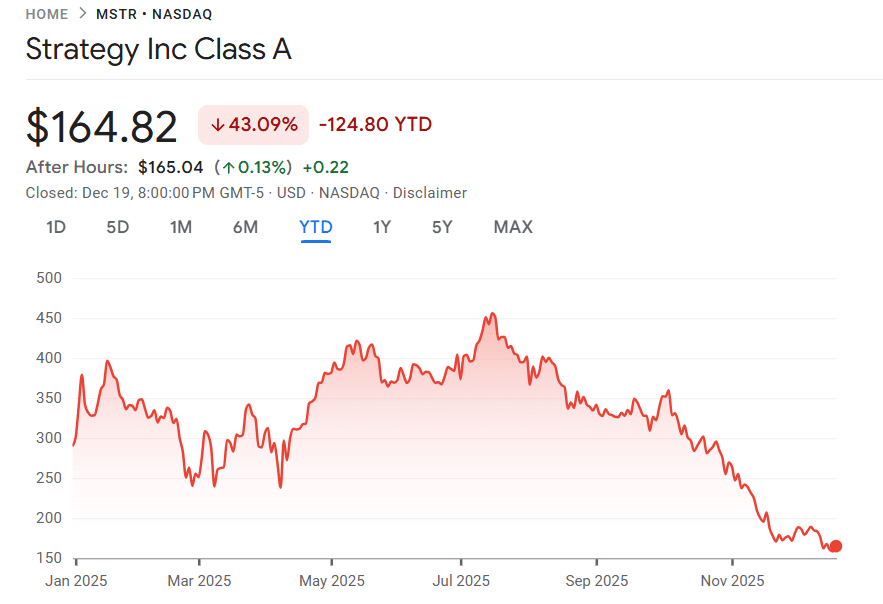
Strategy share price performance (YTD) (Source: Google Finance)
Management frequently highlights its “BTC Yield,†a proprietary metric that measures the accretion of Bitcoin per share, which currently stands at 24.9%.
But many institutional investors appear less focused on internal yield metrics and more concerned about the growing external risks surrounding the company’s structure and classification.
MSCI Review Emerges as Key Risk
The most immediate threat to Strategy’s approach is not Bitcoin’s price volatility, but a potential reclassification by MSCI.
The index provider is considering whether to remove Strategy from its global equity indices during its February review, citing concerns that the firm now operates more like an investment vehicle than a traditional operating company.
Market analysts warn the financial consequences could be severe.
JPMorgan estimates that exclusion from MSCI indices could trigger approximately $11.6 billion in forced selling, as passive ETFs and index-tracking funds would be required to liquidate their MSTR holdings.
Such mechanical selling pressure could temporarily decouple the stock from its underlying Bitcoin exposure, amplifying volatility.
Strategy Pushes Back on Index Threat
Strategy has responded aggressively to the MSCI proposal, calling it “arbitrary, discriminatory, and unworkable.â€
The company argues that the move unfairly targets digital asset-focused firms while ignoring other conglomerates whose balance sheets are dominated by financial holdings.
“The proposal improperly injects policy considerations into indexing,†the firm said, warning that it conflicts with U.S. policy objectives and could stifle innovation in emerging financial technologies.


