State Street and Galaxy Target 2026 With Solana-Powered Tokenized Liquidity Product
State Street and Galaxy Asset Management are preparing to launch a new tokenized liquidity fund in early 2026, marking one of the most significant steps yet in bringing traditional cash-management products onto public blockchains.
Announced Wednesday, the State Street Galaxy Onchain Liquidity Sweep Fund — branded as SWEEP — aims to give institutions the ability to move cash-like assets onchain with the same fluidity and accessibility they expect from established sweep accounts.
The fund will allow subscriptions and redemptions using PYUSD, the regulated stablecoin issued by Paxos, enabling near-instant investor flows.
Redemptions will be processed as long as the fund has sufficient assets available, and access will be restricted to Qualified Purchasers who meet specific regulatory thresholds.
In a major vote of confidence, Ondo Finance has committed roughly $200 million to seed the product.
Expanding Tokenization Across Major Blockchains
SWEEP is slated to launch on Solana, with support for Stellar and Ethereum to follow. The multi-chain approach is designed to meet institutions where they already operate while future-proofing the fund against fragmentation in the maturing tokenization landscape.
Galaxy plans to leverage Chainlink’s interoperability tools, enabling secure data transfer and asset movement across chains — a crucial component for enabling 24/7 liquidity in an institutional environment that typically deals with siloed systems and limited operating hours.
By employing public blockchains, the fund aims to create a programmable, transparent, and highly efficient structure that dramatically simplifies how liquidity is managed across global markets.
A New Model for Institutional Cash on Public Rails
The companies describe SWEEP as a direct response to growing demand for onchain cash-like instruments — particularly from corporates, asset managers, and financial institutions exploring real-world asset markets.
Those investors increasingly want exposure to tokenized T-bills, money-market strategies, and instant-settlement cash funds without sacrificing the liquidity and reliability of traditional offerings.
Kim Hochfeld, State Street’s global head of cash and digital assets, said the partnership signals a new era in industry relationships between major financial institutions and crypto-native firms.
“By partnering with Galaxy, we will push the envelope together and drive the evolution of the TradFi landscape onchain,†Hochfeld said, emphasizing the role of collaboration in building institutional-grade blockchain solutions.
Tokenization as the Bridge Between TradFi and DeFi
For Ondo Finance — now one of the most active issuers in the tokenized real-world asset space — the project marks a continuation of its strategy to connect institutional liquidity with blockchain-native markets. Ian De Bode, the firm’s president, said SWEEP is evidence of how fast tokenization is becoming a defining theme in global finance.
“Tokenization is rapidly becoming the connective tissue between traditional finance and the onchain economy, and SWEEP represents a major leap forward in that evolution,†De Bode said.
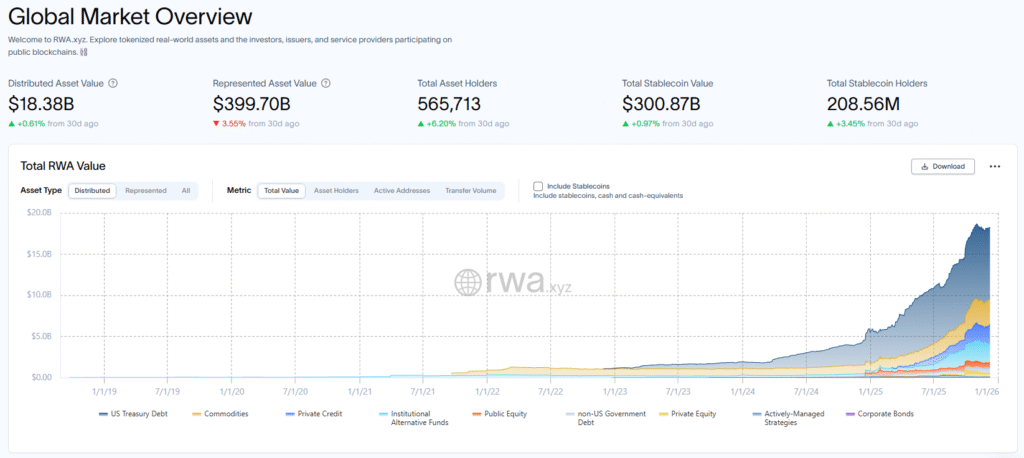
Total value tokenized on-chain (Source: RWA.xyz)
Ondo’s $200 million seed is also notable given its size relative to other tokenized liquidity initiatives, signaling strong expectations for institutional adoption as more firms test blockchain-based treasury strategies.
Building on Growing Momentum
The new fund builds on an expanding set of collaborations between State Street and Galaxy, including a suite of digital-asset ETFs the firms launched in 2024.
Their ongoing partnership is part of a broader trend of major Wall Street players increasingly entering the tokenization market through alliances with crypto specialists, rather than attempting to build these systems alone.
As global financial institutions deepen their exploration of blockchain-based infrastructure, products like SWEEP may become foundational to how liquidity is managed, transferred, and deployed in the years ahead — not only within crypto ecosystems but across the broader capital markets.
If successful, the initiative could hasten the shift toward a world where traditional financial operations run seamlessly on public blockchains, enabling new levels of speed, transparency, and interoperability across the global economy.


