
Strive Unveils 500 Million Plan to Supercharge Its Bitcoin Treasury
Publicly traded asset manager Strive has unveiled a $500 million stock sales program to fuel additional Bitcoin purchases, reinforcing the growing trend of corporate treasuries turning to capital markets for direct exposure to the world’s largest cryptocurrency.
In a recent statement, Strive Asset Management said it plans to use the net proceeds from the offering for “general corporate purposes,†including the acquisition of Bitcoin and Bitcoin-related products, as well as for working capital.
The firm also disclosed plans to purchase “income-generating assets†to help expand its business operations, though it stopped short of identifying specific asset classes.
The announcement marks another significant step in the expanding role of publicly traded firms accumulating Bitcoin through equity issuance—a strategy that has gained traction as institutional interest in digital assets continues to accelerate.
Strive’s Rapid Shift Into a Bitcoin Treasury Model
Strive was co-founded in 2022 by American entrepreneur and politician Vivek Ramaswamy and initially built its reputation around traditional asset management products.
That strategy shifted earlier this year when the firm formally pivoted into a Bitcoin treasury company via a public reverse merger, reorienting its balance sheet around long-term BTC accumulation.
The company now ranks as the 14th-largest corporate holder of Bitcoin, with 7,525 BTC on its balance sheet—worth approximately $694 million at current market prices near $92,400 per coin.
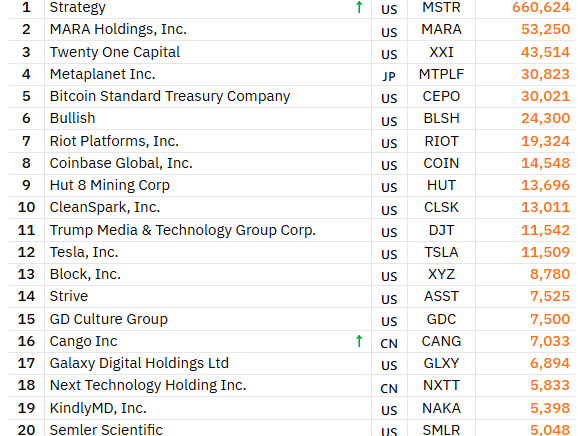
Top 20 largest corporate BTC holders (Source: Bitcoin Treasuries)
The approach closely mirrors the model pioneered by Michael Saylor and his firm Strategy, which transformed itself into a de facto Bitcoin proxy through aggressive debt- and equity-funded purchases.
Strive’s accumulation campaign accelerated further in September, when it agreed to acquire Semler Scientific.
That transaction helped position the combined entity among the largest corporate Bitcoin holders globally and signaled Strive’s intent to use mergers and balance sheet engineering alongside capital raises to scale its crypto exposure.
Share Price Rallies After Funding Announcement
Markets responded positively to the latest capital raise. Strive shares (ASST) climbed 3.57% on Tuesday to close at $1.02, according to data from Google Finance.
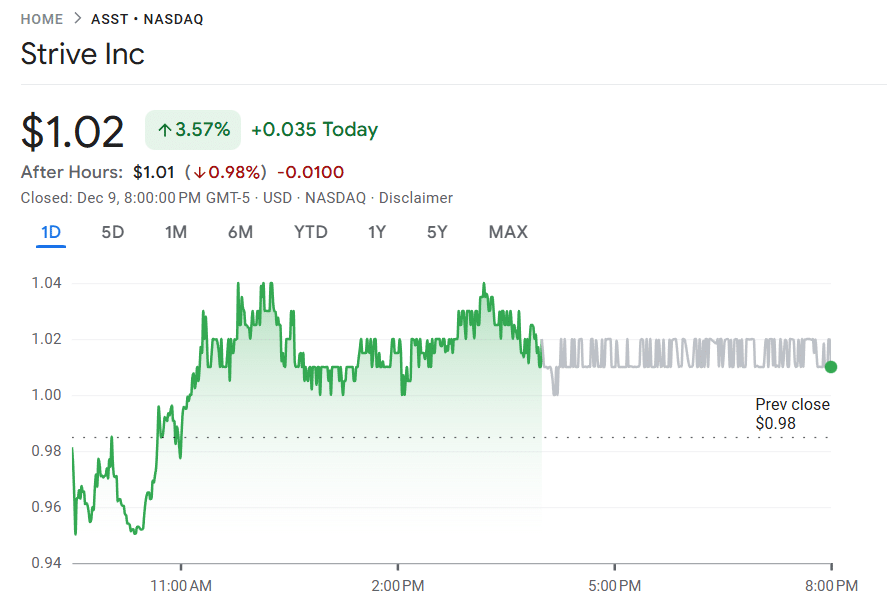
Strive share price (Source: Google Finance)
The stock has now more than doubled since the beginning of the year, reflecting rising investor appetite for equity vehicles tied directly to Bitcoin accumulation strategies.
Pressure Mounts on MSCI Over Bitcoin Index Rules
Strive’s rapid rise has also pushed the firm into the center of a growing debate over how digital asset treasury companies should be treated inside major stock indices.
Earlier this month, Strive CEO Matt Cole publicly urged MSCI to “let the market decide†whether Bitcoin-holding companies should be included in passive investment products.
His comments came in response to MSCI’s ongoing consultations with institutional investors over whether to exclude so-called digital asset treasury companies—often referred to as DATs—that hold more than 50% of their balance sheet in cryptocurrencies.
Cole warned that excluding such firms could distort capital allocation and limit investor choice at a time when demand for regulated Bitcoin exposure through public equities is expanding rapidly. The outcome of MSCI’s review could have wide-reaching implications for index funds and ETFs that track its benchmarks, potentially shaping billions of dollars in passive capital flows.
From ETF Issuer to Crypto Balance Sheet Builder
Since launching its first exchange-traded fund in August 2022, Strive Asset Management has grown to oversee more than $2 billion in assets under management. That scale has given the firm greater flexibility to pursue hybrid strategies that blend traditional asset management with direct exposure to digital assets.
Unlike spot Bitcoin ETFs, which offer pure-price exposure, Bitcoin treasury companies often amplify both upside and downside through balance sheet leverage, equity issuance, and acquisition strategies.
Supporters argue that this structure creates asymmetric return potential during bull markets, while critics caution that it exposes shareholders to elevated downside risk in periods of crypto volatility.
The Corporate Bitcoin Arms Race Expands
If fully deployed toward additional Bitcoin purchases, Strive’s $500 million stock sales program could significantly increase its BTC holdings and further cement its position among the world’s largest corporate treasuries.
As capital continues flowing into crypto-linked equities, Strive’s latest raise signals that the next phase of corporate Bitcoin adoption will be shaped less by retail speculation and more by structured Wall Street financing—bringing both deeper liquidity and greater scrutiny to the rapidly evolving sector.


