Tether Expands Global Footprint With Abu Dhabi Regulatory Win
Tether’s USDt, the world’s largest stablecoin by circulation, has achieved a major regulatory milestone in the Middle East after receiving formal recognition as an “accepted fiat-referenced token” within the Abu Dhabi Global Market.
The designation allows licensed institutions operating inside the international financial center to provide trading, custody, settlement, and other regulated services tied to the dollar-pegged token.
The announcement, made Monday, marks a significant expansion of institutional access for USDt (USDT) and further cements Abu Dhabi’s growing role as a global digital asset hub. With this approval, regulated firms within ADGM can now directly integrate USDT into compliant financial products and services.
Tether said the move represents a turning point for stablecoin adoption within traditional finance across the Gulf region and beyond.
Also read: Tether Cuts Staff and Halts Mining in Uruguay Amid Soaring Power Costs
ADGM Strengthens Its Role as a Global Crypto Hub
The Abu Dhabi Global Market has rapidly become one of the most sought-after jurisdictions for digital asset firms seeking regulatory clarity and institutional credibility.
Operating as an international financial center and free economic zone, ADGM has built a reputation for offering structured oversight without stifling innovation.
Prior to this latest recognition, ADGM had already classified USDT as an accepted virtual asset across its issuance on Ethereum, Solana, and Avalanche. However, the new classification as a fiat-referenced token significantly broadens the scope of its permitted institutional use, particularly in regulated financial services such as custody, payments, and settlement.
This move also aligns with ADGM’s broader strategy of attracting exchanges, custodians, token issuers, and infrastructure providers that want access to both global capital markets and the fast-growing digital asset economy.
Tether’s Paolo Ardoino Highlights Institutional Role of Stablecoins
Tether CEO Paolo Ardoino welcomed the designation, describing it as another step toward embedding stablecoins within the global financial system.
According to Ardoino, the recognition “reinforces the role of stablecoins as essential components of today’s financial landscape,” pointing to their expanding role in remittances, cross-border settlements, and digital asset markets.
He noted that regulatory clarity in major financial centers plays a critical role in accelerating institutional adoption.
The approval provides regulated firms in Abu Dhabi with clearer legal pathways to deploy USDT within structured financial products—an area that has historically faced regulatory ambiguity in many regions globally.
Also read: Jefferies Says Tether Is Quietly Driving Gold’s Record-Breaking Rally
Ripple’s RLUSD and Abu Dhabi’s Broader Stablecoin Push
Tether’s USDT is not the only stablecoin gaining official traction in Abu Dhabi.
Local regulators recently approved Ripple’s dollar-pegged RLUSD as an accepted fiat-referenced token within ADGM, clearing the path for institutional use.
Ripple has positioned RLUSD as a key enterprise-grade stablecoin aimed at payments, liquidity, and blockchain-native financial infrastructure.
Beyond dollar-pegged tokens, Abu Dhabi is also laying the groundwork for a locally denominated stablecoin. A consortium that includes sovereign wealth fund ADQ, International Holding Company, and First Abu Dhabi Bank has announced plans for a dirham-pegged stablecoin, pending approval from the UAE Central Bank.
If approved, the project would represent one of the most significant government-backed stablecoin initiatives in the region and could reshape domestic and cross-border payments across the Gulf markets.
Stablecoin Market Tops $300 Billion Amid Rapid Growth
The regulatory momentum in Abu Dhabi comes as the global stablecoin market surpasses $300 billion in total supply, following two years of rapid expansion driven by demand for blockchain-based liquidity and settlement.
Data from DefiLlama shows that stablecoins now underpin much of the activity across centralized exchanges, decentralized finance platforms, and cross-border crypto payments.
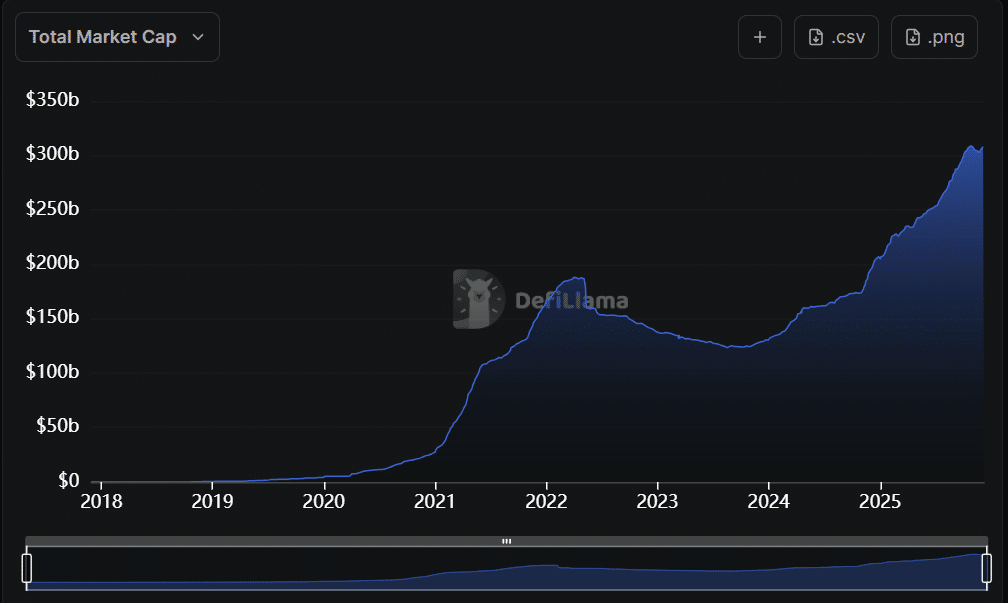
Stablecoin market cap (Source: DefiLlama)
Stablecoins have become a preferred settlement layer for traders and institutions seeking dollar exposure without relying on traditional banking hours or correspondent networks.
Their rising prominence has also placed regulators under pressure to introduce clearer legal frameworks—something the UAE has moved swiftly to address.
Also read: Stablecoins Near a Breakout in Emerging Markets, Says Exodus CFO
Abu Dhabi Emerges as a Global Stablecoin Power Center
Abu Dhabi and the UAE more broadly are increasingly positioning themselves as strategic power centers for stablecoins and tokenized finance.
ADGM has become a magnet for crypto exchanges, custodians, and blockchain infrastructure firms seeking formal licensing and global market access under a single regulatory umbrella.
For Tether, the ADGM approval strengthens USDT’s institutional standing at a time when regulatory scrutiny remains intense in several Western jurisdictions. While USDT continues to dominate global stablecoin liquidity and trading volumes, endorsements from internationally recognized financial centers are increasingly viewed as critical to its long-term sustainability.
As Abu Dhabi continues to approve both private and sovereign-backed stablecoin projects, the emirate is rapidly shaping a new model for how digital dollars integrate into regulated finance.